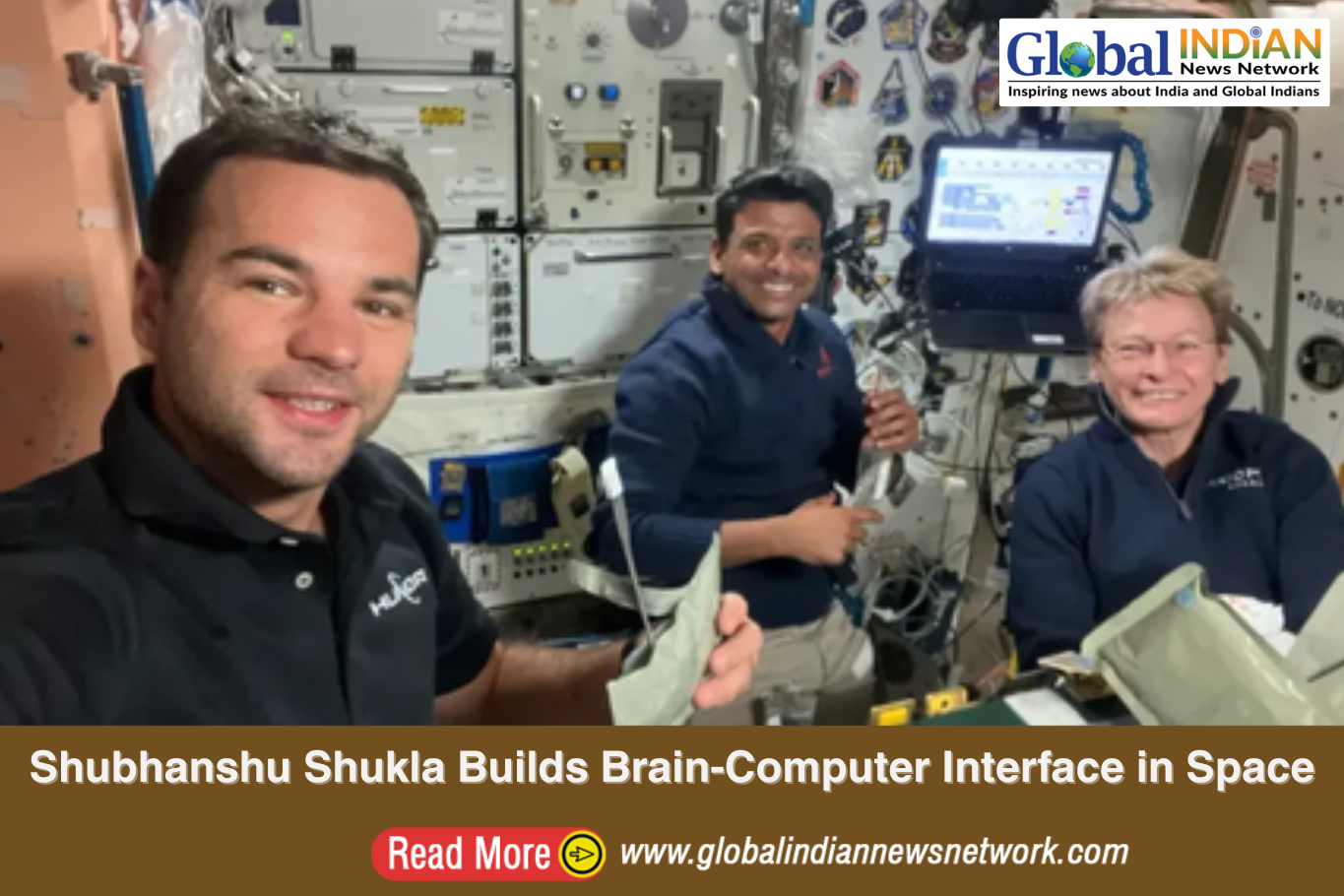
Indian astronaut Shubhanshu Shukla, currently aboard the International Space Station (ISS) as part of the Axiom Space Mission-4, is working on a pioneering experiment to develop a brain-computer interface (BCI) in microgravity. The initiative, revealed by NASA on Thursday, uses near-infrared technology to record brain activity in space and enable communication between the brain and digital systems in a zero-gravity environment.
Conducted in the Columbus laboratory module, the experiment titled “Thoughts over Gravity” (PhotonGrav) is a collaborative effort between Shukla and Polish astronaut Sławosz Uznański-Wiśniewski. The study aims to test the effectiveness of functional Near-Infrared Spectroscopy (fNIRS) in low-Earth orbit.
During the experiment, Uznański-Wiśniewski wore a specialized Bluetooth-connected cap that recorded his brain signals, while Shukla optimized the data quality and fine-tuned the interface. The successful calibration of the device in space represents a breakthrough in understanding how the human brain interacts with machines in microgravity conditions.
The experiment has potential implications for deep space missions, where human-computer interaction will play a vital role in autonomous operations, especially in communication-limited environments.
Beyond brain-computer interface development, Shukla has engaged in a range of critical studies on the ISS. He recently worked in the Destiny lab module studying tardigrades, microscopic aquatic organisms known for surviving extreme environments, to understand their adaptability to microgravity.
In another session, he analyzed muscle cell stem cultures to better understand how human muscle repair mechanisms function in space, an area of increasing interest for future long-duration space travel.
Shukla also recorded an educational video demonstrating how the human digestive system adapts to space, aimed at inspiring young students in India. He is scheduled to interact with schoolchildren and ISRO scientists via ham radio on Friday evening.
Born in Lucknow, Shukla is serving a 14-day science-focused mission onboard the ISS, representing India alongside astronauts from the US, Poland, and Hungary. The Axiom-4 mission will include around 60 science and commercial studies across 31 countries.
India, under ISRO’s guidance, has contributed seven major scientific experiments to the mission, showcasing the country’s growing role in global space research.