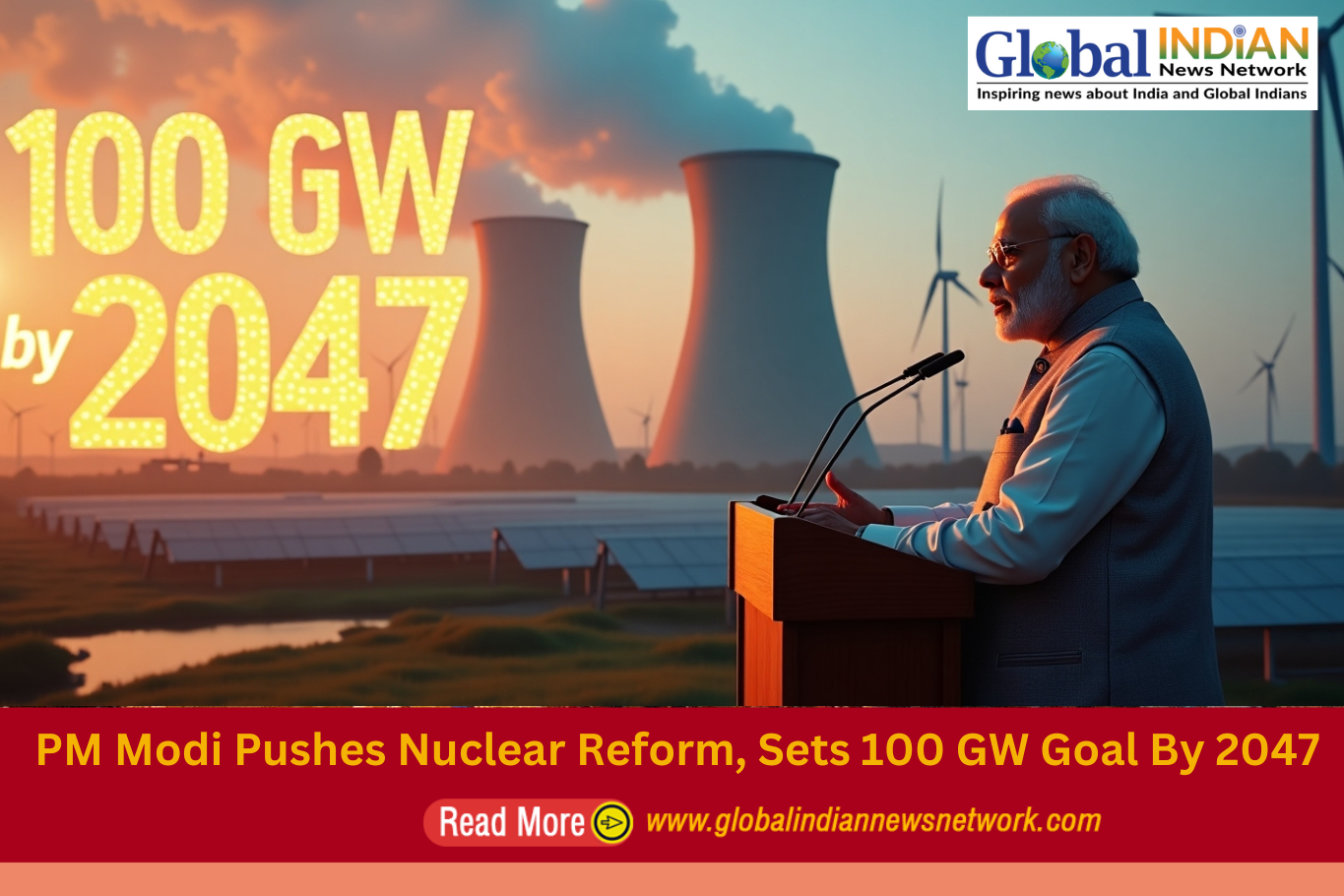
 Prime Minister Narendra Modi, while speaking at the India-Japan Joint Economic Forum in Tokyo, announced a major policy shift by opening India’s nuclear energy sector to private players. Describing this as a landmark decision, he said nuclear power will now follow defence and space in welcoming private participation.
Highlighting India’s investment-friendly climate, Modi stressed that the country enjoys political stability, economic predictability, and policy transparency. “India is the fastest-growing major economy today, and soon it will become the world’s third-largest economy,” he said. He further underlined reforms such as simplified tax compliance, a unified digital approval system, and the rationalisation of nearly 45,000 regulations, all designed to make India more attractive for global investors.
Linking the growth momentum with clean energy, Modi said that India aims to achieve 100 gigawatts of nuclear power capacity by 2047. He added that Japan’s technology combined with India’s skilled workforce can accelerate this transformation. Both nations have agreed to work through a joint credit mechanism to push forward a sustainable, green future.
This announcement closely ties in with the Union Budget 2025-26, which launched the “Nuclear Mission” as a transformative step in the energy sector. Union Minister Dr. Jitendra Singh had earlier described it as a groundbreaking reform that will unlock innovation by allowing private participation. The budget earmarked $2.4 billion for research and development in Small Modular Reactors (SMRs), with a target of commissioning at least five indigenous SMRs by 2033. These compact reactors are expected to significantly benefit decentralized energy supply, particularly in remote regions.
Currently, India’s nuclear capacity stands at 8,180 MW. By 2031-32, it is projected to rise to 22,480 MW, supported by ten new reactors under construction in states including Gujarat, Rajasthan, Tamil Nadu, Karnataka, Haryana, and Madhya Pradesh. Additionally, a large-scale 6 x 1208 MW project is being developed with US collaboration at Kovvada in Andhra Pradesh.
Dr. Jitendra Singh emphasized that nuclear power is key to India’s energy security as the country works to cut dependence on petroleum imports and achieve its clean energy targets. India has committed to 500 GW of non-fossil fuel capacity by 2030 and achieving net-zero emissions by 2070. Together with initiatives like the BIOe3 Policy for biotechnology and Mission LiFE for sustainable living, the Nuclear Mission reflects India’s integrated approach to innovation and sustainability.