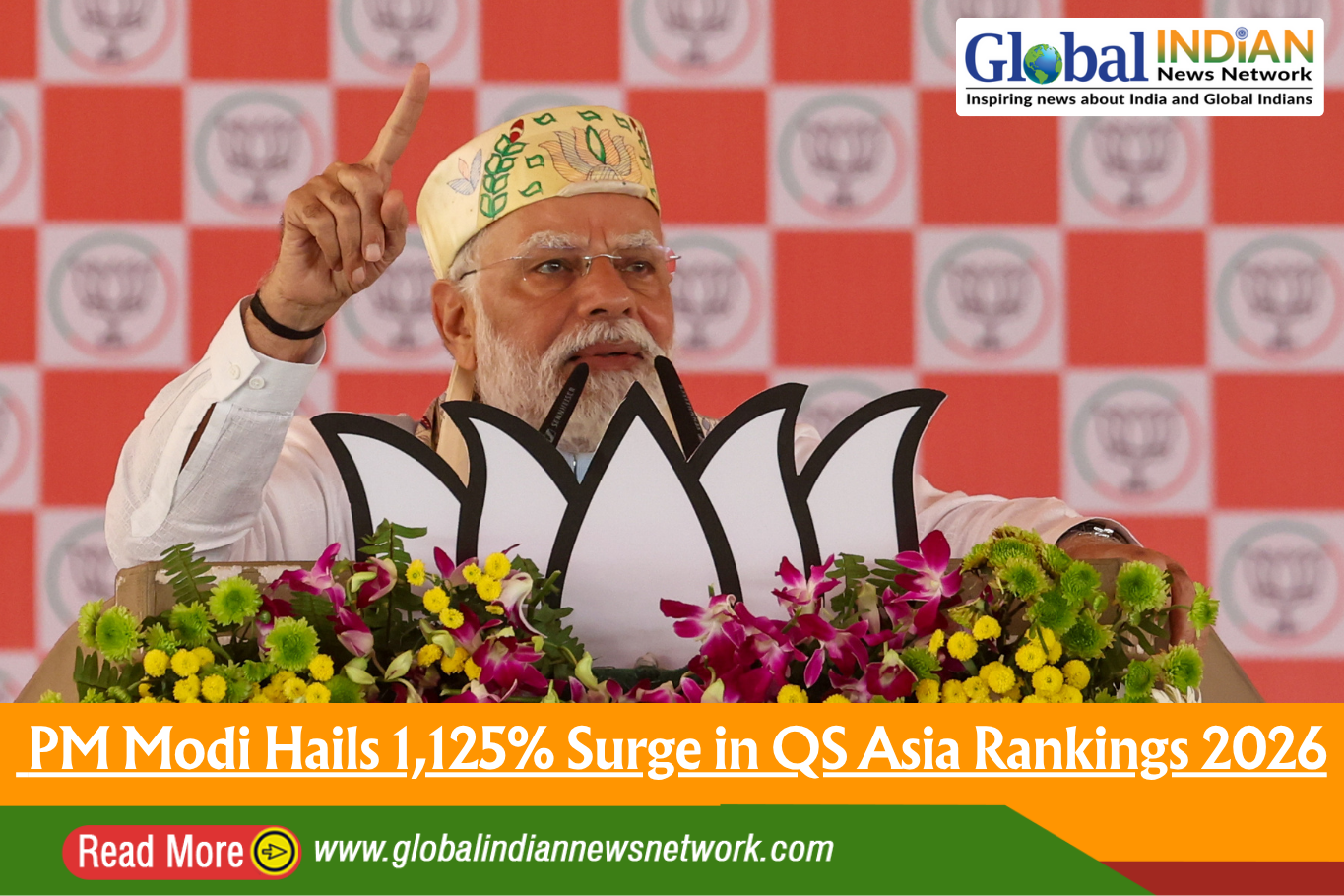
 Prime Minister Narendra Modi celebrated a historic milestone for Indian higher education, announcing a 1,125% jump in the number of Indian universities featured in the QS Asia University Rankings over the past decade. From only 24 institutions in 2016, India now proudly counts 294 universities on the list—a sign of growing academic excellence and research capacity.
Taking to X on Tuesday, Modi said he was “delighted” by the achievement, crediting his government’s continuous efforts to enhance research and innovation. “Our government is committed to ensuring quality education for our youth, with a focus on research and innovation,” he wrote, emphasizing that India is rapidly expanding its educational infrastructure nationwide.
India now ranks just behind China, which leads with 395 universities. This year alone, 137 new Indian institutions entered the rankings. The nation also outperformed China in key research metrics—five Indian institutions feature among Asia’s top 10 for papers per faculty, and 28 occupy spots in the top 50, highlighting the country’s growing research output and expanding base of PhD-qualified faculty.
Seven Indian universities secured positions in Asia’s top 100, maintaining last year’s count despite rising global competition. IIT Delhi emerged as India’s highest-ranked institution at 59th, earning praise for its strong employer reputation and increased research citations. The Indian Institute of Science (IISc) Bengaluru followed at 64th, IIT Madras at 70th, IIT Bombay at 71st, while IIT Kanpur and IIT Kharagpur shared the 77th position. The University of Delhi rounded out the top 100 at 95th, reflecting the growing prominence of public universities beyond the IIT ecosystem.
At the regional level, the University of Hong Kong claimed first place, overtaking Peking University, while Singapore’s National University of Singapore and Nanyang Technological University tied for third, reaffirming East Asia’s dominance in elite education.
QS Chief Executive Jessica Turner credited India’s National Education Policy for creating “globally relevant and locally empowering” institutions but noted that the next decade will require stronger global collaborations and digital-era academic reforms.
Despite remarkable progress, some IITs slipped in absolute rankings due to limited foreign faculty and international student enrollment compared with top universities in China, Singapore, and South Korea. Yet, as Indian vice-chancellors review the data, one fact stands clear—India’s universities are advancing faster than ever, determined to redefine global higher education.