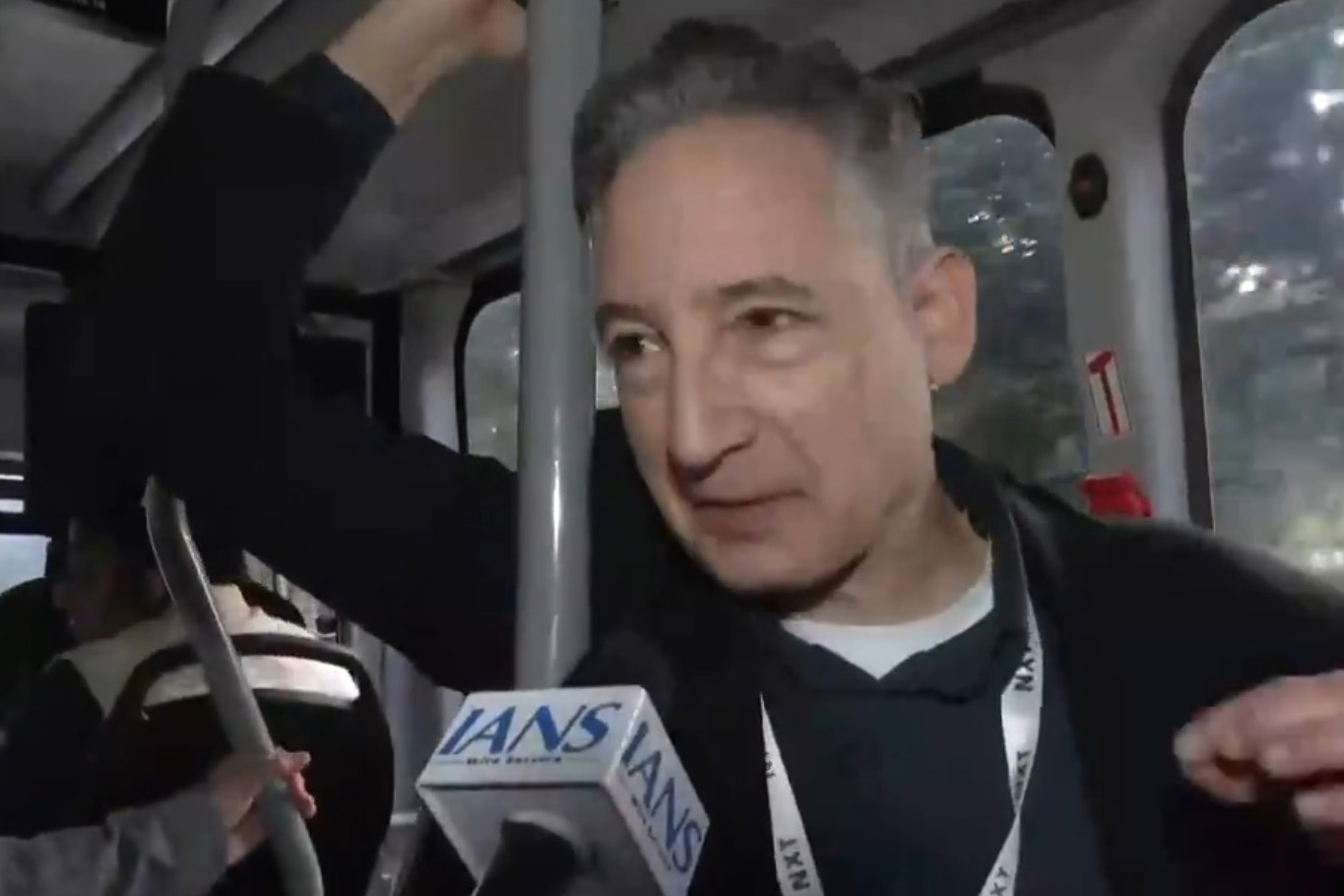
Renowned physicist Dr. Brian Greene on Sunday commended Indian students for their exceptional passion for science and innovation, stating that their ambition and curiosity will undoubtedly leave a significant impact on the global scientific community.
“The passion for science and innovation that I have witnessed in India is unparalleled. The energy and curiosity among students here are truly inspiring,” Dr. Greene said while visiting the Taj Mahal.
Greene, who has long been an advocate for scientific exploration and education, praised India’s distinctive approach to learning and research. He highlighted how the enthusiasm and drive of Indian students to contribute to science and technology make them well-positioned to influence future global advancements.
Admiration for India’s Beauty and Engineering Marvels
Accompanying Dr. Greene on the visit to the Taj Mahal was former NASA astronaut Mike Massimino, who shared his admiration for India’s beauty and its architectural wonders. Having observed the country from space, Massimino expressed his awe at seeing India’s grandeur firsthand.
“India is even more beautiful from the ground,” said Massimino, reflecting on the country’s landscapes and historical landmarks. He was particularly impressed by the exquisite craftsmanship of the Taj Mahal, calling it a true testament to India’s rich legacy of engineering, design, and artistic excellence.
Both Greene and Massimino are currently on a visit to India, immersing themselves in the nation’s scientific, educational, and cultural heritage. Their engagements include interactions with students, discussions on space exploration, and insights into India’s scientific advancements.
About Dr. Brian Greene
Dr. Brian Greene is a celebrated theoretical physicist, author, and professor of mathematics and physics at Columbia University. He is best known for his groundbreaking contributions to superstring theory, particularly the co-discovery of mirror symmetry and the discovery of spatial topology change, both of which have significantly advanced the understanding of fundamental physics.
In addition to his research, Greene has been an influential figure in science communication, making complex theories more accessible to the public through bestselling books, television appearances, and lectures worldwide. His work has inspired a new generation of scientists and thinkers eager to explore the mysteries of the universe.
About Mike Massimino
Dr. Mike Massimino, a former NASA astronaut and veteran of two space missions, has had an illustrious career in space exploration. He holds a Ph.D. in Mechanical Engineering from the Massachusetts Institute of Technology (MIT) and currently serves as a professor of mechanical engineering at Columbia University.
Massimino played a key role in servicing the Hubble Space Telescope, participating in critical missions in 2002 and 2009 that extended the telescope’s life and enhanced its capabilities. Notably, he became the first astronaut to tweet from space, further bridging the gap between space science and public engagement.
Throughout his career, Massimino has been honored with multiple accolades, including:
- NASA Space Flight Medals
- NASA Distinguished Service Medal
- American Astronautical Society’s Flight Achievement Award
In addition to his academic role, he serves as the Senior Advisor for Space Programs at the Intrepid Sea, Air & Space Museum in New York City, where he continues to inspire the next generation of space enthusiasts.
A Visit That Highlights India’s Role in Science and Innovation
The visit of such esteemed scientists to India underscores the country’s growing influence in the global scientific landscape. Their appreciation for India’s educational enthusiasm and engineering marvels further highlights the country’s longstanding commitment to knowledge, discovery, and innovation.
As Indian students continue to make strides in scientific research, space exploration, and technological advancements, the encouragement from distinguished figures like Dr. Greene and Dr. Massimino serves as a motivation to push the boundaries of knowledge and contribute to the future of science on a global scale.