

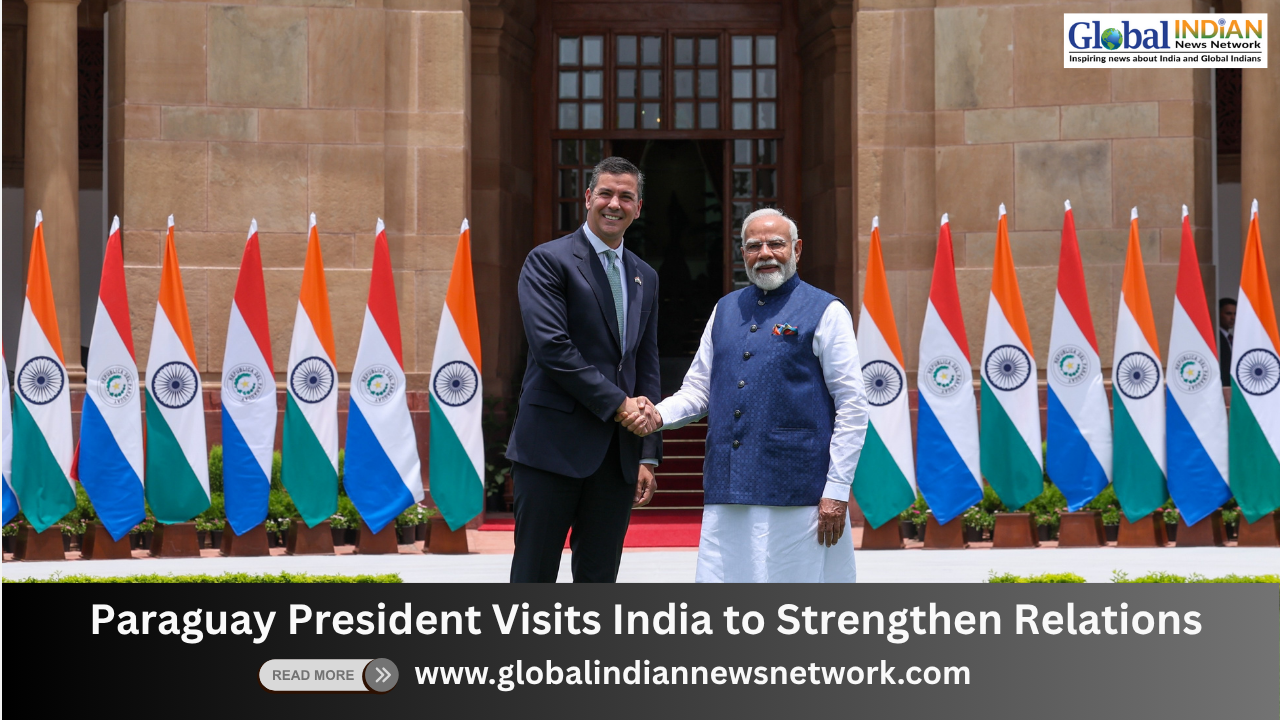
 Santiago Peña Palacios, the President of Paraguay, arrived in New Delhi for his first State Visit to India, where he was accorded a ceremonial welcome and a Guard of Honour at Palam Air Force Station. The warm reception was led by Minister of State Harsh Vardhan Malhotra, underscoring the strong diplomatic ties shared between the two nations.
According to an update from Randhir Jaiswal of India’s Ministry of External Affairs, the President was greeted with enthusiasm as he arrived for this significant visit, marking a new chapter in India-Paraguay relations. This trip, which spans from June 2 to June 4, is designed to expand cooperation across political, economic, and cultural arenas.
Invited by Prime Minister Narendra Modi, President Pena is accompanied by a senior delegation that includes ministers, officials, and business leaders. Throughout the visit, he is scheduled to engage in high-level discussions with Prime Minister Modi and other key Indian officials to review and enhance bilateral collaboration.
Among the planned events, Prime Minister Modi will host a luncheon in the President’s honour, while President Droupadi Murmu is set to meet Pena and hold a formal banquet. Vice President Jagdeep Dhankar and External Affairs Minister S. Jaishankar will also hold talks with the visiting dignitary.
Following his visit to New Delhi, President Peña is scheduled to head to Mumbai, where he will engage with state officials, business leaders, startups, and tech innovators. This leg of the visit offers an opportunity to deepen economic partnerships and explore new avenues for innovation and investment.
Since establishing diplomatic relations in 1961, India and Paraguay have nurtured a friendly partnership that spans sectors such as trade, agriculture, health, pharmaceuticals, and information technology. Paraguay holds a key position as a trading partner for India in Latin America, with active Indian companies in automotive and pharmaceutical industries. Paraguayan firms have also entered the Indian market through joint ventures, enhancing economic collaboration.
Both countries also align on global issues including UN reforms, climate action, renewable energy, and counterterrorism efforts, reflecting a shared vision for international cooperation.








1 Comment
gsn casino app
References:
https://www.google.mn/url?q=https://mrocasino.blackcoin.co