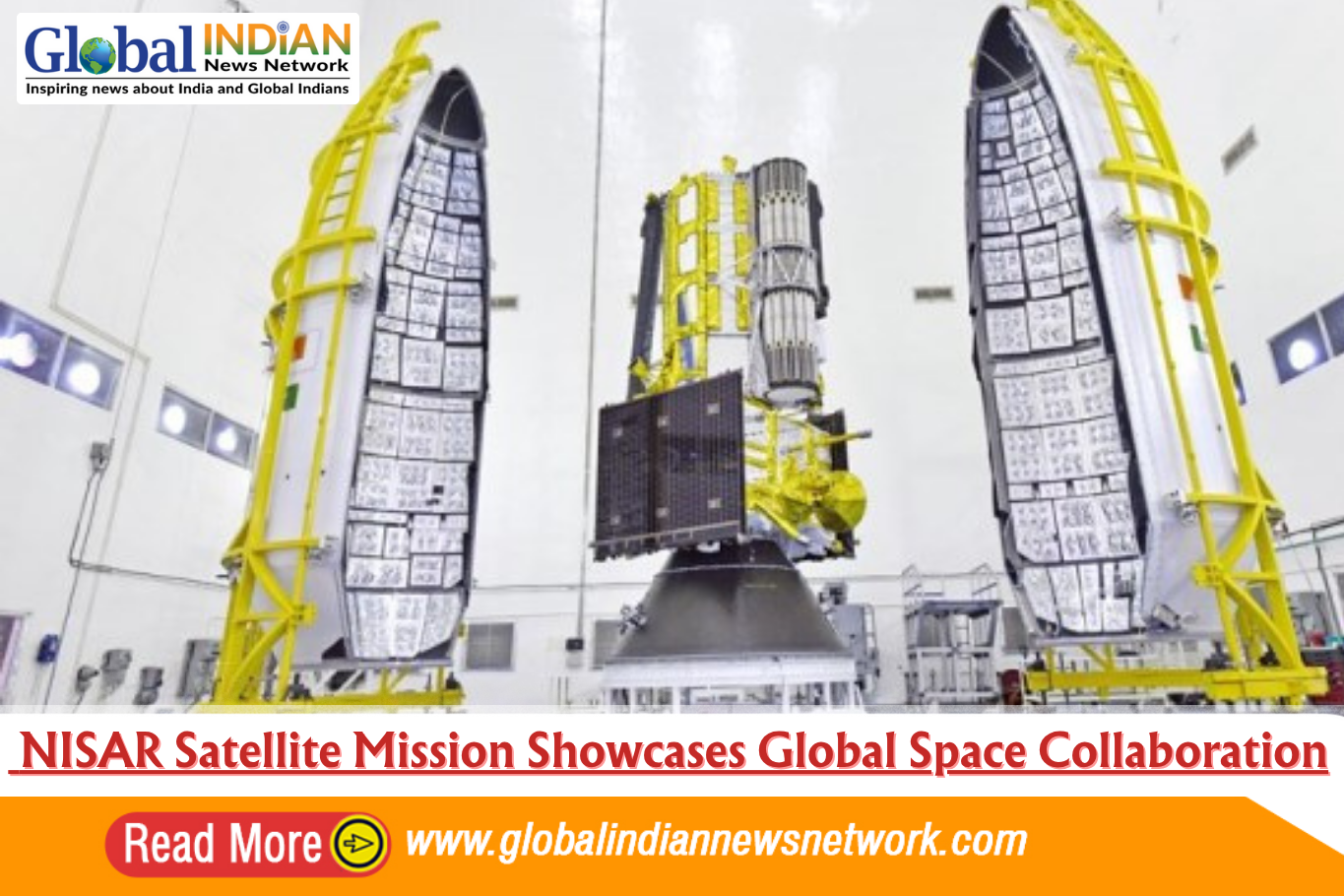
In a groundbreaking collaboration between two of the world’s top space agencies, the Indian Space Research Organisation (ISRO) and NASA are preparing to launch the NISAR (NASA-ISRO Synthetic Aperture Radar) satellite next week. This joint effort marks a milestone in space innovation and international scientific cooperation.
Set for liftoff from the Satish Dhawan Space Centre in Sriharikota, Andhra Pradesh, the NISAR satellite will be launched aboard ISRO’s GSLV-F16 rocket at 5:40 p.m. It will enter a Sun-Synchronous Orbit (SSO) at an inclination of 98.4 degrees, orbiting 743 km above Earth’s surface.
Built over several years by teams across continents, NISAR is a result of meticulous integration and technological synergy between ISRO and NASA’s Jet Propulsion Laboratory (JPL). According to ISRO, this mission stands out for achieving several firsts: it’s the first dual-band radar satellite using both NASA’s L-band and ISRO’s S-band radars, the first ISRO-NASA Earth observation mission, and the first GSLV launch into an SSO.
Weighing 2,392 kg, NISAR is engineered to deliver highly accurate, day-and-night, all-weather Earth observations. It features NASA’s 12-meter-wide, deployable mesh reflector antenna, integrated into ISRO’s modified I3K satellite platform. This powerful Earth-monitoring tool is designed to scan the globe every 12 days, offering a data swath of 242 km and using advanced SweepSAR technology for high-resolution imaging.
The mission’s scientific goals are ambitious and vital. NISAR will track minute shifts on Earth’s surface, from glacier and ice sheet changes to soil moisture variations, land deformation, and vegetation dynamics. The data will be essential for monitoring landslides, earthquakes, storm damage, coastal erosion, and environmental changes.
NASA called NISAR a “big win for Earth,” emphasizing that this is the first time the agencies have co-developed satellite hardware of this scale. By enabling precise tracking of environmental and geological changes, the mission is expected to contribute significantly to disaster response, agriculture, climate science, and natural resource management.
As the satellite readies for launch, the NISAR mission exemplifies what global cooperation in science and technology can achieve — redefining how we study and protect our planet from space.