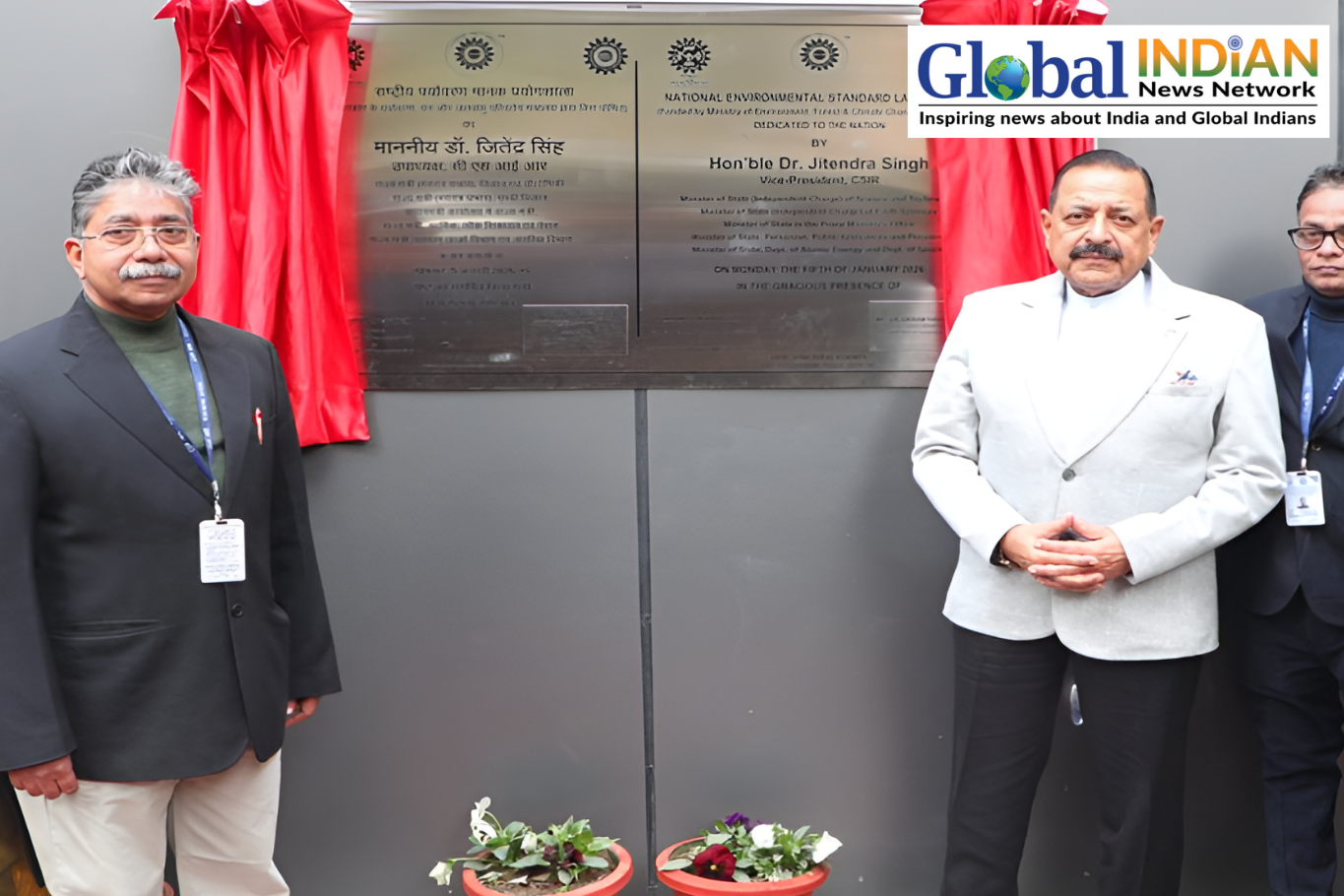
 India has taken a significant step towards strengthening its environmental governance and renewable energy ecosystem with the inauguration of two world-class national facilities at the CSIR–National Physical Laboratory (NPL). The newly launched National Environmental Standard Laboratory and the Solar Energy Complex are expected to enhance the country’s capacity for accurate environmental monitoring and global-standard solar energy calibration.
The National Environmental Standard Laboratory, one of only a handful globally, is designed to provide India-specific calibration and certification of air pollution monitoring systems. The facility addresses a long-standing gap in reliable, traceable environmental data by ensuring that monitoring instruments are tested under Indian climatic conditions. This advancement is expected to improve transparency, regulatory enforcement, and policy effectiveness, particularly under national clean air initiatives.
The Solar Energy Complex positions India among an elite group of countries with advanced photovoltaic measurement standards. Developed in collaboration with Germany’s PTB, the facility houses a laser-based Differential Spectral Responsivity system that achieves exceptionally low uncertainty in reference solar cell calibration. This capability is critical for maintaining quality assurance across India’s rapidly expanding solar sector.
The establishment of these facilities is expected to reduce reliance on foreign certification agencies, cut costs, shorten calibration timelines, and strengthen investor confidence in India’s renewable energy market. As solar power continues to play a central role in India’s energy transition, the new complex enhances the credibility and global competitiveness of domestic solar manufacturing and deployment.
The inauguration also highlighted the evolving role of science and technology in shaping India’s socio-economic future. Institutions like CSIR-NPL represent India’s scientific journey from pre-Independence foundations to modern global leadership. The laboratory has played a historic role in national standardisation, including the establishment of Indian Standard Time through its atomic clock systems.
With these new facilities, Indian scientists are increasingly positioned at the centre of national development priorities. The expansion of advanced measurement and calibration infrastructure underscores India’s commitment to sustainable growth, clean energy leadership, and evidence-based environmental governance in the decades ahead.