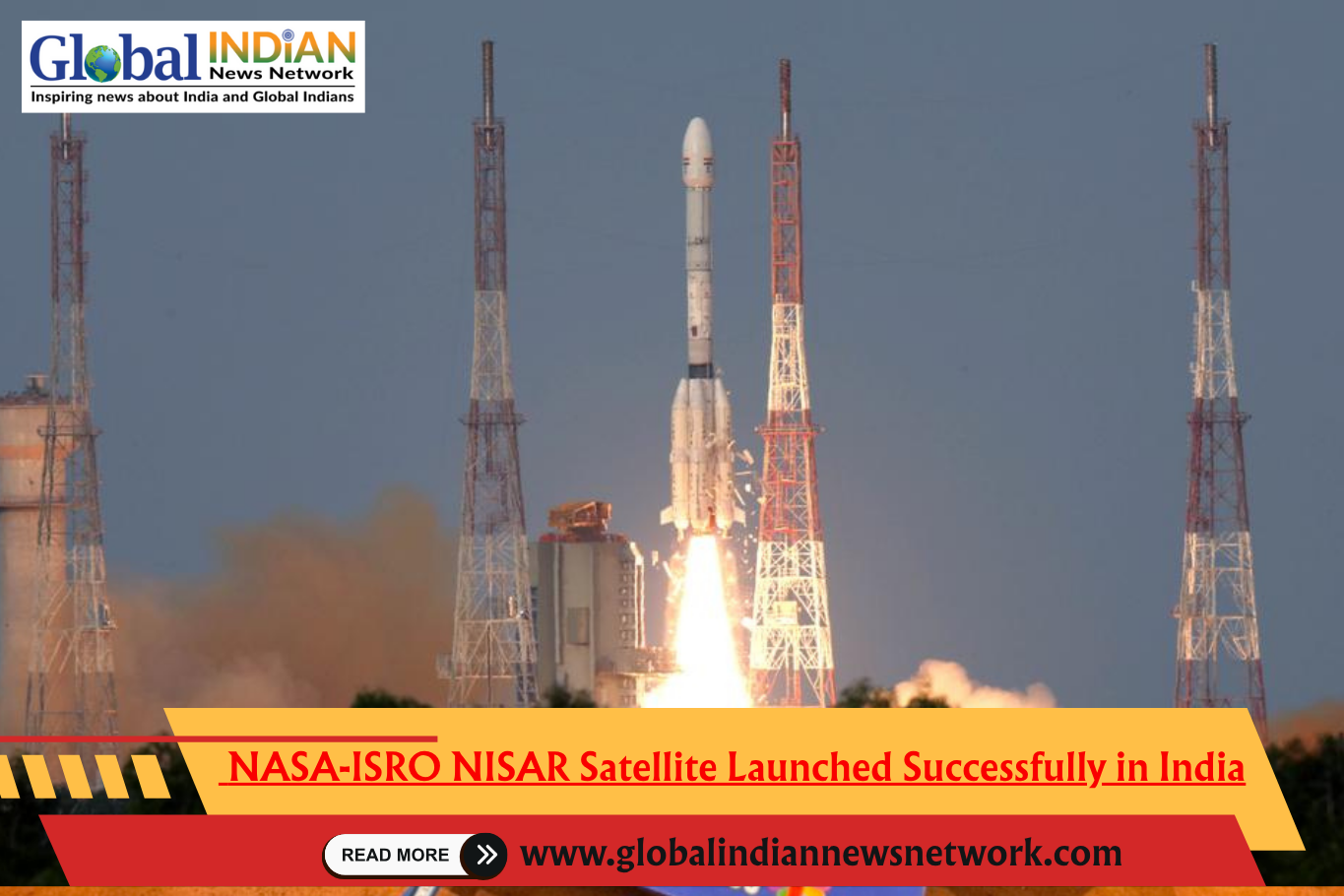
On July 30, 2025, India successfully launched the NASA-ISRO Synthetic Aperture Radar (NISAR) satellite from the Satish Dhawan Space Centre in Sriharikota. Lifted by the GSLV-F16 rocket at 5:40 p.m., the satellite was deployed precisely into a sun-synchronous orbit just 18 minutes after launch — marking a major milestone in India-US space cooperation.
Weighing about 2,392 kg, NISAR is the first-ever satellite developed collaboratively by the Indian Space Research Organisation (ISRO) and the National Aeronautics and Space Administration (NASA). It’s designed for a five-year mission to monitor changes on Earth with high accuracy using dual-frequency Synthetic Aperture Radar — NASA’s L-band and ISRO’s S-band — making it a globally unique system.
This cutting-edge satellite will deliver comprehensive Earth data day and night, across all weather conditions, with revisit intervals of 12 days. The satellite’s powerful radar can detect subtle changes on the planet’s surface such as land deformation, movement of ice sheets, and vegetation dynamics. It will also assist in disaster monitoring — like tracking earthquakes, floods, and landslides — while supporting agricultural and water resource planning.
According to NASA’s Casey Swails, NISAR equips decision-makers with critical data for faster and smarter responses to natural hazards, infrastructure management, and environmental monitoring. The mission also represents the first time a GSLV rocket has placed a satellite in a sun-synchronous orbit.
The satellite carries a 12-meter deployable radar antenna supported by a 9-meter boom. Deployment begins on Day 10 post-launch, followed by a three-month commissioning phase, during which ISRO and NASA will conduct thorough system calibrations.
This launch was especially significant for ISRO after previous setbacks earlier in 2025, including the unsuccessful PSLV-C61 mission and complications with the NVS-02 satellite. NISAR’s successful deployment brings renewed momentum to India’s space program and underscores the strength of international cooperation in tackling global challenges through science and technology.