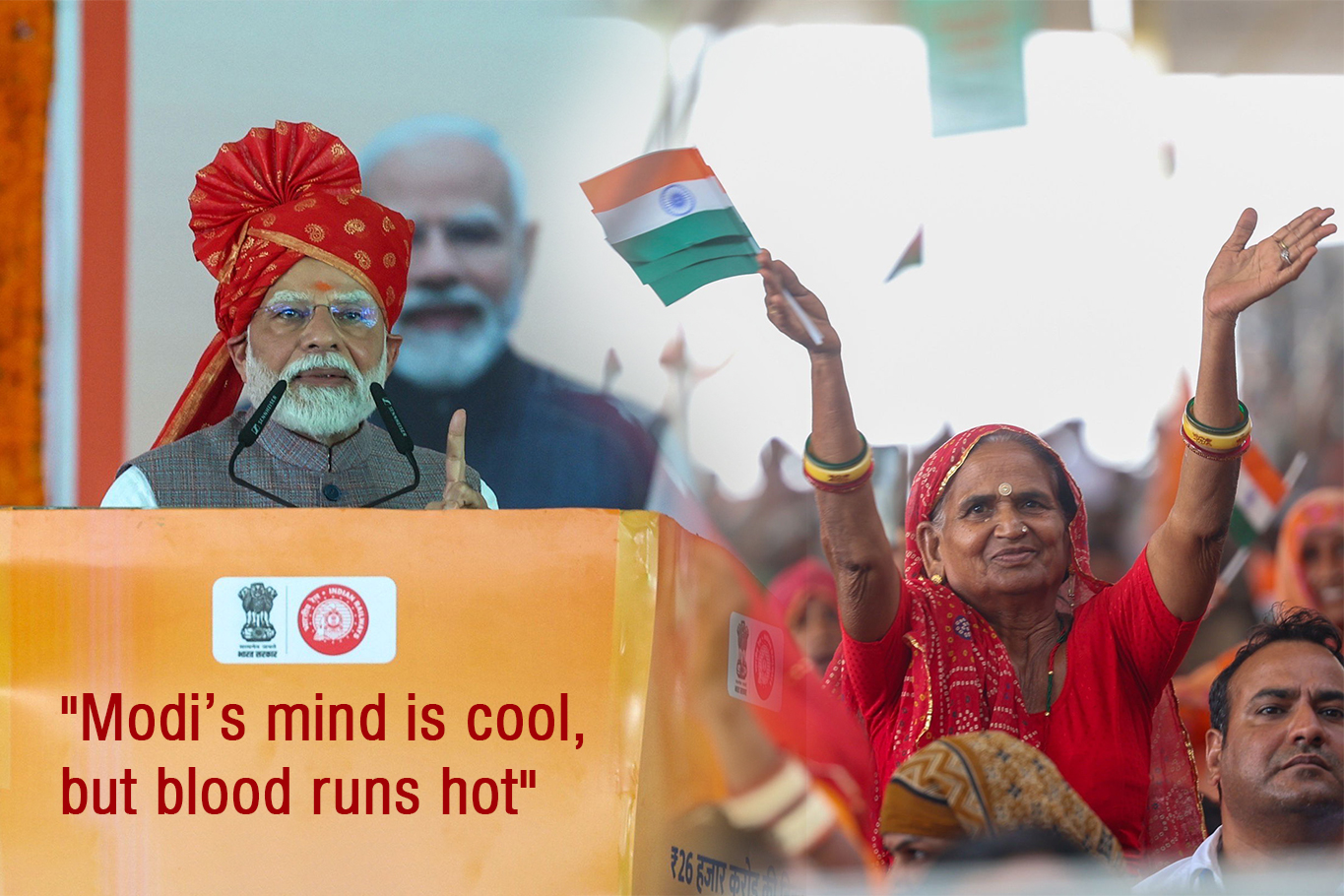
 In a powerful address delivered in Bikaner, Rajasthan, the Prime Minister articulated a new and resolute approach to national security, particularly in dealing with cross-border terrorism. While the speech touched upon various aspects of national development and infrastructure, its most striking and impactful segment was a stern declaration of India’s retaliatory doctrine, symbolically dubbed “Operation Sindoor.” This term, evoking the sacred vermillion mark worn by married women, was transformed into a metaphor for India’s fierce and unyielding response to any act of aggression that threatens its people and sovereignty.
The genesis of this assertive stance, as highlighted by the Prime Minister, was a recent terrorist attack on April 22nd. Though the bullets were fired in Pahalgam, their impact resonated deeply across the nation. The Prime Minister described the attack as one that “destroyed the sindoor of our sisters,” a poignant and culturally resonant phrase that conveyed the profound violation and sorrow felt by 140 crore countrymen. This act of violence, far from instilling fear, ignited a collective resolve across India: to crush the terrorists and deliver a punishment “greater than they could ever imagine.”
The Prime Minister proudly affirmed that this national pledge had been fulfilled, crediting the “blessings of the people and the bravery of the armed forces.” He revealed that his government had granted “full freedom” to all three branches of the armed forces, enabling them to devise and execute a strategic plan that ultimately “forced Pakistan to surrender.” This assertion underscored a significant shift in India’s defense posture, moving from a position of strategic restraint to one of proactive and decisive action.
The core of “Operation Sindoor” was then laid bare with a striking claim: in a mere 22 minutes following the April 22nd attack, “nine of the biggest terrorist hideouts” were destroyed. This swift and overwhelming retaliation was presented as a clear message to the world and to India’s adversaries. The Prime Minister’s words, “the world and the enemies of the country have also seen what happens when sindoor turns into gunpowder,” were a potent metaphor for the transformation of a symbol of sanctity into an instrument of fierce retribution.
Drawing a parallel to the Balakot air strike five years prior, the Prime Minister recalled his earlier vow, “I swear on this soil, I will not let the country be destroyed, I will not let the country bow down.” Now, in the wake of “Operation Sindoor,” he reiterated this commitment with even greater intensity. He declared that “those who set out to wipe out sindoor, they have been crushed into the dust.” For those who “shed the blood of Hindustan,” he asserted, “today every drop has been avenged.” The message to those who presumed India would remain silent was equally stark: “today they are drowning in their homes.” And to those who “were proud of their weapons,” the Prime Minister stated, “today they are buried under piles of rubble.” These powerful pronouncements underscored a definitive end to an era of perceived impunity for those who sought to harm India.
The Prime Minister characterized “Operation Sindoor” not as mere revenge but as “a new form of justice.” He described it as “the fierce form of a capable India” and “the new form of India,” signaling a fundamental shift in the nation’s approach to its security challenges. He starkly contrasted past actions with the present: “Earlier, they attacked by entering our homes… now it is a direct blow to the chest.” This statement encapsulated the transition from defensive measures to a more assertive, offensive posture when national security is threatened. The overarching message was clear: “This is the policy, this is the tradition, this is India, this is the new India, to crush the serpent of terror.”
To further elaborate on this new doctrine, the Prime Minister outlined three critical principles that would guide India’s counter-terrorism strategy:
- Strong Retaliation: Any terrorist attack on India would be met with a decisive and strong response. Crucially, the Indian armed forces would determine the time, method, and conditions of this response, indicating a departure from external pressures or predetermined frameworks.
- No Intimidation: India would not be swayed or intimidated by “atom bomb threats,” a direct challenge to Pakistan’s past nuclear posturing. This principle highlighted India’s resolve to act without fear, regardless of perceived threats.
- No Differentiation: Perhaps the most significant shift, this principle declared an end to distinguishing between “terror patrons and terrorist-supporting governments.” Pakistan’s long-standing narrative of “state and non-state actors” was explicitly rejected; India would now treat them as one entity. To reinforce this, the Prime Minister mentioned that seven Indian delegations, comprising members from all political parties, foreign policy experts, and respected citizens, were actively working worldwide to expose Pakistan’s true face.
The Prime Minister then directly addressed Pakistan, asserting that it could never win a direct war against India, having repeatedly faced defeat. He noted that Pakistan had therefore resorted to terrorism as its primary weapon against India for decades. However, he declared that this era was over, emphasizing a personal commitment: “Now, Modi, the servant of Mother India, stands tall here. Modi’s mind is cool, it remains cool, but Modi’s blood runs hot. And now, not blood, but hot sindoor flows in Modi’s veins.” This vivid imagery conveyed a deeply personal and emotional commitment to the nation’s security.
A stern warning followed: “Pakistan will have to pay a heavy price for every terrorist attack. And this price will be paid by the Pakistan Army and the Pakistani economy.” To underscore this point, the Prime Minister drew a direct comparison between Bikaner’s Nal Airport, which remained unharmed despite a Pakistani attempt to target it, and Pakistan’s Rahim Yar Khan airbase, which he claimed was in “ICU” due to the Indian Army’s “precise strike.”
The speech concluded the security segment with an unequivocal declaration: there would be “no trade, no talks” with Pakistan. The only discussion that would take place, he asserted, would be concerning Pakistan-occupied Kashmir (PoK). He issued a stark economic threat: if Pakistan continued to “export terrorists,” it would face extreme financial hardship, and India would also consider denying Pakistan its share of water. The Prime Minister’s final words on the subject resonated with unwavering resolve: “Playing with the blood of Indians will be costly for Pakistan. This is India’s resolve, and no power in the world can deter us from this resolve.”
In essence, “Operation Sindoor” as articulated by the Prime Minister, represents a paradigm shift in India’s national security doctrine. It is a declaration of proactive, decisive, and comprehensive retaliation against terrorism, coupled with a firm commitment to hold state sponsors of terror accountable. It signals a new, assertive India, ready to defend its sovereignty and its people with unwavering strength and resolve.