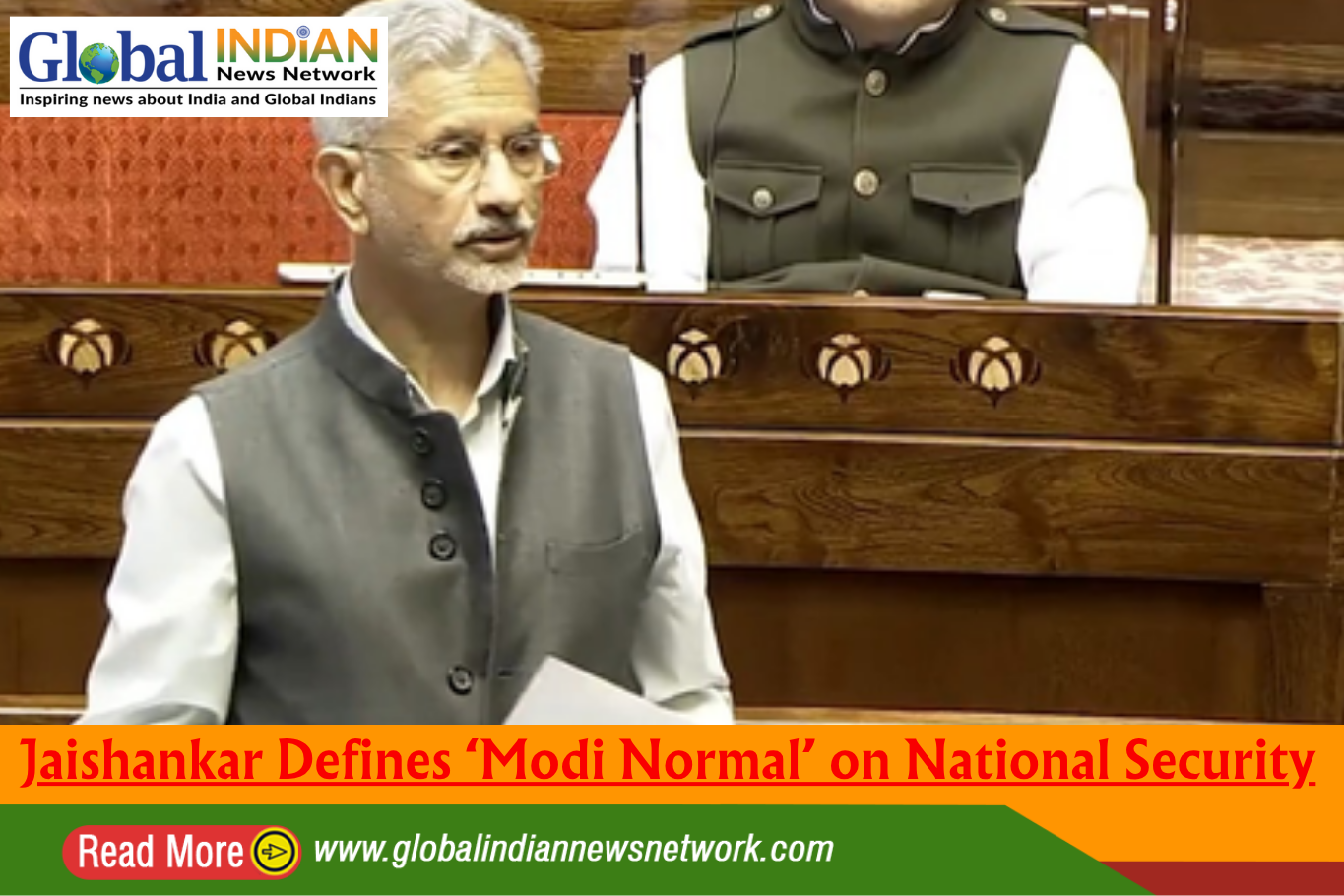
 External Affairs Minister S. Jaishankar, in a sharp rebuttal to the Opposition during a Rajya Sabha debate on Operation Sindoor, outlined India’s evolving national security doctrine, labeling it the ‘Modi normal’. This came in response to questions raised by several members who expressed confusion or criticism about India’s “new normal” approach to tackling terrorism.
Clarifying the term, Jaishankar distinguished between what he called the ‘Modi normal’ and the ‘Congress normal’, asserting that the current government has drawn clear, non-negotiable lines on issues of terrorism and sovereignty.
He elaborated on the principles of the ‘Modi normal’, stating: “Terrorists will not be treated as proxies, cross-border terror will get an appropriate response, talks and terror won’t go together, we won’t give into nuclear blackmailing, and blood and water won’t flow together.”
These, he emphasized, are not temporary political slogans but enduring policy guidelines that reflect a shift in India’s strategic mindset.
Referring to Operation Sindoor, Jaishankar said the government had granted full operational freedom to Indian forces, declaring that any act of terror on Indian soil will henceforth be treated as an attack on national sovereignty. The armed forces, he said, have responded in the strongest manner possible.
He further claimed that the Indian military’s actions during Operation Sindoor had served the global fight against terrorism by targeting and dismantling terror breeding hubs inside Pakistan.
“Bahalwapur and Muridke remain the biggest centres of nurturing terrorists. Our forces reduced them to dust. That is not just a service to India—it is a global service, and the world is taking note,” he said.
Jaishankar took direct aim at critics within the country, accusing the Opposition of undermining the credibility and achievements of the Indian Armed Forces for political gain. He pointed to Pakistani Prime Minister Shehbaz Sharif’s admission that Indian strikes had damaged key Pakistani military sites, including the Noor Khan Air Base.
“Shehbaz Sharif himself confessed that Indian missiles, including BrahMos, targeted key Pakistani military installations. Yet, some people here still cast doubt on our own forces,” Jaishankar remarked.
He warned that doubting the country’s security apparatus weakens national unity and emboldens adversaries, urging political parties to rise above partisan interests when it comes to national defense.
The Minister’s remarks come amid growing national and international acknowledgment of India’s assertive counter-terrorism policies under the Modi government. The redefined doctrine, now being dubbed the ‘Modi normal’, signals a long-term shift in how India responds to threats and asserts its sovereignty.