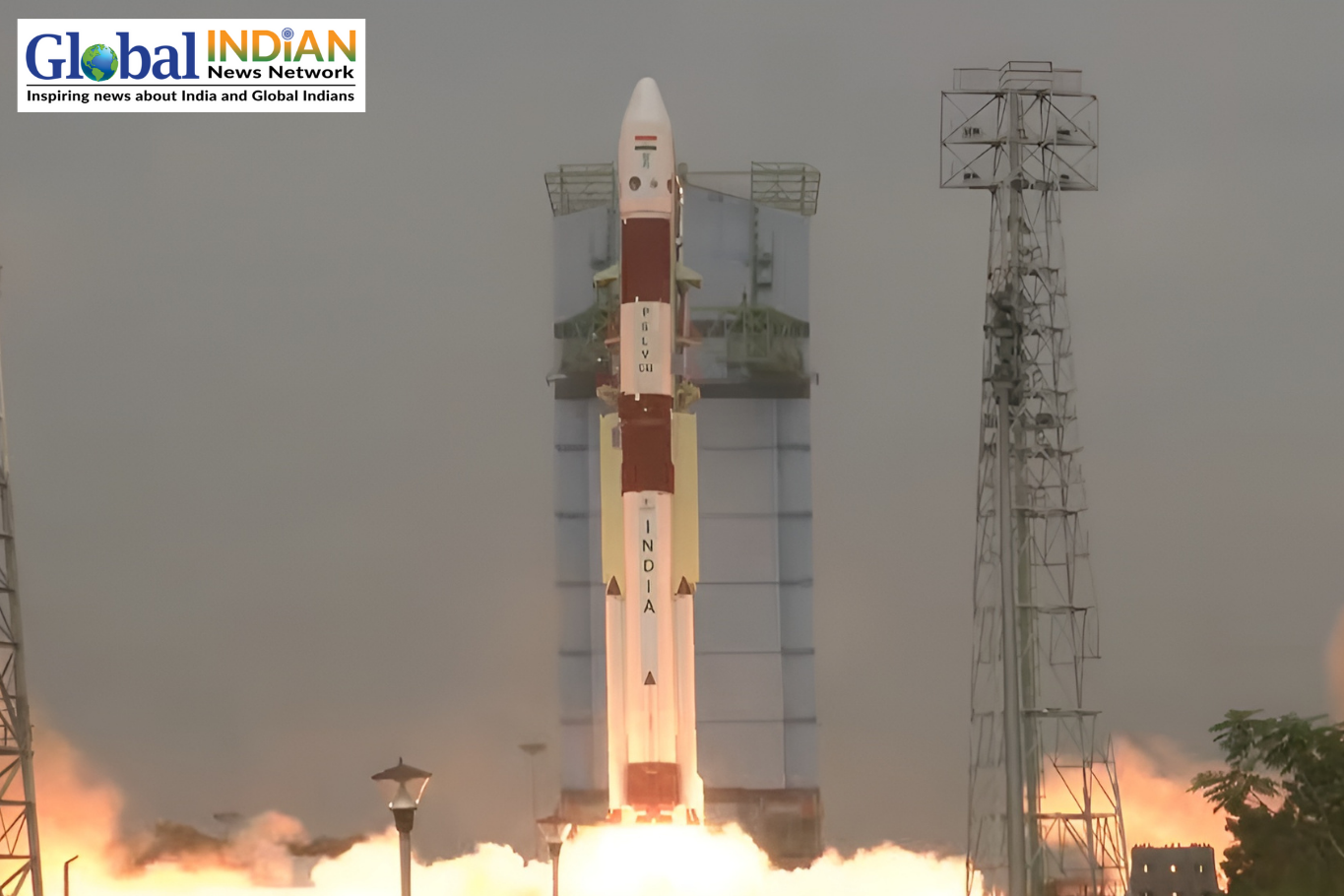
 India’s space agency began its mission calendar for the year with the launch of the Polar Satellite Launch Vehicle PSLV-C62 from the Satish Dhawan Space Centre in Sriharikota. The four-stage launch vehicle carried an Earth observation satellite along with multiple commercial payloads belonging to domestic and international customers. While the liftoff occurred on schedule, the mission experienced an unexpected technical issue during the later phase of the flight.
Standing at approximately forty-four meters tall, the PSLV-C62 lifted off at 10:18 local time from the first launch pad. Initial flight performance matched pre-launch expectations, with both the first and second stages functioning normally. However, close to the completion of the third stage, onboard systems detected disturbances that resulted in a deviation from the planned flight trajectory.
ISRO officials confirmed that the anomaly occurred toward the end of the solid-fuel-powered third stage. Addressing engineers and scientists at the Mission Control Centre, ISRO Chairman S. Somanath Narayanan explained that the vehicle’s behavior remained nominal until the final moments of the third stage burn. At that point, unexpected variations were observed, prompting immediate analysis of telemetry and flight data.
Following the event, ISRO released a statement on social media confirming that the mission encountered an anomaly during the PS3 phase and that a detailed investigation has been initiated. The agency emphasized that it would share further updates once the assessment is completed.
The mission was executed under a commercial agreement facilitated by NewSpace India Limited, ISRO’s commercial arm. The PSLV-C62 was tasked with deploying the EOS-N1 satellite, developed jointly by organizations in Thailand and the United Kingdom, along with several co-passenger satellites. The spacecraft were intended to be placed into a Sun-synchronous orbit at an altitude of approximately five hundred eleven kilometers roughly seventeen minutes after launch.
PSLV remains one of ISRO’s most reliable launch vehicles, having completed sixty-three missions to date. Its legacy includes landmark projects such as Chandrayaan-1, the Mars Orbiter Mission, and the Aditya-L1 solar observatory. Notably, the previous PSLV mission in May 2025 also faced a third-stage observation, highlighting the importance of the ongoing technical review.
Despite the setback, ISRO’s prompt response and transparent communication underline its commitment to mission reliability and continuous improvement within India’s growing space ecosystem.