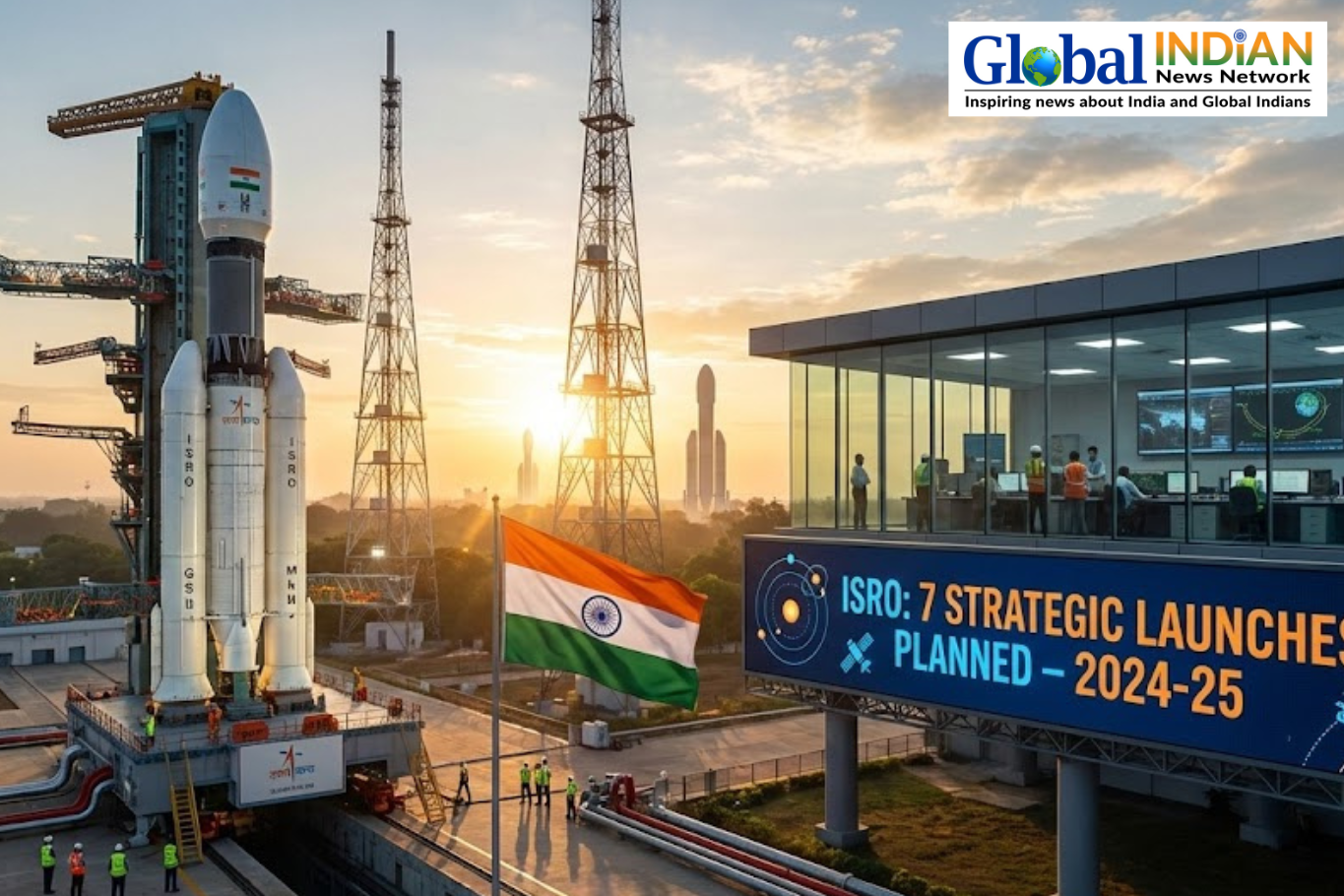
 The Indian Space Research Organisation has charted an intensive launch calendar, with seven missions scheduled to lift off by March next year. These missions reflect a mix of strategic goals, advanced technology demonstrations, and growing commercial collaborations. The first launch from this series is expected as early as next week, setting the pace for a crucial phase in India’s space program.
A major highlight of the lineup is the human-rated LVM3 rocket, the country’s most powerful launch vehicle. Under a commercial agreement facilitated by New Space India Limited, the LVM3 will place the Bluebird-6 communication satellite into orbit for US-based AST Spacemobile. This mission underscores ISRO’s expanding role in the global commercial launch market.
Early next year, the same human-rated LVM3 will undertake the first uncrewed mission of the Gaganyaan program. This flight will carry the humanoid robot Vyommitra inside the crew module and will test the complete mission profile. The objective is to validate the launch vehicle’s aerodynamics, orbital operations, safe re-entry, and recovery systems. Another uncrewed Gaganyaan mission is planned later, ahead of India’s first human spaceflight targeted for 2027.
ISRO will also mark a milestone by launching the first industry-manufactured Polar Satellite Launch Vehicle. Built by an industrial consortium, this PSLV will deploy the Oceansat satellite along with the Indo-Mauritius Joint Satellite and Dhruva Space’s LEAP-2 payload. Separately, an ISRO-built PSLV will carry an earth observation satellite for a strategic user, accompanied by 18 smaller satellites from domestic and international clients.
Technology demonstration remains a key focus. The PSLV63 mission will launch the TDS-01 satellite to test a high-thrust electric propulsion system, quantum key distribution technology, and an indigenous travelling wave tube amplifier. Electric propulsion significantly reduces satellite fuel requirements, allowing lighter spacecraft to deliver the same operational capability as heavier, conventionally fueled satellites.
Additional missions include the GSLV-Mk II launch of the EOS-5 satellite, replacing a previously unsuccessful mission, and a dedicated Small Satellite Launch Vehicle flight before March 2026. Together, these launches highlight ISRO’s push toward self-reliance, advanced technologies, and a stronger commercial presence in space.