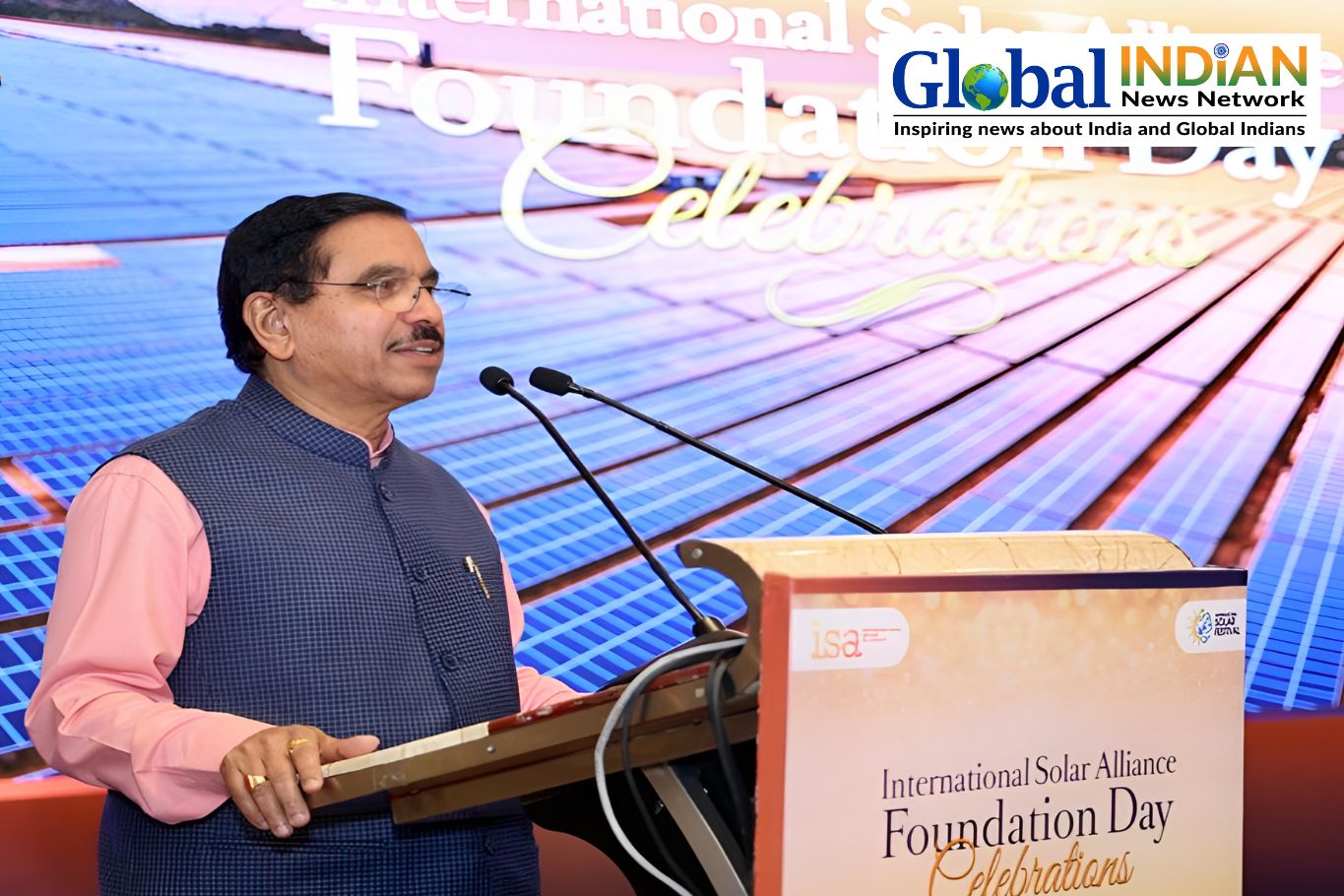
 India’s installed solar power capacity has reached nearly 136 gigawatts, accounting for almost half of the country’s total renewable energy capacity, Union Minister for New and Renewable Energy Pralhad Joshi said while highlighting the nation’s rapid progress in clean energy deployment.
Speaking at the Foundation Day celebrations of the International Solar Alliance in New Delhi, Joshi noted that the growth of India’s solar sector reflects the impact of sustained policy commitment, technological innovation and international cooperation in accelerating the global clean energy transition.
He said the International Solar Alliance has played a crucial role in expanding solar adoption across the world and has helped transform the promise of solar energy into meaningful benefits for communities, particularly in emerging and developing economies.
According to the minister, the alliance represents the power of a shared global vision aimed at advancing sustainable development through clean and reliable solar energy. Over the years, it has become a major platform for collaboration among governments, development partners, financial institutions and private sector stakeholders.
The International Solar Alliance, which began as a joint initiative of India and France, has grown into a coalition of more than 120 countries working together to accelerate solar deployment and expand access to clean energy worldwide.
Joshi also highlighted several flagship programmes launched by the Indian government to promote solar adoption at the grassroots level. Initiatives such as the PM Surya Ghar: Muft Bijli Yojana are enabling millions of households to generate their own electricity through rooftop solar installations, while the PM-KUSUM scheme is helping farmers adopt solar-powered irrigation systems.
These initiatives are designed to bring the benefits of renewable energy directly to households and agricultural communities, reducing electricity costs while supporting sustainable development.
The minister also pointed out that the global solar energy sector is witnessing unprecedented expansion. While it took nearly twenty-five years for the world to install the first 1,000 gigawatts of solar capacity, the next 1,000 gigawatts is expected to be achieved much faster as countries accelerate their clean energy transition.
He noted that the centre of the global energy transition is increasingly shifting toward the Global South, where rising energy demand and abundant solar resources offer a unique opportunity to adopt sustainable energy systems.
Ashish Khanna, Director General of the International Solar Alliance, also acknowledged the role of member countries in driving the organisation’s progress. He said the alliance’s achievements reflect the commitment, leadership and ambition of its member nations and partner organisations working together to expand solar energy deployment globally.
The International Solar Alliance was launched during the 2015 climate conference in Paris under the leadership of Prime Minister Narendra Modi and with the support of France. Since then, it has evolved into one of the most prominent international initiatives promoting solar energy as a key driver of global climate action and sustainable development.