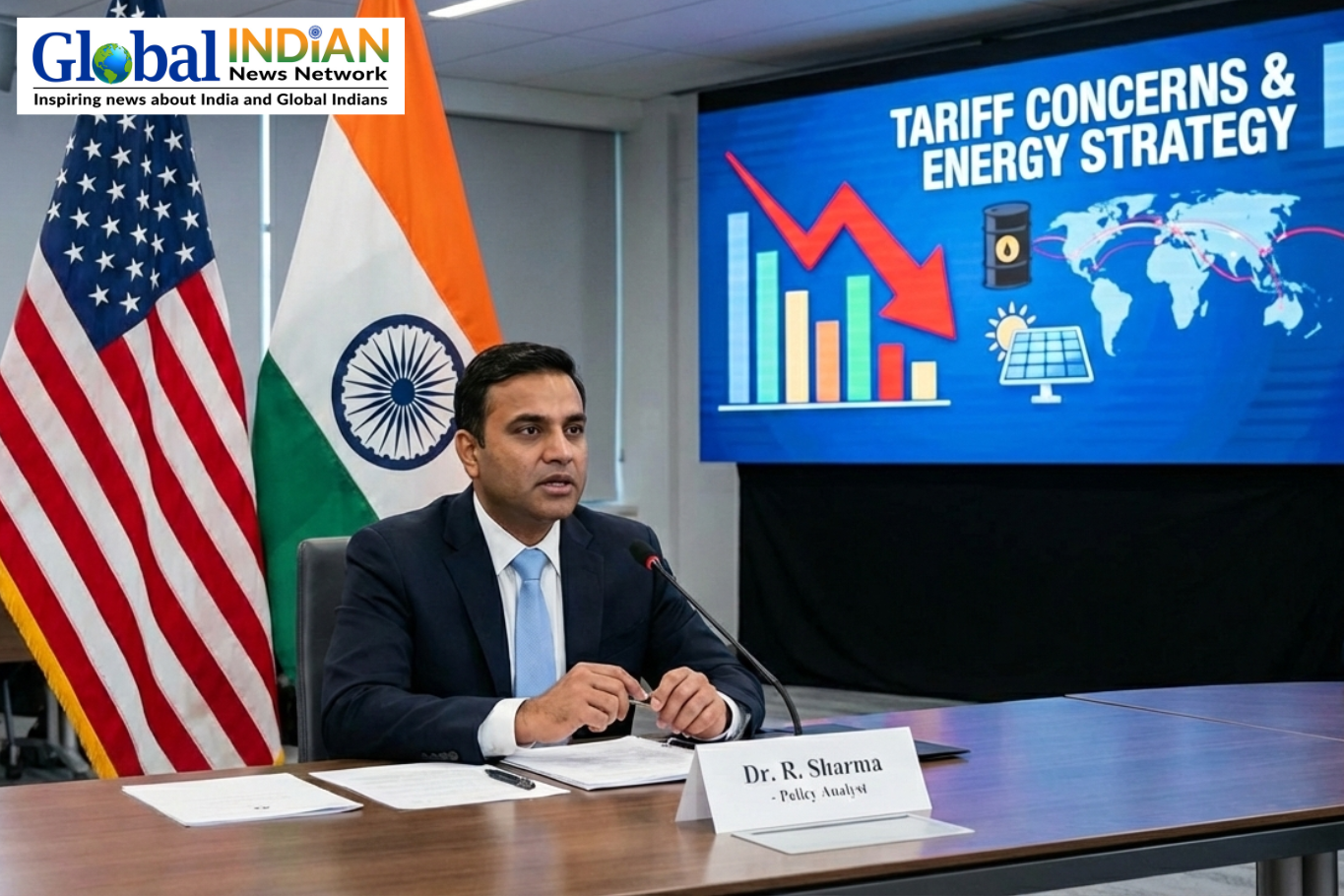
 Eminent Indian American physician and community leader, Dr Bharat Barai, has cautioned that India–US relations could remain tense unless Washington revises recent tariff measures. He argued that India has been unfairly targeted amid wider global trade and energy dynamics. According to Dr Barai, progress in bilateral ties built over several administrations has been undermined by the return of President Donald Trump, whose trade policies, he believes, are driven more by politics than economics.
While acknowledging the US trade deficit with India, Dr Barai emphasized that a measured economic approach should have guided any corrective actions. “A calculated tariff to address the trade deficit is reasonable, but the 25 per cent reciprocal duty imposed is excessive. A lower rate around 15 per cent would have sufficed,” he said. His criticism was particularly sharp regarding the 25 per cent duty linked to India’s imports of Russian oil, pointing out that India has become “an innocent bystander casualty” in a policy lacking consistency.
Dr Barai contrasted India’s treatment with that of China and European nations. China continues to import more Russian oil without facing similar penalties, benefiting from its control over rare earth metals critical to the US and Europe. European countries importing Russian energy, such as Hungary and Slovenia, face lower duties, highlighting a lack of uniformity in enforcement.
The physician attributed these tariff measures to a small group within the administration, including President Trump, immigration hardliner Stephen Miller, and trade adviser Peter Navarro. Although many lawmakers privately opposed the policy, fear of political retaliation prevented them from speaking out. Recent elections in New Jersey, Virginia, and Miami, he said, reflect growing public disapproval of arbitrary trade decisions. Dr Barai expressed hope that the Supreme Court would clarify that tariff imposition falls under Congress’s authority.
Regarding India’s stance, Dr Barai noted that Indian companies like Reliance have partially reduced Russian oil imports but cannot fully abandon a major energy source critical for serving a population of 1.4 billion. Prime Minister Narendra Modi, he said, has acted diplomatically, prioritizing India’s national interest. Dr Barai also highlighted India’s rising global standing through stronger ties with Europe, a UK trade agreement, engagement with Africa, and a defence pact with Australia, adding that India now commands respect internationally, though relations with the US remain strained.