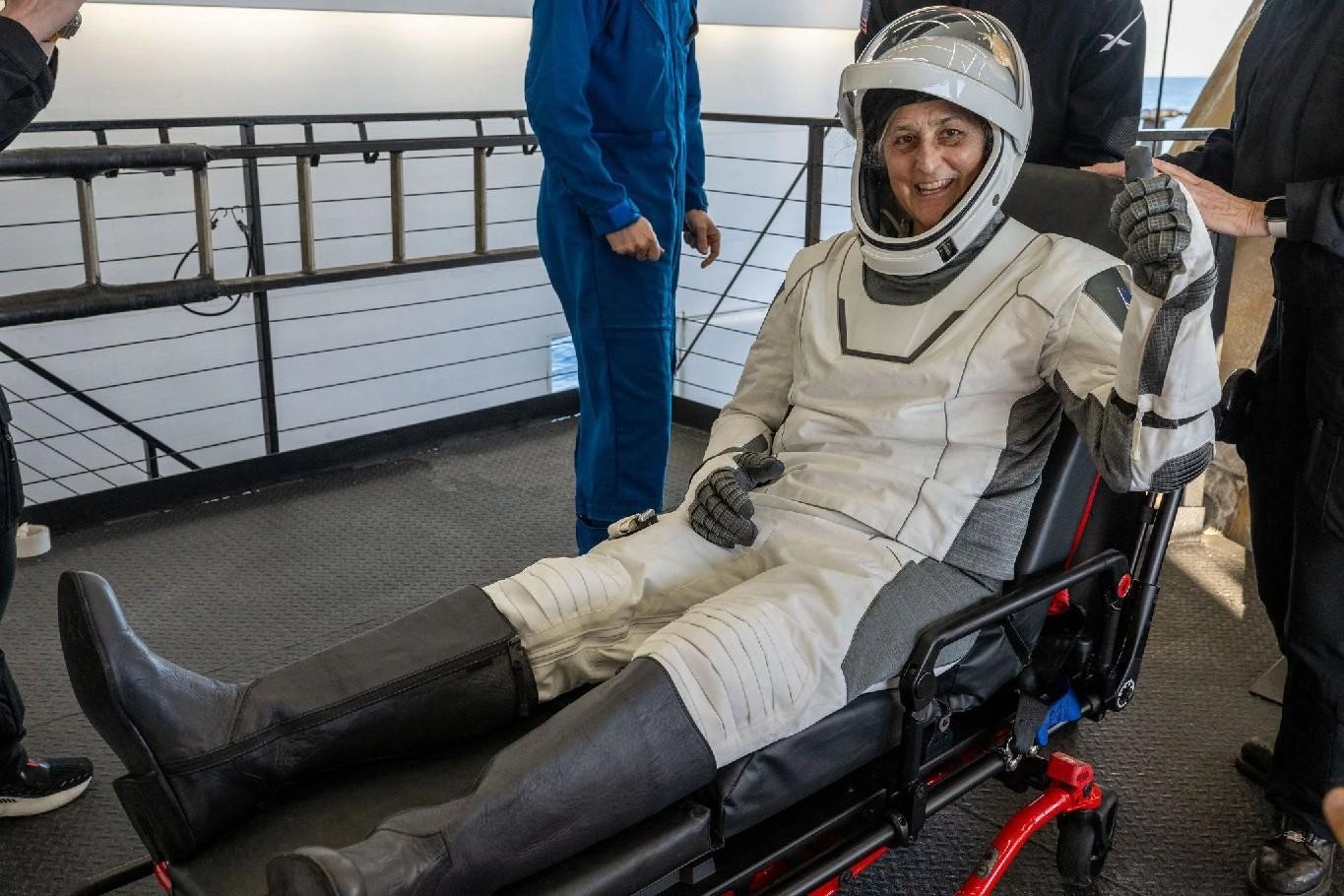
NASA astronaut Sunita Williams, a spaceflight veteran of Indian origin, has successfully returned to Earth after spending over nine months aboard the International Space Station (ISS). She, along with fellow astronaut Butch Wilmore, splashed down off the coast of Florida on March 19, 2025, aboard a SpaceX Dragon spacecraft.
Their mission was initially expected to last only a week, but due to technical issues with Boeing’s Starliner capsule, their stay on the ISS was extended to more than nine months. Williams and Wilmore were finally brought back on NASA’s Crew-9 mission, alongside astronaut Nick Hague and Russian cosmonaut Aleksandr Gorbunov.
Indian Roots of Sunita Williams
Sunita Williams, born on September 19, 1965, in Euclid, Ohio, has strong Indian roots. Her father, Dr. Deepak Pandya, was a renowned neuroanatomist who was originally from Jhulasan village in Gujarat, India. Over the years, she has openly expressed her connection to India, and her family in Gujarat has been celebrating her return. Her cousin recently shared, “Sunita is a proud daughter of Gujarat, and our village is overjoyed by her safe homecoming.”
Sunita Williams’ Achievements in Space
With this mission, Sunita Williams has now spent a total of 608 days in space, making her the second-most experienced US astronaut in terms of time spent in orbit. She also holds the record for the most spacewalk hours by a female astronaut, completing 62 hours and 6 minutes of extravehicular activity.
Her remarkable achievements include:
- Commander of Expedition 33 aboard the ISS
- Veteran of three space missions (Expeditions 14/15, 32/33, and 71/72)
- First female astronaut to pilot Boeing’s Starliner spacecraft
- First Indian-origin woman to command the ISS
In recognition of her contributions, she has been honored with several prestigious awards, including:
- Legion of Merit
- Distinguished Service Medal (DSSM)
- Navy Commendation Medal
- Humanitarian Service Medal
Challenges During the Mission and Return to Earth
NASA officials clarified that while Sunita Williams and Butch Wilmore’s return was delayed due to technical issues with Boeing’s Starliner capsule, they were never “stranded” in space. NASA had a contingency plan and a “lifeboat” ready at all times for their safe return.
Now back on Earth, Williams will undergo extensive reconditioning to help her body readjust to gravity. NASA has warned that astronauts returning from long-duration missions often experience dizziness, disorientation, and difficulty standing up due to the effects of microgravity on the body. She will undergo vascular and cardiovascular reconditioning to regain normal balance and strength.
Fitness and Diet in Space
Throughout her extended mission, Sunita Williams followed a strict fitness regimen to maintain muscle and bone health. She engaged in:
- Cardio workouts to keep her heart strong
- Resistance training to counteract muscle loss due to microgravity
Regarding her diet, NASA provided her with pre-packaged and freeze-dried foods. Some of her meals included:
- Roast chicken and shrimp cocktails
- Freeze-dried fruits and vegetables
- Sardines and smoked turkey for Thanksgiving
Due to the extended mission, her intake of fresh produce was restricted, but NASA ensured that all astronauts received a balanced diet.
What’s Next for Sunita Williams?
After completing her historic third space mission, Williams is expected to:
- Undergo medical evaluations to study the effects of long-duration spaceflight on the human body.
- Continue mentoring young astronauts and contribute to NASA’s upcoming Artemis lunar missions.
- Possibly return to space for future deep-space missions, including those to the Moon or Mars.
Global Recognition and India’s Celebration
Sunita Williams’ return has captured global attention. Google searches for her name surged past 2 million in the last two days, highlighting the world’s fascination with her space journey.
Her homecoming has been widely celebrated in India, especially in Gujarat, where people see her as a symbol of inspiration and pride. Prime Minister Narendra Modi and ISRO scientists have also extended their congratulations, recognizing her as an Indian-origin space pioneer.
Her incredible journey continues to inspire young scientists and aspiring astronauts, proving that talent and perseverance have no boundaries.