Photo Courtesy : X.com
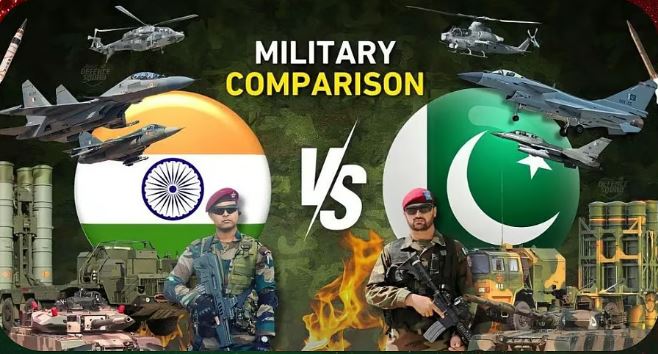
The 2025 Global Firepower Index data paints a detailed and striking picture of the military balance between India and Pakistan, two nuclear-armed neighbors whose rivalry has defined South Asian geopolitics for over seven decades. While both countries maintain sizable and capable armed forces, a close examination reveals that India enjoys clear advantages across almost every dimension of military power—manpower, economic strength, airpower, ground forces, and naval capabilities. However, Pakistan’s defense strategy relies on specific strengths, strategic deterrence, and regional tactics to maintain a credible balance.
Source : https://www.globalfirepower.com
Manpower: India’s Numerical Supremacy
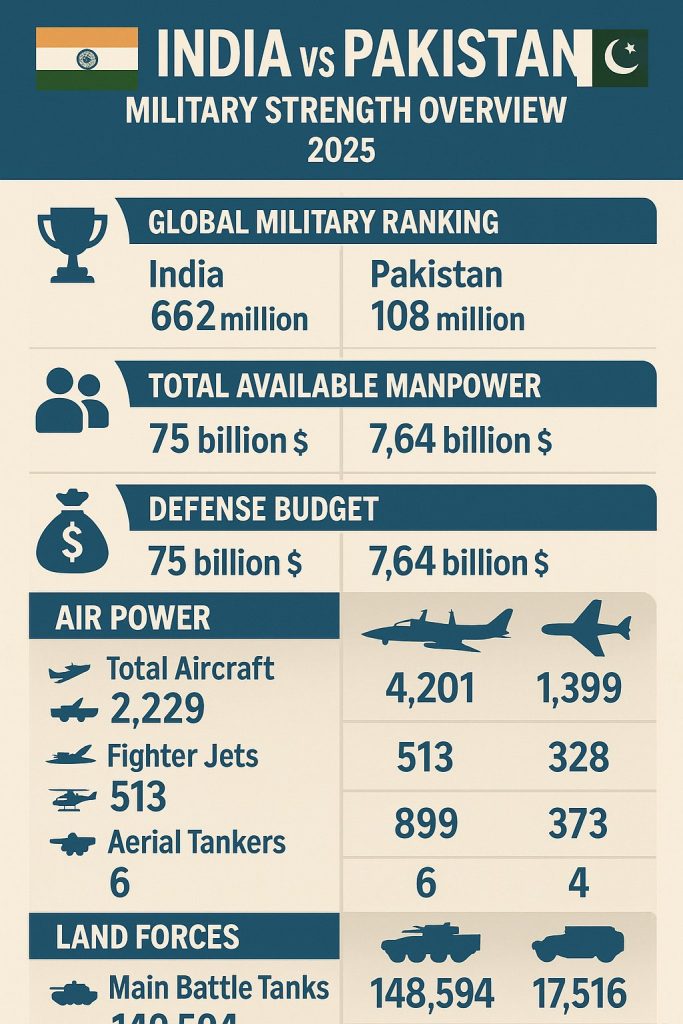
Manpower remains one of India’s most significant military advantages. India’s massive population of approximately 1.4 billion provides a large and resilient human resource base, with 662 million individuals considered available for military service. In contrast, Pakistan’s total population stands at around 252 million, with 108 million available manpower.
This demographic difference translates into substantial disparities in active and reserve forces:
- India fields 1,455,550 active military personnel and maintains 1,155,000 reservists.
- Pakistan, meanwhile, fields 654,000 active personnel and 550,000 reservists.
Furthermore, India’s paramilitary forces are massive, with over 2.5 million personnel compared to Pakistan’s 500,000. In the event of prolonged conflict, India’s ability to sustain military operations through rapid mobilization of reserves and paramilitary units far exceeds Pakistan’s capability.
Financial Resources and Defense Budgets
A nation’s ability to fund its military often determines its long-term effectiveness. Here too, India holds an overwhelming advantage. India’s annual defense budget stands at $75 billion, compared to Pakistan’s $7.64 billion—a nearly tenfold difference.
Beyond defense spending, broader economic indicators reveal an even wider gap:
- India’s GDP (PPP): Approximately $13.1 trillion.
- Pakistan’s GDP (PPP): Around $1.35 trillion.
India also enjoys vastly higher foreign currency reserves ($627.8 billion vs. Pakistan’s $13.7 billion), giving it a stronger financial backbone to support modernization programs, advanced weapons purchases, defense research, and strategic partnerships. Pakistan’s constrained economy, burdened with debt and inflation, limits its capacity to sustain prolonged military buildups or technological advancement without external support.
Airpower: India’s Technological Edge
Control of the skies is pivotal in modern warfare. In airpower, India maintains technological and numerical superiority.
- Total Aircraft: India fields 2,229 aircraft compared to Pakistan’s 1,399.
- Fighter Jets: India has 513 fighters, including state-of-the-art Rafale jets and the highly maneuverable Su-30MKI fleet. Pakistan operates 328 fighters, mostly comprising JF-17 Thunders (jointly developed with China) and older U.S.-origin F-16s.
India also possesses 80 attack helicopters versus Pakistan’s 57, giving India an edge in close air support and anti-armor operations.
Importantly, India’s diversified inventory sourced from Russia, France, and indigenous production (e.g., HAL Tejas) ensures operational flexibility and reduces dependency on any single supplier, unlike Pakistan, which relies heavily on Chinese defense imports and selective U.S. partnerships.
Land Forces: Numerical Strength vs. Tactical Doctrine
Ground forces form the backbone of both militaries, and India again holds numeric superiority.
- Tanks: India operates 4,614 tanks compared to Pakistan’s 3,742.
- Armored Fighting Vehicles: India commands a massive 100,000 armored vehicles, overshadowing Pakistan’s 15,000.
- Towed Artillery: India fields 4,060 units against Pakistan’s 1,200.
Interestingly, Pakistan slightly surpasses India in self-propelled artillery (134 units vs. India’s 100). This evidence suggests that Pakistan has emphasized mobility and responsiveness in its artillery doctrine, possibly reflecting its focus on rapid deployment in contested zones like Kashmir.
Moreover, India’s broader doctrine accommodates large-scale conventional operations and the flexibility to address threats on two fronts—Pakistan in the west and China in the north.
Naval Power: Blue Water vs. Coastal Defense
The naval dimension shows India’s broader strategic ambitions.
- Total Naval Assets: India operates 295 ships and submarines, while Pakistan has 114.
- Aircraft Carriers: India possesses 2 active aircraft carriers (INS Vikramaditya and INS Vikrant). Pakistan has none.
- Submarines: India operates 17 submarines, including nuclear-powered boats, while Pakistan fields 9 conventional submarines.
India’s navy has transitioned toward becoming a “blue-water navy” capable of projecting power across the Indian Ocean region and protecting sea lanes of communication. In contrast, Pakistan’s navy primarily focuses on regional coastal defense and littoral operations, aiming to safeguard its maritime interests within the Arabian Sea.
India’s stronger naval aviation and amphibious warfare capabilities further amplify its maritime edge, especially in a potential blockade or sea-denial scenario.
Strategic Balance and Deterrence
Despite India’s clear conventional advantages, Pakistan maintains a credible deterrent strategy centered around its nuclear capabilities and focus on asymmetrical warfare.
Pakistan’s investment in tactical nuclear weapons (TNWs) and missile systems such as the Nasr (Hatf-IX) short-range missile is designed to offset India’s conventional superiority by lowering the nuclear threshold in case of a major ground offensive.
Moreover, Pakistan has developed a robust doctrine of strategic depth and quick mobilization aimed at deterring a swift Indian advance. On the other hand, India adheres to a “No First Use” nuclear doctrine, focusing on massive retaliation if attacked, thus maintaining strategic stability—albeit one underpinned by significant tension.
Other Factors: Global Alliances and Indigenous Defense Production
India’s global partnerships—such as those within the Quad alliance (with the United States, Japan, and Australia)—enhance its technological edge and access to cutting-edge military hardware. Initiatives like the “Make in India” campaign have boosted indigenous production of missiles (BrahMos), aircraft (Tejas), and naval vessels.
Pakistan continues to strengthen ties with China, securing critical military hardware and diplomatic support. However, this partnership also increases Pakistan’s dependence on Chinese technology and limits diversification options.
In sum, India’s advantages across manpower, economy, military hardware, and international partnerships place it firmly ahead of Pakistan in conventional military strength. India’s forces are larger, better funded, and technologically more advanced.
About the Author
Brigadier Rathore is a renowned Indian military strategist and advisor, celebrated for his expertise in modern warfare and counter-terrorism operations. A decorated officer, he served 32 years in the Indian Army, leading missions across the toughest battlefronts from Kashmir to the Northeast. Trained at the Indian Military Academy and the Royal College of Defense Studies, London, Brigadier Rathore is a master of both battlefield tactics and geopolitical strategy. After retirement, he became a sought-after consultant for think tanks and international agencies. His sharp analyses and first-hand combat experience lend powerful authenticity to his writings. Rathore continues to mentor young officers and inspire readers with real-world insights into courage, leadership, and national security.