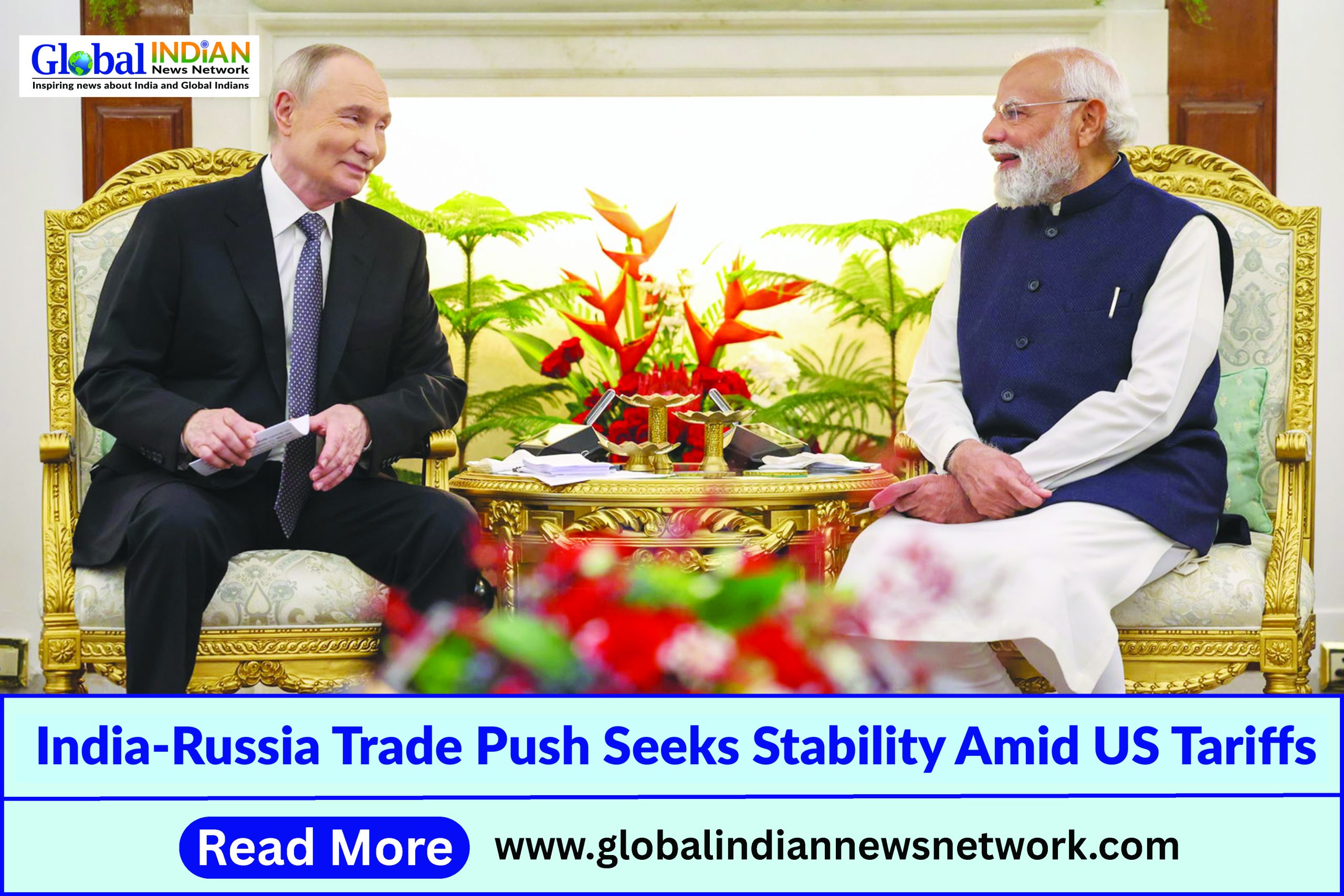
 India and Russia have opened a new chapter in their long-standing relationship by signing a series of agreements designed to broaden their economic engagement beyond the familiar domains of oil and defense. Russian President Vladimir Putin’s two-day visit to New Delhi for the 23rd India-Russia Annual Summit marked his first official trip to India since the outbreak of the Russia-Ukraine conflict in 2022. During the summit, both nations committed to significantly expanding trade, setting an ambitious target of reaching $100 billion in bilateral commerce by the end of the decade.
Leaders from both countries stressed the need to make bilateral trade more balanced, sustainable, and diversified. India aims to increase its exports to Russia while deepening collaboration in advanced technology, industrial partnerships, and investment opportunities. The adoption of “Programme 2030,” a roadmap for strategic economic cooperation, reflects this shared long-term vision.
Energy remained a central pillar of discussions, with President Putin assuring India of steady and uninterrupted fuel supplies. Both sides praised their growing collaboration in the energy sector, which is expected to remain a cornerstone of their strategic partnership. Defense cooperation also received a boost, with agreements to jointly manufacture spare parts and components for Russian-origin military equipment in India under the Make in India initiative. This move aims to support India’s armed forces while enabling exports to friendly nations.
Other high-impact sectors also featured prominently. Talks included the possibility of constructing a second nuclear power facility using Russian reactor technology. Additionally, Indian fertilizer companies signed an MoU with Russia’s Uralchem to build a greenfield urea plant worth $1.2 billion, highlighting new avenues of cooperation.
The summit occurred at a challenging time for India, which currently faces a steep 50% tariff on goods exported to the United States due to its continued imports of Russian oil. Experts believe that while the India-Russia agreements offer meaningful economic advantages, they cannot fully offset the strain caused by US trade actions. Analysts note that logistical hurdles—such as the lack of a smooth rupee-ruble settlement mechanism and Russian banks’ restricted access to SWIFT—could slow progress.
Economists argue that although deeper collaboration in areas like critical minerals, nuclear energy, shipbuilding, agriculture, and space has enormous potential, these gains may only partially shield India from US tariff pressures. The American market remains essential for many Indian industries, and Russia cannot fully substitute that scale.
Still, strengthening ties with Russia could increase India’s bargaining power globally and push the US to reconsider its current approach. Over time, success will depend on India’s ability to boost exports, upgrade manufacturing, and adapt to evolving global supply chains.