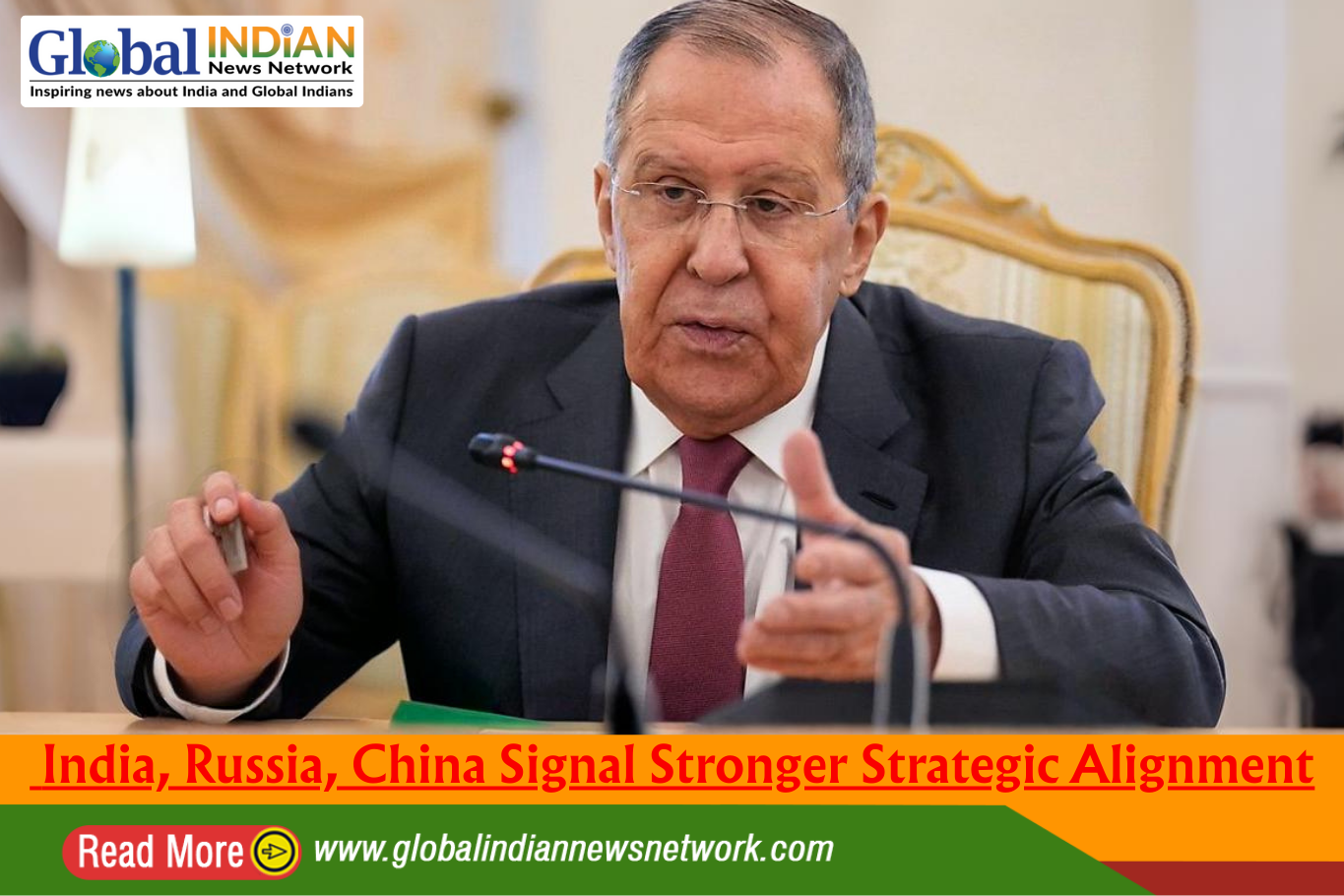
 Russia’s Foreign Minister Sergei Lavrov stated on Sunday, September 7, 2025, that Moscow, New Delhi, and Beijing recognize overlapping interests across multiple sectors, pointing to a rising trend of deeper cooperation. His remarks followed the Shanghai Cooperation Organisation (SCO) summit in Tianjin, where the leaders of the three nations made headlines with a public display of warmth.
The moment that drew worldwide attention was the symbolic handshake and close interaction between Prime Minister Narendra Modi, Russian President Vladimir Putin, and Chinese President Xi Jinping. The images quickly circulated across global media platforms, symbolizing a strengthening trilateral understanding.
The show of unity also stirred a reaction from Washington. US President Donald Trump criticized the development on social media, lamenting the growing closeness of India and Russia with what he described as “darkest China.” His comments came at a time when ties between India and the US are under strain. Recently, Washington increased tariffs on Indian exports to 50%, while also slapping a 25% surcharge on New Delhi’s imports of Russian oil.
Lavrov, however, stressed that the convergence among the three powers does not imply identical positions on every issue. Instead, he explained, the partnership seeks to maximize mutual benefit in areas where their interests align—particularly in economic growth, tackling social challenges, and raising living standards for their citizens.
While the SCO summit’s primary agenda revolved around security cooperation and economic integration among member states, the camaraderie between Modi, Putin, and Xi captured wider attention. A viral video showed Modi and Putin walking hand in hand before joining Xi in a friendly huddle, further underlining the optics of unity.
Despite the optics, analysts remain cautious. Dr. Aleksi Maslov, head of the Africa-Asia Institute at Moscow University, noted that a tightly knit Russia-India-China dialogue remains unlikely. He emphasized that India’s democratic system, distinct from both European and Asian frameworks, shapes its independent decision-making. According to him, future cooperation among the three nations is more likely to progress through bilateral engagements rather than a formal trilateral framework.
Together, these developments reflect both the opportunities and the complexities in the evolving relationship among India, Russia, and China—three influential players seeking balance in a shifting global order.