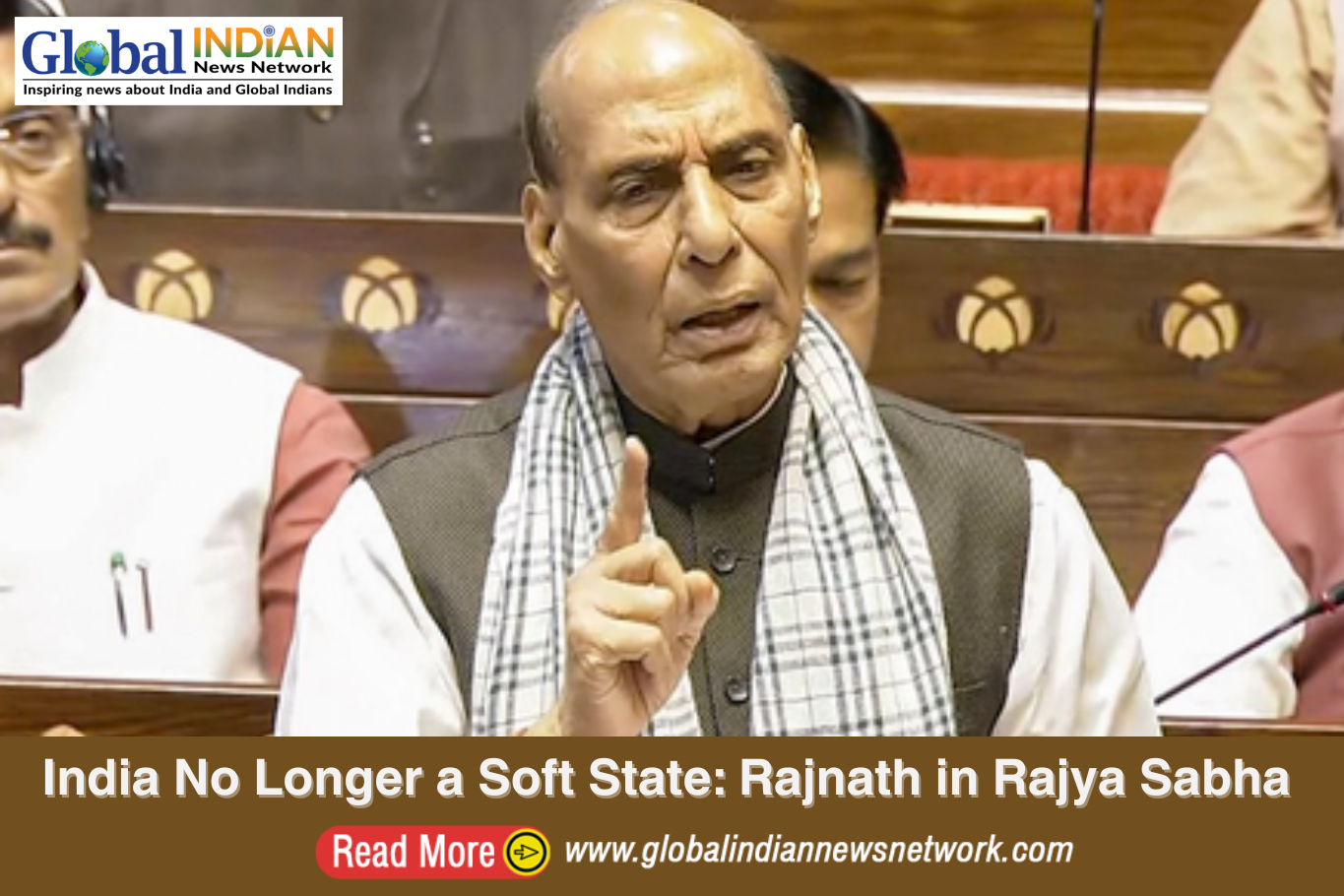
 Defence Minister Rajnath Singh delivered a strong statement in the Rajya Sabha, declaring that India is no longer a soft state. He confirmed that Indian security forces have successfully neutralized the three terrorists responsible for the Pahalgam massacre, which resulted in the loss of 26 civilian lives.
Addressing the Upper House during the debate on Operation Sindoor, Singh stated that forensic analysis had conclusively matched the weapons recovered from the encounter site with those used in the Pahalgam attack. According to Singh, the coordinated operation led to the elimination of all three militants, reinforcing the government’s commitment to a zero-tolerance policy against terrorism.
The terrorists, identified as operatives of The Resistance Front (TRF), were killed in a joint mission involving the Indian Army, Central Reserve Police Force, and Jammu & Kashmir Police. Codenamed Operation Mahadev, the encounter was part of the broader counterterrorism campaign under Operation Sindoor, which targeted terror infrastructure in Pakistan and Pakistan-occupied Kashmir.
Singh praised the synergy and professionalism demonstrated by the security forces, highlighting that the mission was carried out with surgical precision and without any civilian casualties. The government’s approach, he affirmed, is guided by principles of ethical warfare and strategic deterrence.
Home Minister Amit Shah, speaking in the Lok Sabha, echoed the Defence Minister’s statement and reaffirmed the government’s resolve to deliver justice for the victims of the Pahalgam attack. Shah underscored the importance of Operation Sindoor as a calibrated and justified response to cross-border terrorism.
The announcement brought a sense of closure to families impacted by the tragedy and marked a significant milestone in India’s fight against terrorism. The successful elimination of the perpetrators was seen as a necessary step in restoring national confidence and upholding India’s sovereignty.
Singh emphasized that if Pakistan attempts any future misadventure, the response from India would be even more forceful. His remarks reflected a shift in India’s strategic posture, characterized by decisive action and refusal to tolerate proxy terror attacks.
During the ongoing debate, Opposition members demanded transparency regarding operational details and the broader diplomatic implications. Trinamool Congress MP Derek O’Brien raised concerns about lack of disclosure, but his point of order was dismissed by the Deputy Speaker.
Congress President Mallikarjun Kharge led the Opposition’s formal critique, raising questions about military casualties and the decision to allow India’s national cricket team to participate in the Asia Cup alongside Pakistan.
Despite political differences, the ruling government’s message remained consistent: national security will not be compromised. India’s counterterrorism operations are now defined by clarity of intent, ethical precision, and the assertion of sovereign rights.
The debate over Operation Sindoor is expected to continue in both Houses, with Prime Minister Narendra Modi likely to address the matter, outlining the strategic rationale, outcomes, and long-term impact of India’s renewed national security doctrine.
India’s transformation from a state of reactive diplomacy to proactive deterrence signals a new era in its approach to security. With Operation Mahadev as a case in point, the nation has demonstrated that it will not remain passive in the face of aggression. The narrative has shifted — India now answers terrorism not with silence, but with strength.