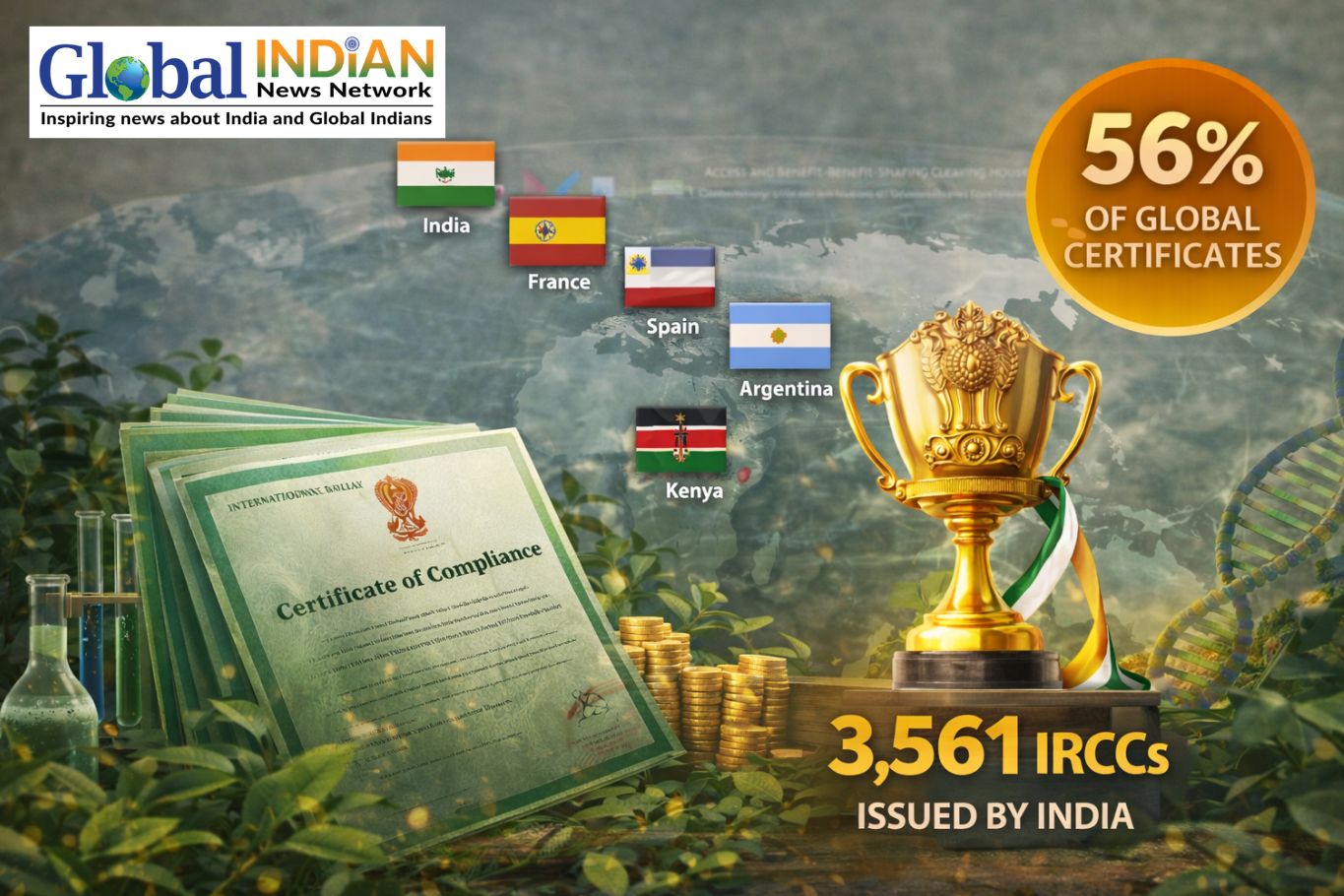
 India has emerged as the global leader in issuing Internationally Recognized Certificates of Compliance (IRCCs) under the Nagoya Protocol on Access and Benefit-Sharing (ABS), according to the Ministry of Environment, Forest and Climate Change.
As per the latest data available on the Access and Benefit-Sharing Clearing-House (ABSCH), India has issued 3,561 IRCCs out of a global total of over 6,300, accounting for more than 56 per cent of all certificates published worldwide. This places India significantly ahead of other contributing countries.
Among the top contributors, France ranks second, followed by Spain, Argentina, Panama, and Kenya. Out of 142 countries registered on the ABS Clearing-House platform, only 34 have issued IRCCs so far.
The Nagoya Protocol requires countries granting access to genetic resources and associated traditional knowledge to issue IRCCs. These certificates serve as official proof that prior informed consent has been obtained and mutually agreed terms have been established between resource providers and users.
IRCCs play a crucial role in tracking the use of genetic resources for research, innovation, and commercial applications, while ensuring that benefits arising from their use are shared fairly and equitably with the provider country.
India’s leading position reflects the effective implementation of its ABS framework under the Biological Diversity Act, 2002. The framework is implemented through the National Biodiversity Authority, along with State Biodiversity Boards, Union Territory Biodiversity Councils, and local Biodiversity Management Committees.
The Ministry highlighted that streamlined procedures and strong institutional mechanisms have enabled efficient processing of applications and ensured compliance with international obligations.
This achievement underscores India’s proactive role in global biodiversity governance and its commitment to promoting the fair and equitable sharing of benefits arising from the use of biological resources, aligning with broader international sustainability goals.