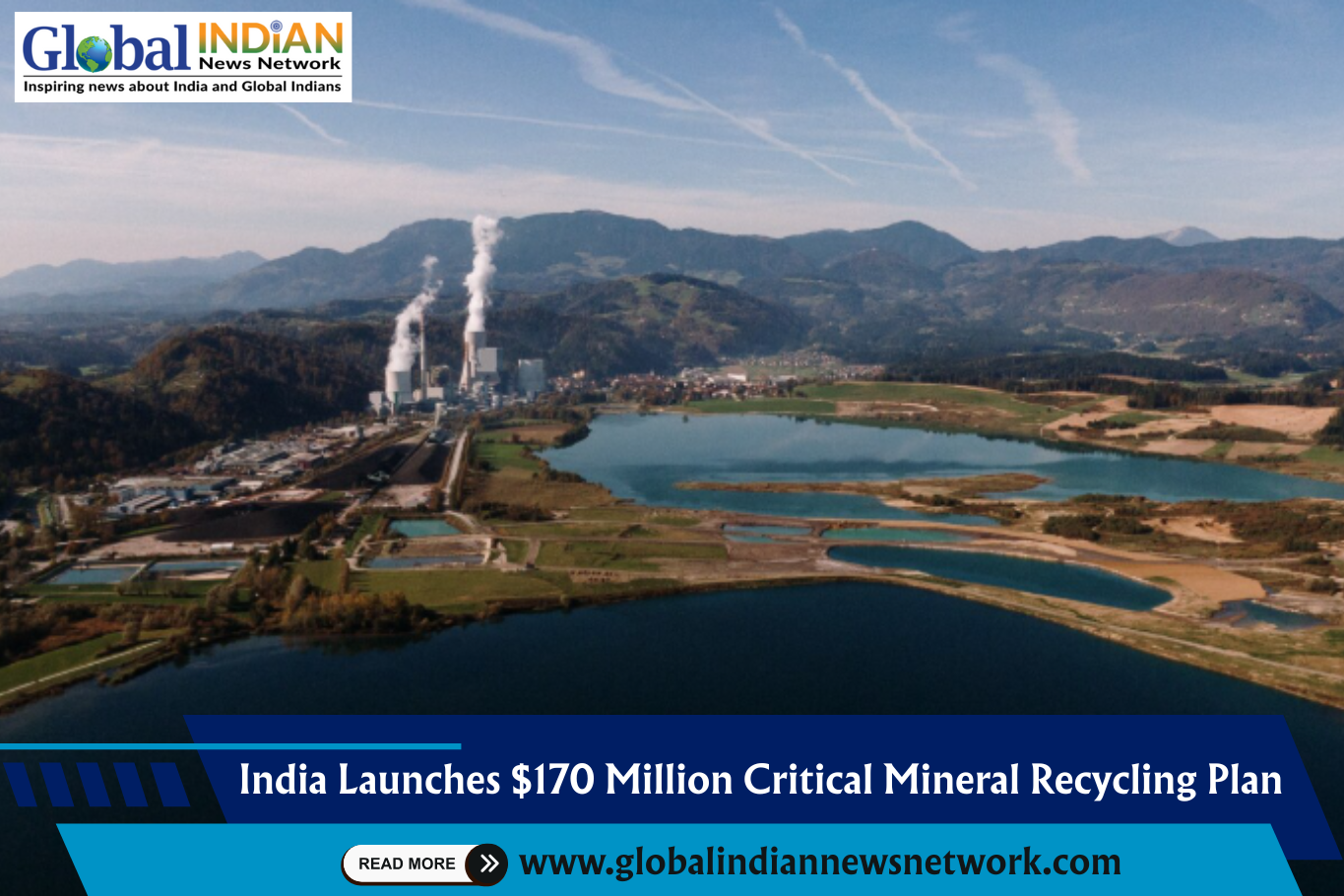
 The Indian government has unveiled a major push to strengthen its critical mineral supply chain by approving a $170.4 million incentive scheme aimed at recycling e-waste and battery waste. Cleared by the Union Cabinet on September 3, 2025, the initiative falls under the National Critical Mineral Mission (NCMM) and will run from FY26 to FY31. It is designed as a near-term solution until domestic mining and exploration of rare minerals can deliver steady results.
The scheme covers a wide range of feedstock, including discarded lithium-ion batteries, catalytic converters from end-of-life vehicles, and general e-waste. Large recycling companies, start-ups, and smaller enterprises are all eligible, with one-third of the total allocation earmarked exclusively for new and small-scale recyclers.
To encourage early participation, the program provides a 20% capital subsidy on plant and equipment for units beginning operations within the stipulated timeframe. Those who start late will receive reduced incentives. Additionally, operating subsidies linked to incremental sales will be offered in two phases between FY27 and FY31, ensuring that support is performance-based.
The benefits will be capped at $5.7 million for large recyclers and $2.8 million for smaller units. Authorities expect the scheme to enable the creation of 270 kilo tonnes of recycling capacity, producing nearly 40 kilo tonnes of critical minerals. These include essential resources like lithium, cobalt, and rare earths, vital for India’s electric mobility and renewable energy goals.
The government anticipates that the program will draw investments worth around $908.9 million from the private sector, while simultaneously generating 70,000 direct and indirect jobs. By integrating smaller and innovative players into the supply chain, the initiative also aims to spur innovation and reduce dependence on imported critical minerals.
Officials highlighted that the scheme will bridge the gap until India’s ongoing exploration and mining projects become fully operational. The NCMM sees recycling as a strategic pathway to both sustainability and resource security, given the surging global demand for minerals critical to batteries, electronics, and clean energy technologies.
With this decision, India has taken a decisive step toward a circular economy model that recycles waste into valuable inputs, strengthening its position in global supply chains while promoting environmental responsibility.