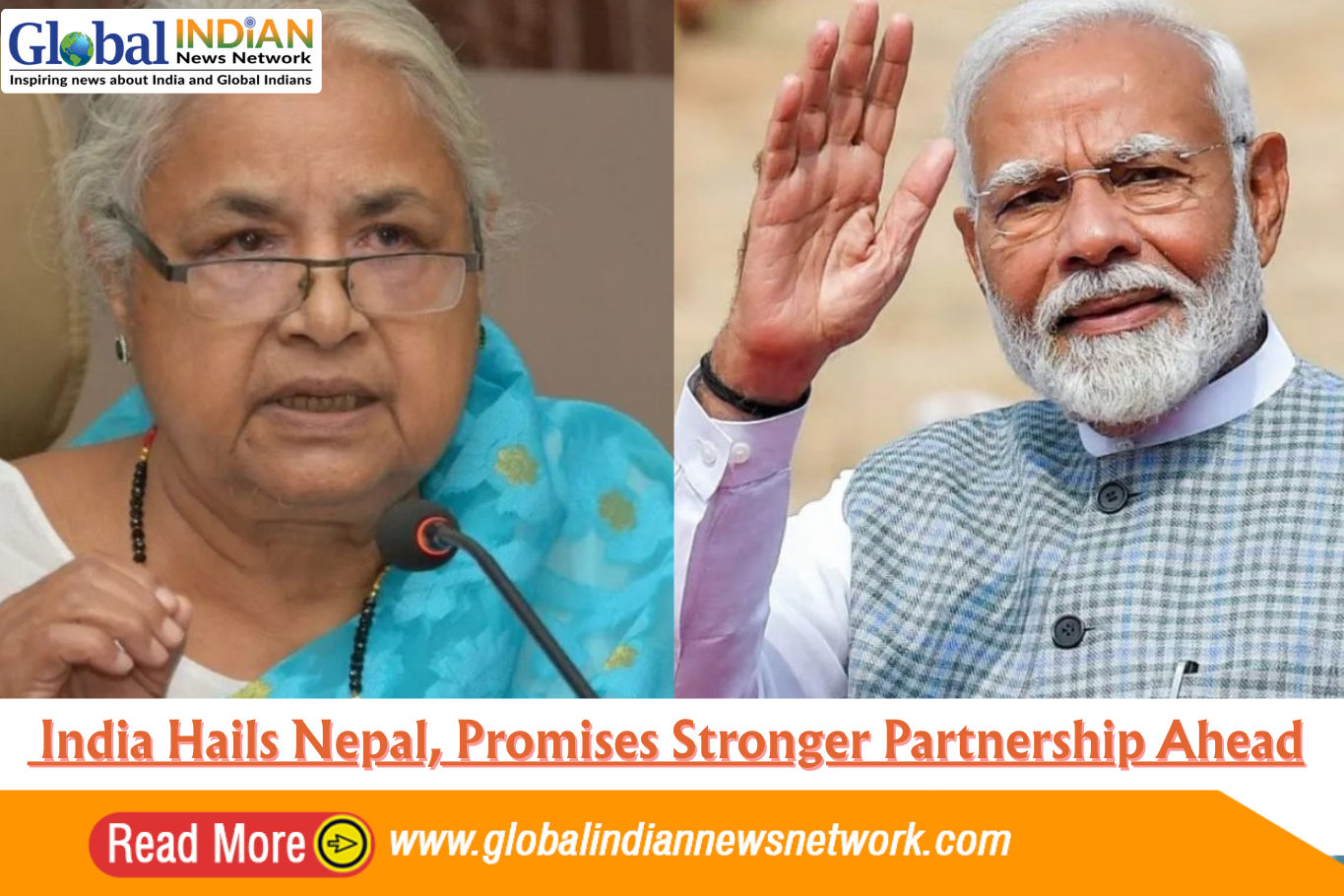
 India has extended a warm welcome to Nepal’s newly formed interim government, led by Prime Minister Sushila Karki. The Ministry of External Affairs said on Friday that India views the political transition in its neighboring democracy as a step toward strengthening peace and stability in the Himalayan nation.
In a formal statement, the ministry praised Nepal as a close neighbor and a fellow democracy, reiterating that India would continue to partner with Kathmandu on development and prosperity. The ministry noted that the two nations share long-standing cultural and economic ties, and India remains committed to supporting Nepal during this transitional phase.
Sushila Karki officially assumed the role of interim Prime Minister at a swearing-in ceremony held at Sheetal Niwas, the presidential residence in Kathmandu. The oath was administered by President Ramchandra Paudel. Karki’s appointment followed days of violent protests that forced the resignation of former Prime Minister KP Sharma Oli.
The demonstrations, largely led by Gen Z activists, began after the government attempted to impose a short-lived social media ban. What started as an outcry against digital restrictions quickly evolved into a nationwide movement targeting corruption, nepotism, and long-entrenched political elites. Protesters set fire to government offices, lawmakers’ residences, and even the parliament building, prompting the military to be stationed throughout the capital to maintain order.
Karki was selected after several names were floated for the top post, including Kulman Ghising, former head of Nepal’s electricity authority, Kathmandu mayor Balendra Shah, and Dharan mayor Harka Sampang. Ultimately, the decision to appoint Karki was seen as a balancing act to restore public confidence and calm political unrest.
This is not Karki’s first time making history. In 2016, she became Nepal’s first female Chief Justice. However, her judicial career was cut short when she faced impeachment amid allegations of partial rulings and executive interference. Despite the controversies, her return to public leadership is being watched closely, both domestically and internationally.
For India, Karki’s leadership offers an opportunity to reaffirm its strategic partnership with Nepal. By highlighting shared democratic values and mutual goals, New Delhi has signaled its readiness to work closely with Kathmandu to ensure peace, stability, and prosperity in the region.