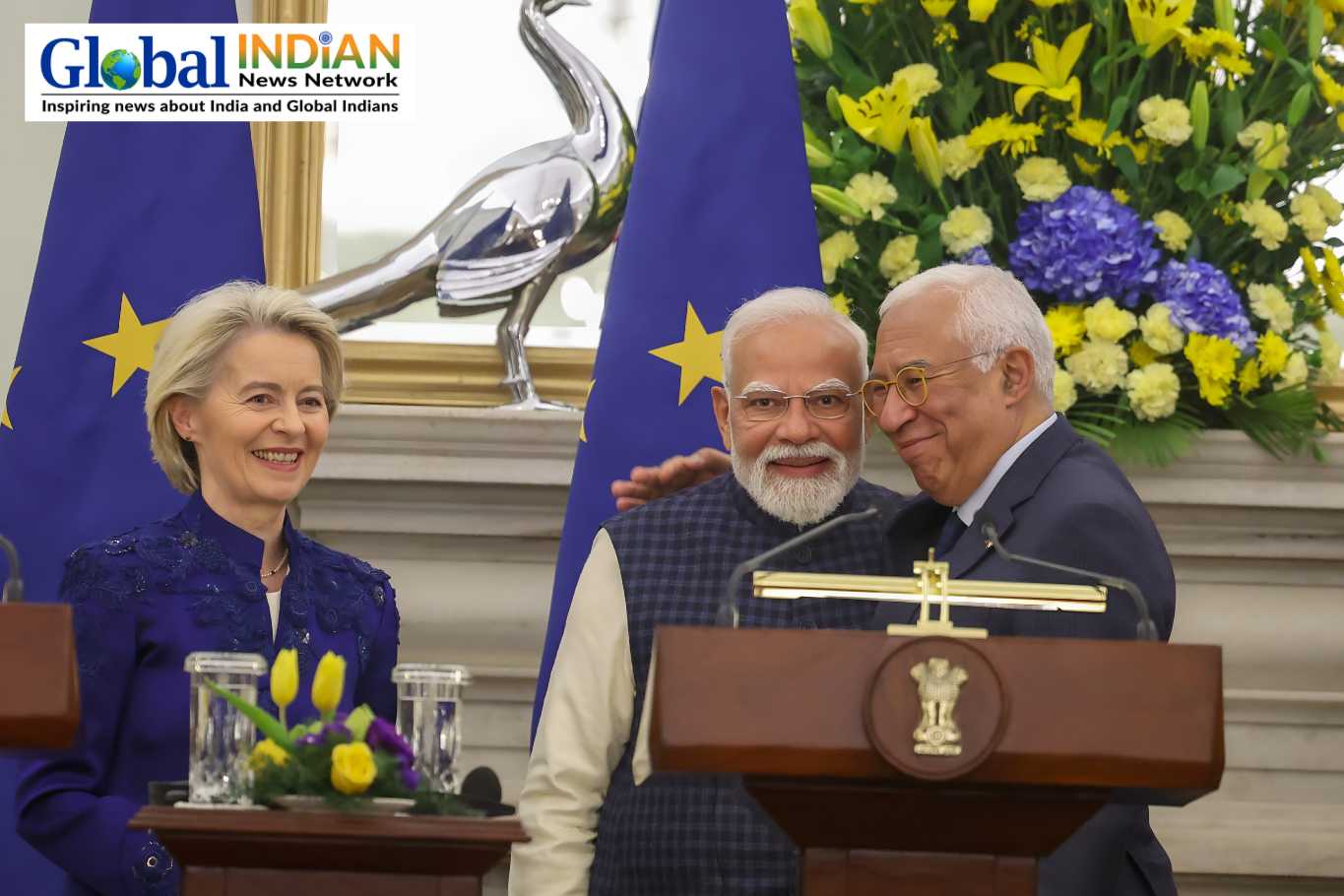
 On January 27, 2026, India and the European Union formally concluded their historic Free Trade Agreement (FTA), marking the end of an 18-year negotiation process. Hosted at Hyderabad House, the summit brought together Prime Minister Narendra Modi, European Commission President Ursula von der Leyen, and European Council President Antonio Costa. The landmark deal eliminates tariffs on 96% of traded goods, unlocking a massive market of nearly 2 billion consumers and providing a significant boost to Indian manufacturing, particularly in textiles, leather, gems, and footwear. European machinery and automobile sectors also gain access to India’s market under structured phased quotas.
The FTA goes beyond commercial benefits, integrating a first-ever security and defence partnership between India and the EU. This framework emphasizes joint commitment to a rules-based international order and collective resilience against emerging global threats, including maritime security and counter-terrorism. The agreement follows historic participation of EU naval personnel in India’s Republic Day parade and signals a strengthened strategic relationship. Defence Minister Rajnath Singh and the three service chiefs underscored India’s capacity to contribute to European defence programs through this collaboration.
Prime Minister Modi described the FTA as a “perfect example of partnership,” highlighting its potential to create jobs, facilitate youth employment, and strengthen global supply chains. By combining India’s workforce, services, and scale with European technology and investment, the agreement is expected to foster long-term shared prosperity and reduce strategic dependencies at a time of increasing geopolitical uncertainty.
European leaders also celebrated the strategic dimension of the partnership. Ursula von der Leyen called the agreement the “mother of all deals,” emphasizing its win-win nature and the creation of opportunities for millions on both continents. António Costa noted that economic growth and regional security are inseparable, stressing that the new partnership strengthens trust, stability, and resilience in a multipolar world.
The India-EU FTA, coupled with a five-year strategic roadmap, positions both powers as central pillars of the global economy. It is expected to drive innovation, deepen people-to-people ties, and establish corridors for trilateral trade from the Indo-Pacific to Europe, reinforcing the partnership as a stabilizing force in global geopolitics.