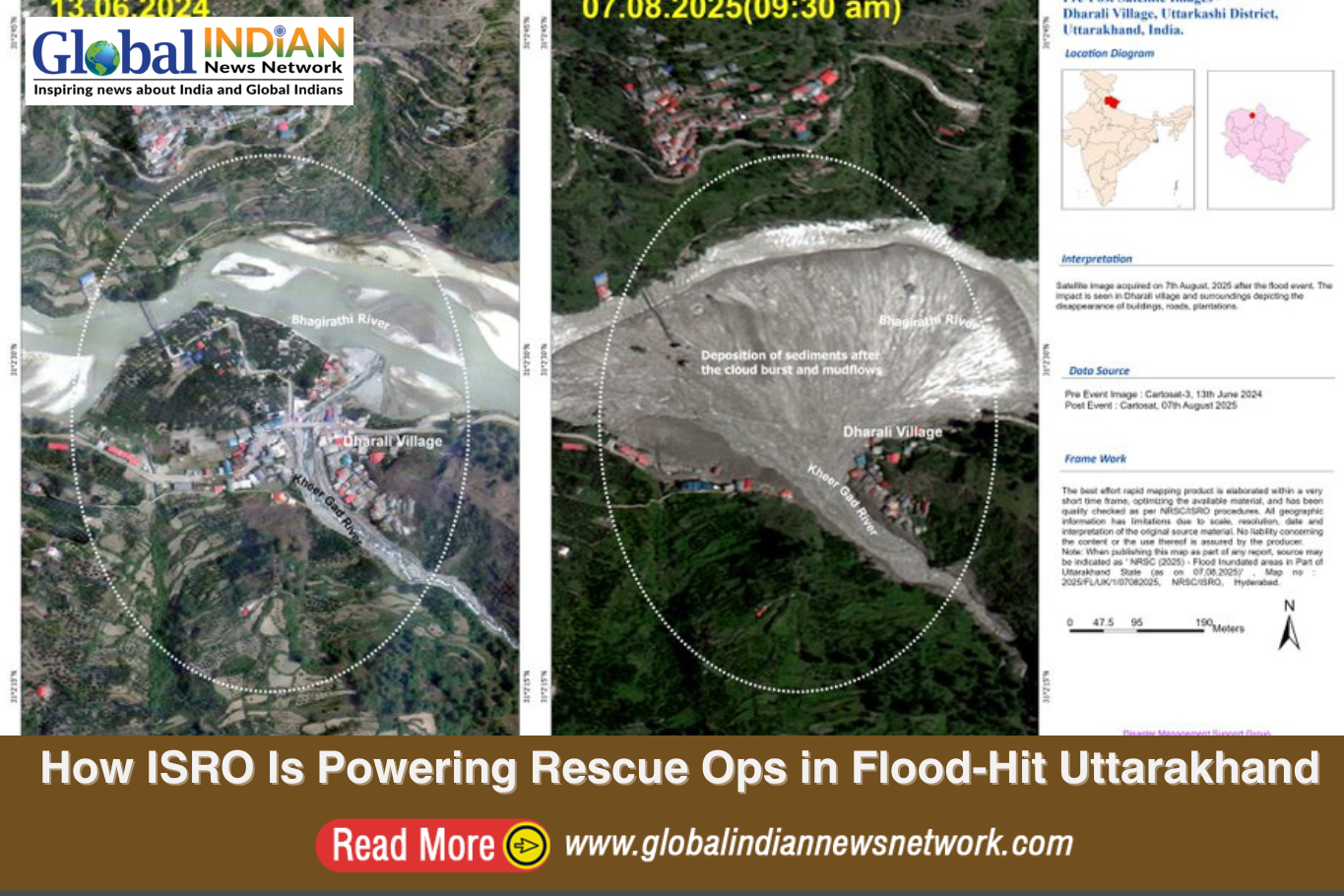
 Just days after a catastrophic flash flood tore through Uttarakhand’s Dharali and Harsil villages, the Indian Space Research Organisation (ISRO) has released striking high-resolution satellite images that lay bare the scale of the disaster. Triggered by intense rainfall and a sudden cloudburst on Tuesday afternoon, the deluge swept away homes, hotels, bridges, and roads in Uttarkashi district, claiming at least five lives while more than 100 remain missing.
Captured by the Cartosat-2S satellite, the images—shared on ISRO’s official X account—are now serving as a crucial guide for ground-based rescue and relief teams. Comparative analysis shows a significant change in the river’s course, widespread destruction of property, and a “fan-shaped” deposit of sediment and debris spanning roughly 20 hectares at Dharali, where the Kheer Gad meets the Bhagirathi River. Entire buildings appear to have vanished, likely submerged or swept away in the violent flow of mud, rock, and water.
State Disaster Response Force (SDRF) Inspector General Arun Mohan Joshi confirmed that rescuers are prioritizing the airlift of advanced equipment to navigate debris piles as high as 60 feet. These tools will allow teams to dig through massive rubble fields in search of trapped residents. Rescue personnel are also working to evacuate an estimated 300–400 pilgrims stranded in the district due to severely damaged roads. Dharali, a popular stopover for travelers heading to the Gangotri shrine, has seen several of its hotels and homestays destroyed.
Officials are also preparing to deploy ground-penetrating radars and trained sniffer dogs to aid in locating the missing. The recovery effort has already yielded two additional bodies as of Wednesday.
Chief Minister Pushkar Singh Dhami is stationed in Uttarkashi to oversee operations firsthand. However, persistent bad weather and blocked arterial roads have slowed progress. Among the missing are eleven Army personnel stationed at a nearby Harsil camp, underscoring the severity of the tragedy.
ISRO noted that its imagery will continue to support search and rescue missions, help restore connectivity to cut-off areas, and inform scientific assessments of the disaster’s causes. The event has once again drawn attention to the growing vulnerability of Himalayan settlements to extreme weather events, where even a few hours of intense rain can unleash devastating consequences.