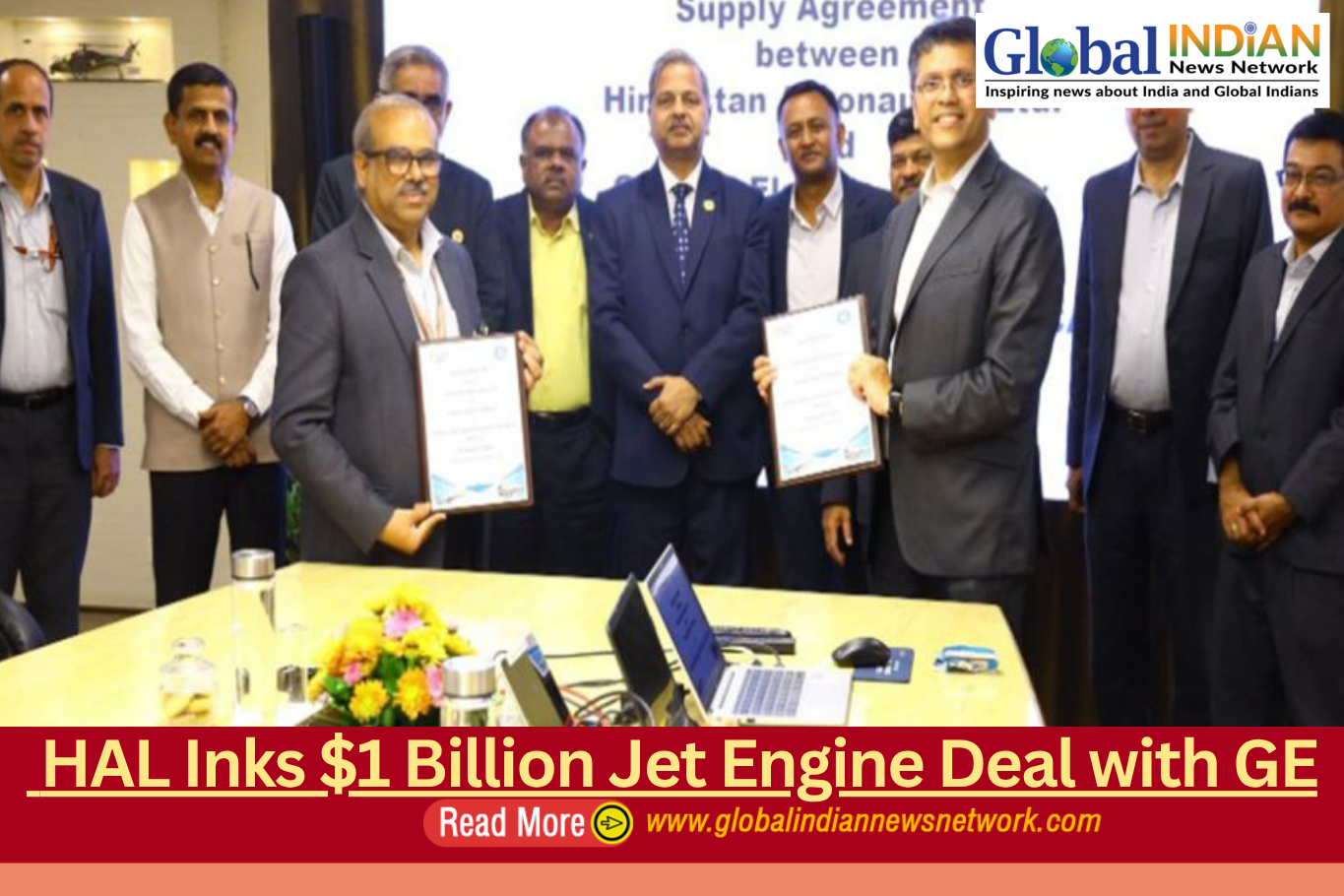
 Hindustan Aeronautics Limited (HAL) announced on Friday that it has finalized a $1 billion agreement with US aerospace giant General Electric (GE) to supply 113 F404-GE-IN20 engines, along with a comprehensive support package. These engines will power the 97 Light Combat Aircraft (LCA) Mk1A jets under the Indian Air Force’s modernization plan.
HAL revealed the development through a post on X, confirming that the deal was signed on November 7, 2025. The company stated that engine deliveries will begin in 2027 and continue through 2032, coinciding with the phased rollout of the LCA Mk1A fleet. The original contract for the 97 aircraft was inked in September 2025.
This billion-dollar agreement marks another milestone in HAL’s expanding collaborations with global aerospace leaders. The partnership with GE aims to enhance India’s self-reliance in defense manufacturing, while leveraging American technology to strengthen the LCA program, one of India’s flagship indigenous defense projects.
In a separate but equally significant move, HAL also signed a Memorandum of Understanding (MoU) with Russia’s Public Joint Stock Company United Aircraft Corporation (PJSC-UAC) earlier this week to jointly produce the SJ-100 passenger aircraft in India. The MoU was signed in Moscow on October 27, 2025, marking the first instance of a complete civil aircraft being built in India since the AVRO HS-748 project ended in 1988.
The SJ-100, a twin-engine, narrow-body jet already operated by over 16 global airlines, has seen more than 200 units manufactured worldwide. Under this collaboration, HAL will gain the rights to produce the SJ-100 for domestic carriers, a move expected to strengthen India’s regional air connectivity under the government’s UDAN initiative.
Industry experts estimate that India will need over 200 aircraft of this class in the coming decade to serve short-haul and regional routes, along with an additional 350 planes for the Indian Ocean and nearby international destinations.
According to HAL, this initiative is poised to transform India’s aviation landscape by boosting local manufacturing, promoting private sector participation, and generating thousands of jobs across the aerospace ecosystem—furthering the vision of an “Aatmanirbhar Bharat” in civil aviation.