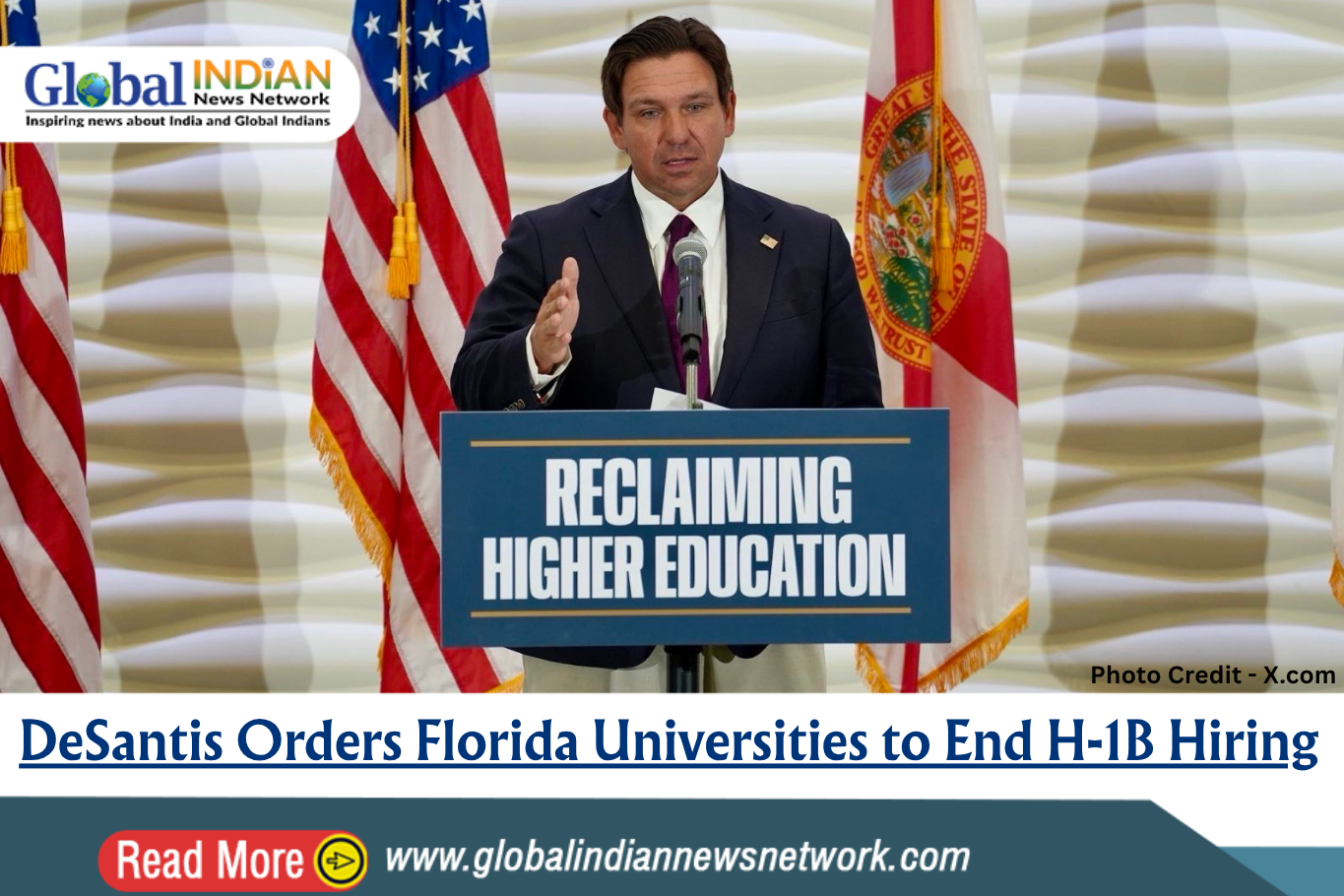
 Florida Governor Ron DeSantis on Wednesday directed the state’s public universities to “pull the plug” on hiring employees through H-1B visas, a move that could end the employment of hundreds of international faculty and researchers across Florida’s higher education system.
DeSantis made the remarks during a speech at the University of South Florida, criticizing the H-1B program as a system that allows universities and tech firms to hire cheaper foreign labor instead of Americans. He called the visa holders “indentured servants,” urging universities to prioritize Florida residents and U.S. citizens.
“Why do we need to bring someone from China to talk about public policy?” DeSantis asked, reading from a list of faculty hired on H-1B visas. He also mocked positions such as “assistant swim coach from Spain” and “clinical professor from supposed Palestine,” claiming these roles could be filled locally.
The University of Florida (UF), which employs nearly half of the state’s 2,000 H-1B workers, acknowledged the governor’s remarks but emphasized the program’s importance for recruiting global talent in science, medicine, and engineering. “Some bright lights from our international student pool become valuable faculty members,” said UF interim president Donald Landry.
Critics, however, denounced DeSantis’s comments as xenophobic and legally questionable. Robert Cassanello, president of the United Faculty of Florida, said, “You can’t discriminate based on foreign birth. This is a nativist and anti-immigrant diatribe with no legal standing.”
The directive comes as several Republican-led states push beyond federal immigration limits, echoing Trump-era policies. Trump recently proposed a $100,000 application fee for H-1B petitions, which has already drawn lawsuits and opposition from higher education groups.
Sarah Spreitzer, vice president at the American Council on Education, warned the move could “limit universities’ ability to hire the best researchers” and damage the state’s academic competitiveness.
The Florida Board of Governors, which oversees the state’s public universities, has yet to clarify how or if it will implement DeSantis’s order. Fourteen of its seventeen members are appointed by the governor, making the outcome likely to align with his agenda.
If enforced, Florida would become the first U.S. state to outright ban H-1B hiring in public universities, deepening the divide between higher education leaders and conservative state governments.