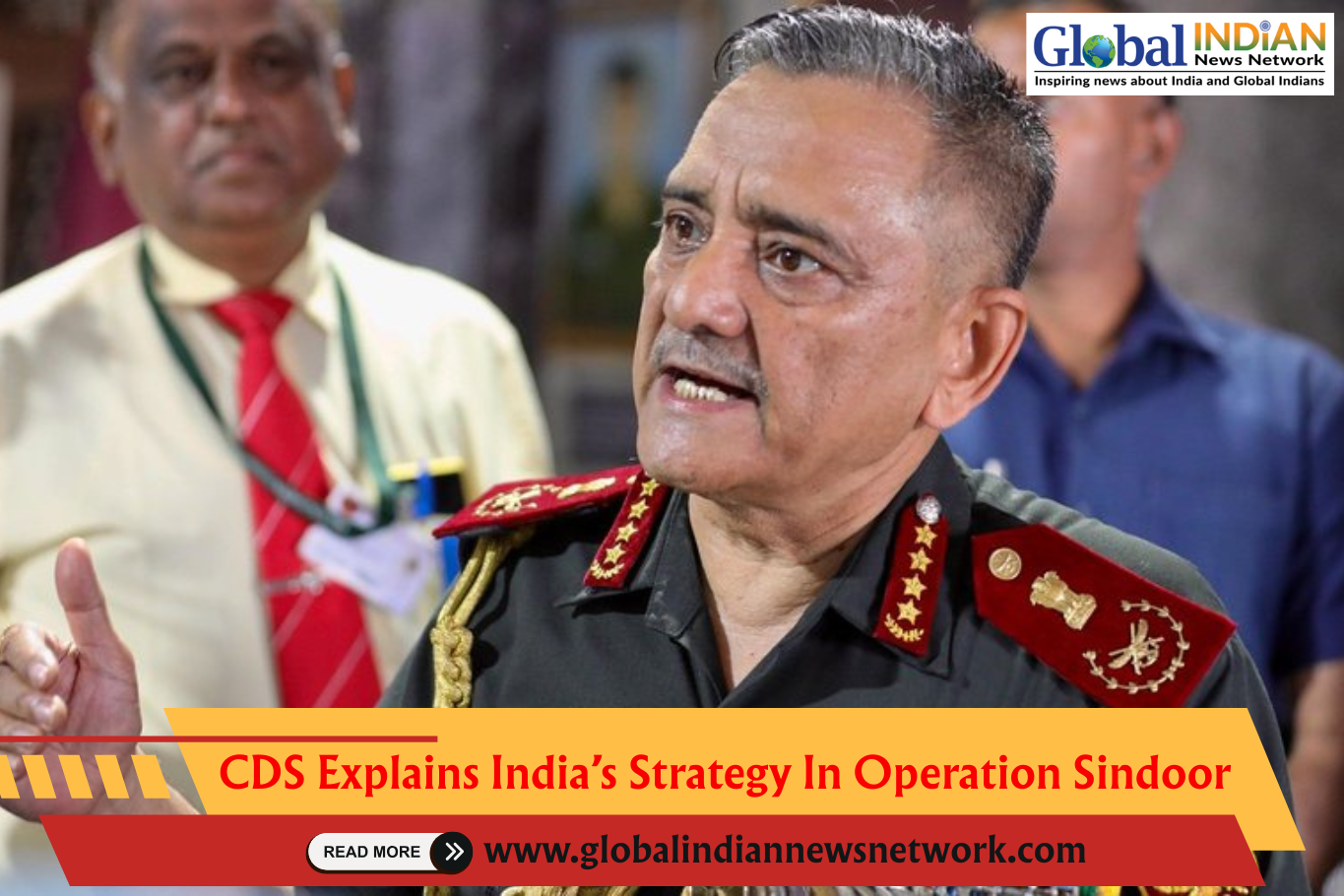
 Chief of Defence Staff (CDS) General Anil Chauhan has shed light on India’s military strategy during Operation Sindoor, stressing why the armed forces went beyond drones and loitering munitions. He explained that precision strikes against Pakistan-backed terrorists demanded the use of air power to meet both military and political goals.
Speaking at an event in Gorakhpur, Chauhan said India already possessed strong precision strike capabilities, demonstrated in earlier responses to the Uri and Pulwama terror attacks. In those instances, Indian forces had successfully carried out cross-border operations, including the 2016 land-based surgical strikes and the 2019 Balakot airstrikes in Pakistan’s Khyber Pakhtunkhwa region. These operations, he noted, gave India vital experience in long-range precision weapons and post-strike assessments, while Pakistan focused largely on strengthening its air defense.
According to Chauhan, after the Pahalgam terror attack in Jammu and Kashmir, India’s leadership held extensive deliberations. The consensus was that simply deploying drones or loitering munitions would not deliver the desired political message. Destroying terror camps in Bahawalpur and Muridke, considered major hubs of anti-India militancy, required full-scale air power to make an unmistakable statement of zero tolerance against terrorism.
He emphasized that the political leadership issued a “clear direction” — terrorist bases had to be eliminated, but retaliation would only follow if India was directly attacked. During Operation Sindoor, the armed forces were granted complete operational freedom, including planning missions and selecting strategic targets. This autonomy, Chauhan highlighted, allowed the military to execute the strikes with precision and confidence.
On May 7, India launched retaliatory strikes after the Pakistan-backed attack in Pahalgam. The operation successfully destroyed multiple terror infrastructures in Pakistan-occupied Jammu and Kashmir (POJK) and deep inside Pakistan. Camps in Bahawalpur and Muridke, long identified as strongholds of extremist networks, were among the key targets neutralized.
Chauhan’s remarks underline India’s evolving counter-terrorism doctrine, where precision air power plays a central role. By balancing military capabilities with political intent, India demonstrated both strategic restraint and operational strength. The decision to rely on airstrikes over drones highlighted New Delhi’s resolve to deliver decisive blows against cross-border terrorism while reinforcing its long-standing position of zero tolerance for such acts.