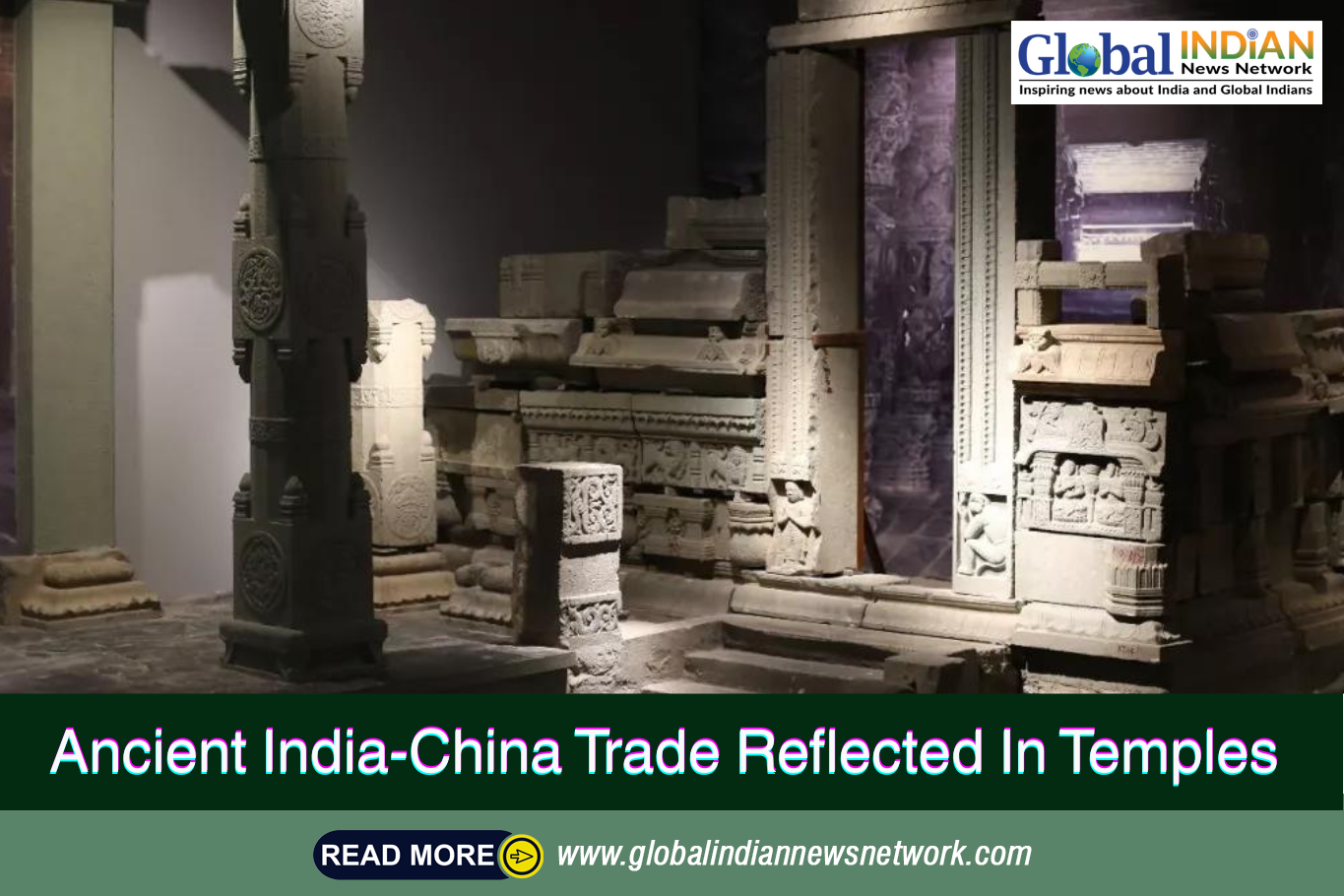
In Quanzhou, a coastal city in China’s Fujian province, stands a Buddhist temple uniquely adorned with Hindu imagery, illustrating the deep maritime connections between India and China that date back centuries. This temple, featuring lions—animals native to neither South India nor China—highlights how cultural symbols traveled with trade. The lion became a shared emblem of royalty across India and China and influenced place names like Sinhala (Sri Lanka) and Singapore, meaning “city of lions.”
According to local legend, the temple was established when a merchant asked a landowner for permission to build a Buddhist shrine. The landowner, hesitant to give up his garden, agreed only if his mulberry trees bloomed with white lotus flowers, a miraculous event that supposedly occurred. Following this, the land was granted, and the temple emerged as a melting pot for different Buddhist and Hindu sects, sponsored by monks and merchants alike.
Even today, visitors can see Shiva in Linga form, worshipped by an elephant, and another depiction of Shiva with matted locks. An image of Narasimha in his rare South Indian form, known as Purushavrigha (Vyaghrapada)—a tiger-footed devotee—is also present. Local worshippers believe an image of Parvati with a demon at her feet represents Guan Yin, the compassionate Chinese bodhisattva. A nearby pillar, resembling a Shiva Linga, is considered by locals to be a symbolic bamboo shoot.
Initially, India and China were linked through overland routes via Central Asia, but maritime trade using monsoon winds gained prominence by 200 AD during China’s Han dynasty. Buddhist ideas and relics flowed into China during the Tang dynasty (600-900 AD), but opposition arose from Confucian scholars who disapproved of practices like relic worship. By the Song period (1000-1300 AD), China had become a hub for Buddhist pilgrimage as Indian Buddhism waned.
With Mongol threats making land travel perilous, sea routes became crucial. The Chola dynasty of Tamilakam strengthened ties with China through Indonesian channels. Merchant ships journeyed from Arabia to India in about 30 days, then to the Malacca Straits, and finally to China—completing the route in roughly 100 days.
This vast trade network saw Arabian horses, Indian cotton, Southeast Asian gold, Chinese silk, silver, tea, and porcelain exchanged across nations. The trade was largely dominated by India’s merchant guild known as “The 500,” whose wealth supported the Rashtrakuta dynasty in Karnataka and funded temple construction both in India and coastal China.