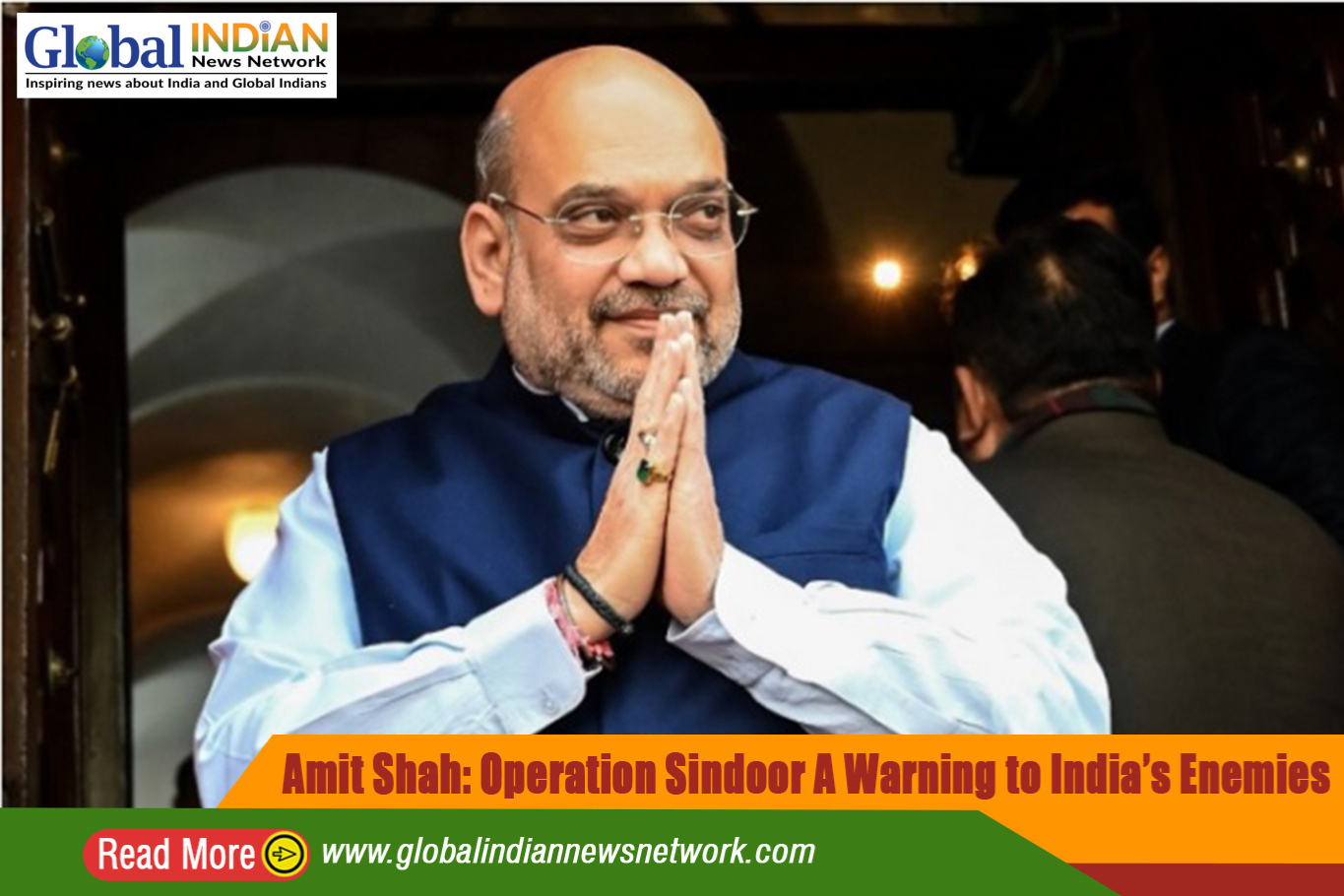
 Union Home Minister Amit Shah on Sunday emphasized that Prime Minister Narendra Modi’s leadership has made it clear to the global community—India will not tolerate violence against its citizens. Referring to the recent anti-terror Operation Sindoor, Shah declared it a stern warning to those who shed innocent Indian blood, showcasing the country’s resolve through precise and effective strikes by its armed forces.
Speaking at a major event where 60,244 new police constables were given appointment letters in Uttar Pradesh—including 12,048 women—Shah lauded the recruitment drive’s transparency and commitment to merit. He contrasted the current government’s response to terror with the previous Congress era, which he described as passive in the face of repeated attacks.
Highlighting the progress made under the Modi administration, Shah celebrated the emergence of a stronger India, or Sashakt Bharat. He pointed to developments in space exploration, education, aviation, urban transportation through metro systems, and skill-building via digital platforms. Internal security, he noted, has also drastically improved, reducing Maoist presence from 11 districts to just three.
Shah boldly predicted the complete elimination of Maoist insurgency in India by March 21, 2026. He further cited India’s economic rise, predicting that by 2027, India would become the world’s third-largest economy—up from the 11th position when Modi first took office.
The Home Minister also outlined the government’s efforts in poverty reduction and social equity. Over 250 million people have moved out of poverty in the past 11 years, and millions have benefitted from welfare schemes including free cooking gas, food rations, medical treatment up to $6,000, and annual farmer payouts of $72.
Targeting the former Samajwadi Party government in Uttar Pradesh, Shah criticized their governance, especially in law and order and police recruitment. He praised the Yogi Adityanath-led BJP government for restoring discipline and dismantling criminal dominance. The recent mass hiring in UP Police, he emphasized, occurred without corruption or favoritism—unlike in the past where selections were allegedly influenced by caste and bribes.
Shah concluded by celebrating the appointment of over 12,000 women as a step towards inclusive policing, cementing the government’s commitment to fairness and national strength.