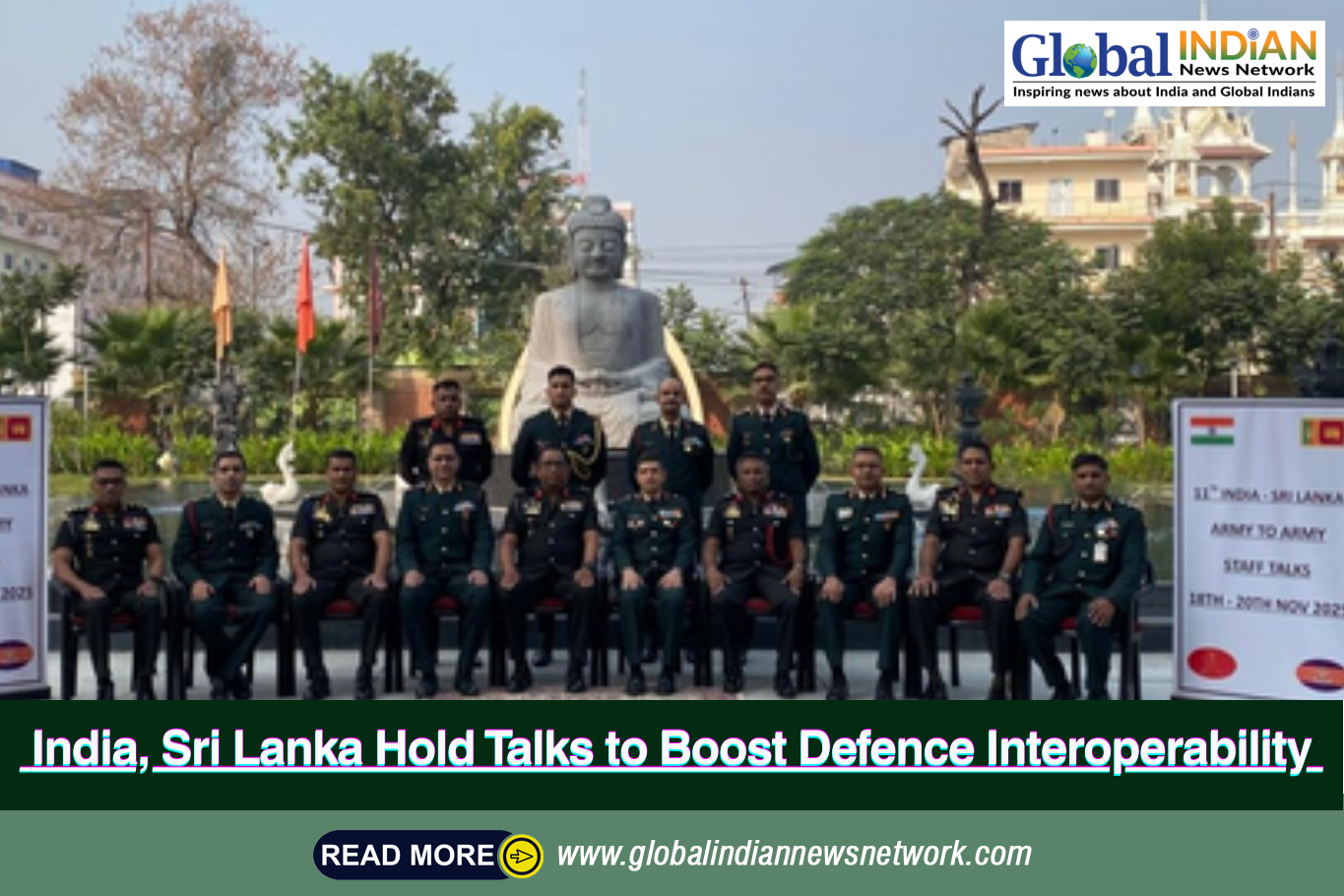
 India and Sri Lanka have taken another step toward strengthening their long-standing defense bond by conducting the 11th Army-to-Army Staff Talks (AAST) in Bodhgaya, Bihar. The discussions, held from November 18 to 20, 2025, centered on expanding cooperation, refining interoperability, and reinforcing their shared responsibility for maintaining peace and stability across the region.
According to a post by the Additional Directorate General of Public Information (ADGPI) on X, the Sri Lankan delegation consisted of six members and was led by Major General Ravi Pathiravithana, Director General General Staff. Both sides reaffirmed their commitment to a deeper military partnership and outlined new avenues of collaboration that align with their broader regional security goals. The talks emphasized the importance of coordinated efforts to address evolving security challenges in South Asia.
Alongside these discussions, the two armies are also engaged in the 11th edition of the annual Exercise Mitra Shakti, currently underway in Belagavi, Karnataka. Running from November 10 to 23, the exercise highlights the countries’ collective intent to strengthen operational preparedness and enhance mutual trust. The Indian contingent includes 170 soldiers, primarily from the Rajput Regiment, while Sri Lanka is represented by 135 troops mainly from the Gajaba Regiment. The drills also feature 20 personnel from the Indian Air Force and 10 from the Sri Lankan Air Force.
The ADGPI noted that Mitra Shakti 2025 is progressing at full pace, with both armies conducting joint maneuvers across urban and semi-urban landscapes. These coordinated actions aim to refine tactical synergy, improve battlefield communication, and enhance the overall effectiveness of combined missions. The training incorporates the use of drones, counter-UAS systems, helicopter support, and mock helipad security tasks. Casualty evacuation procedures during counterterror operations are also being practiced to build real-time readiness.
A major focus of the exercise is to develop stronger interoperability for peacekeeping missions under the United Nations framework. By sharing combat techniques, operational strategies, and best practices, the troops gain insights that contribute to smoother joint responses during high-risk situations. Activities such as raids, search-and-destroy drills, heliborne missions, Army Martial Arts Routine (AMAR), reflex shooting, and Yoga form part of the extensive training module.
The Ministry of Defence emphasized that the goal of the exercise is to fine-tune coordinated responses during sub-conventional operations. The joint effort aims to strengthen defense cooperation, enhance mutual understanding, and cement the already close ties between the two neighboring nations.