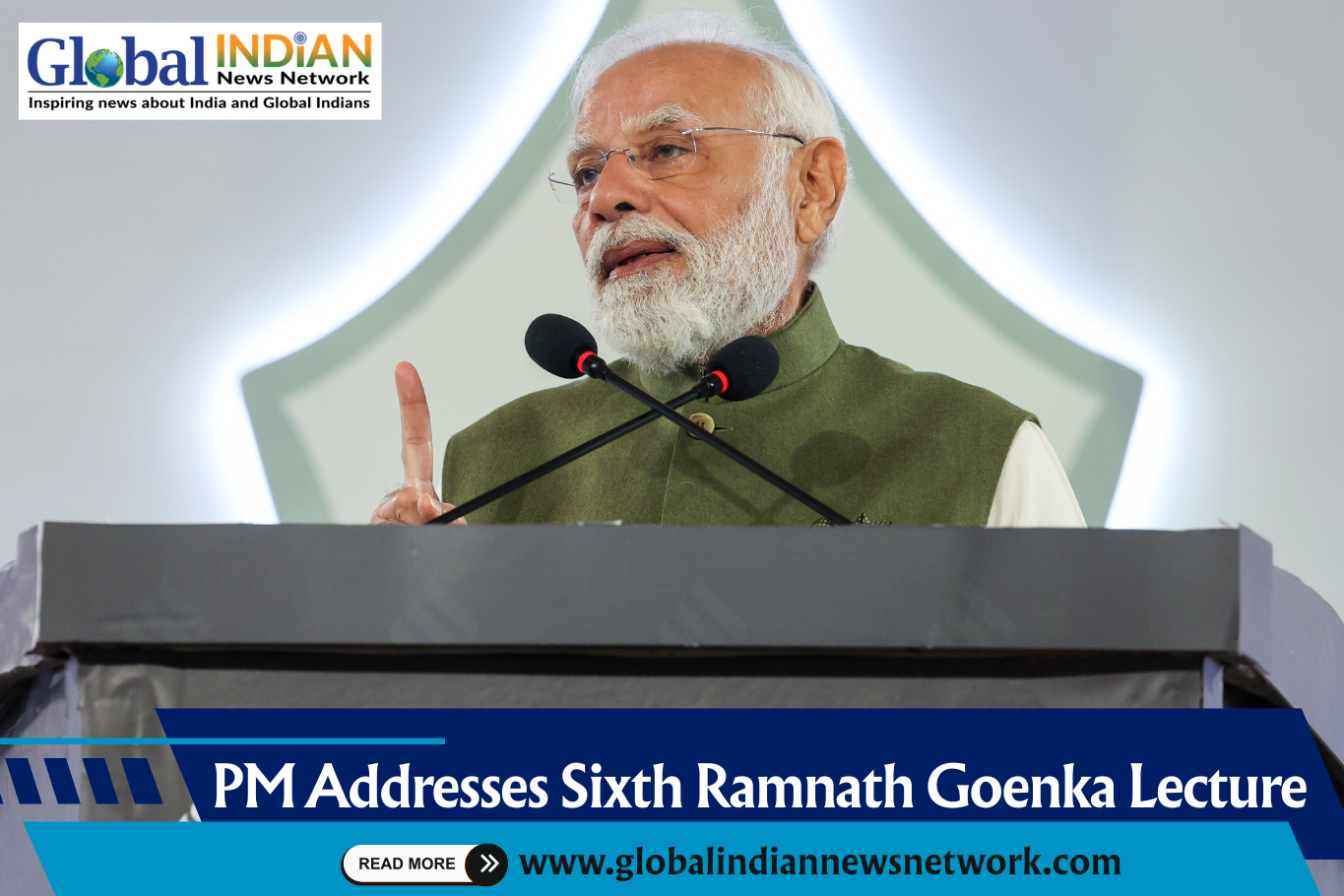
Prime Minister Narendra Modi delivered the sixth Ramnath Goenka Lecture in New Delhi, using the platform to reflect on India’s democratic evolution, economic resilience, and its renewed push toward becoming a fully developed nation. He paid tribute to Ramnath Goenka, calling him a visionary who transformed the Indian Express Group into an institution rooted in public interest, national duty, and fearless journalism.
Modi emphasized that Goenka’s commitment to truth and nation-building continues to inspire India’s journey in the 21st century. He highlighted Goenka’s unwaveringdherence to duty, noting how he supported various political movements based solely on national interest rather than ideology.
The Prime Minister described today’s India as “impatient in the best sense”—driven to become self-reliant, future-ready, and economically stronger. He recounted recent global disruptions—from the pandemic to geopolitical crises—and noted that despite these shocks, India sustained strong growth. He said the world now views India not only as a rising market but as a model offering stability and hope.
Modi underlined that democracy’s strength is reflected in public participation, pointing to Bihar’s record voter turnout, particularly among women. According to him, the election results reaffirmed that citizens trust leaders who prioritize development over political rivalry.
He urged state governments to compete in improving investment conditions, ease of doing business, and development benchmarks. Modi added that governance anchored in empathy—not campaign strategy—drives electoral success.
The Prime Minister also stressed that inclusive development defines true social justice. He cited national achievements such as millions of new homes, bank accounts, and social security coverage, saying these initiatives have helped millions rise out of poverty in the last decade.
Highlighting the transformation of formerly neglected areas, he pointed to the Aspirational Districts Programme, which repositioned more than 100 backward districts as engines of progress. He noted Bastar’s development journey as an example of how focused governance can reshape long-standing challenges.
Modi also addressed the cultural consequences of colonial-era policies, urging the nation to break free from the “mindset of dependence” imposed nearly two centuries ago. He said the National Education Policy’s emphasis on Indian languages reflects this larger effort to rebuild cultural confidence.
He concluded by acknowledging the Indian Express Group’s continued role in documenting India’s growth story and urged the nation to embrace the coming decade as a turning point toward a fully developed future.