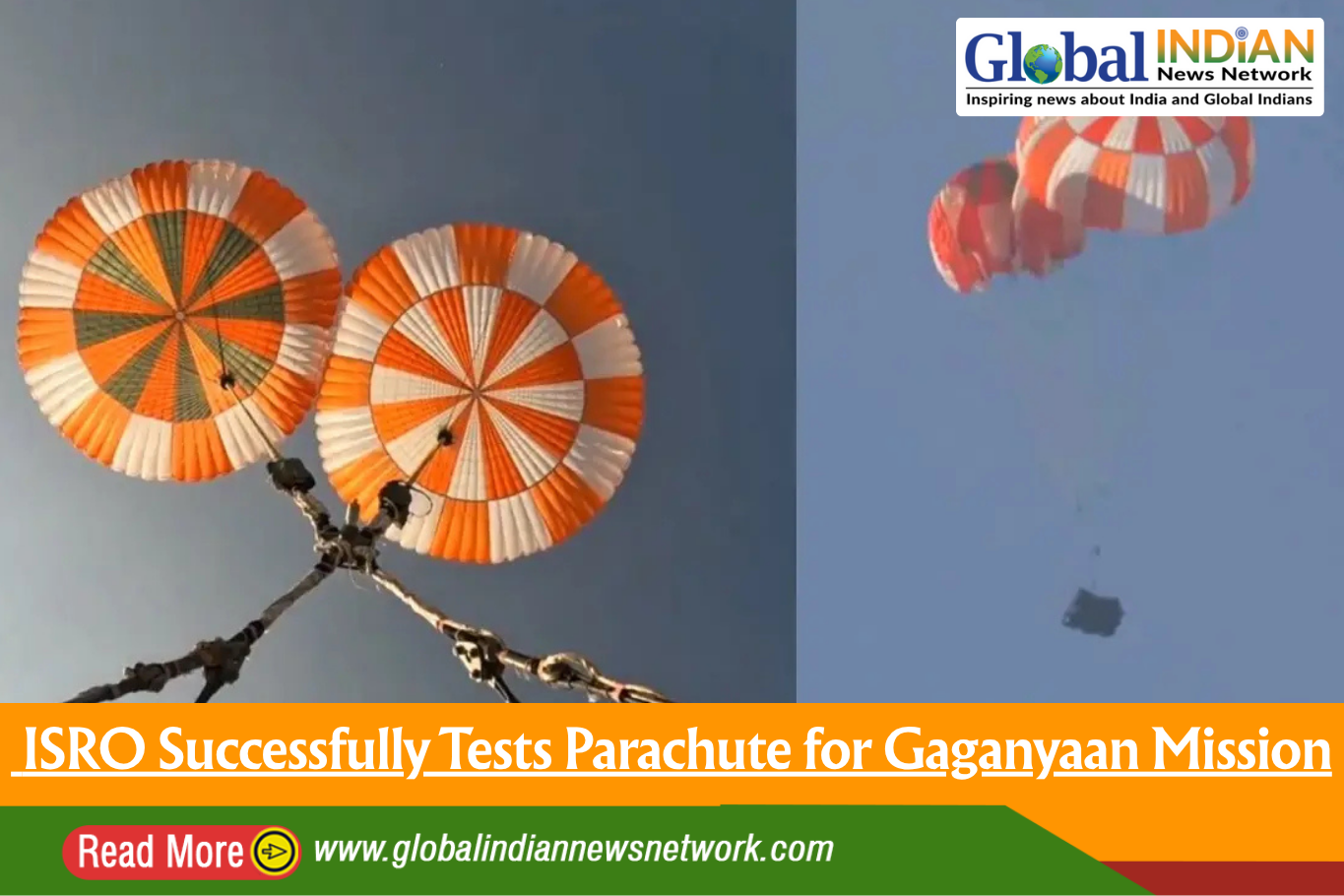
 The Indian Space Research Organisation (ISRO) has successfully carried out a crucial trial of the main parachutes designed for the Gaganyaan mission—India’s first human spaceflight program. The test took place at the Babina Field Firing Range in Jhansi, Uttar Pradesh, on November 3, marking a critical milestone in validating the safety systems of the crew module.
The trial is part of a continuing series of Integrated Main Parachute Airdrop Tests (IMAT), which are essential for qualifying the parachute system for crewed missions. According to ISRO, the Gaganyaan crew module features a complex network of ten parachutes, divided into four distinct types. The sequence starts with two apex cover separation parachutes that detach the protective casing, followed by two drogue parachutes responsible for stabilizing and decelerating the module during re-entry.
Once the drogue parachutes deploy, three pilot parachutes are released to extract the three main parachutes, ensuring a gradual and secure descent. The design includes built-in redundancy—only two of the three main parachutes are required to safely land the crew module, ensuring reliability even in unforeseen conditions.
The test also examined the process of “reefed inflation,” a two-stage deployment method where each parachute partially opens first and then fully inflates after a timed delay, achieved using a pyrotechnic mechanism. This specific trial focused on one of the most challenging conditions—an intentional delay in the disreefing phase between two main parachutes. ISRO confirmed that the system demonstrated exceptional performance, validating its structural strength and load-bearing capacity even under asymmetric conditions.
To simulate real-world scenarios, a mass equivalent to the actual crew module was dropped from an altitude of roughly 2.5 kilometers using an Indian Air Force IL-76 aircraft. The parachute deployment sequence executed perfectly, ensuring smooth descent and landing as planned.
This success represents a major leap forward for India’s ambitious human spaceflight mission. The test involved coordinated efforts from ISRO’s Vikram Sarabhai Space Centre (VSSC), the Aerial Delivery Research and Development Establishment (ADRDE) under DRDO, the Indian Air Force, and the Indian Army—demonstrating India’s collective expertise in aerospace engineering and safety validation.
With this achievement, ISRO moves one step closer to launching astronauts into space, reaffirming India’s growing strength in advanced space technology.