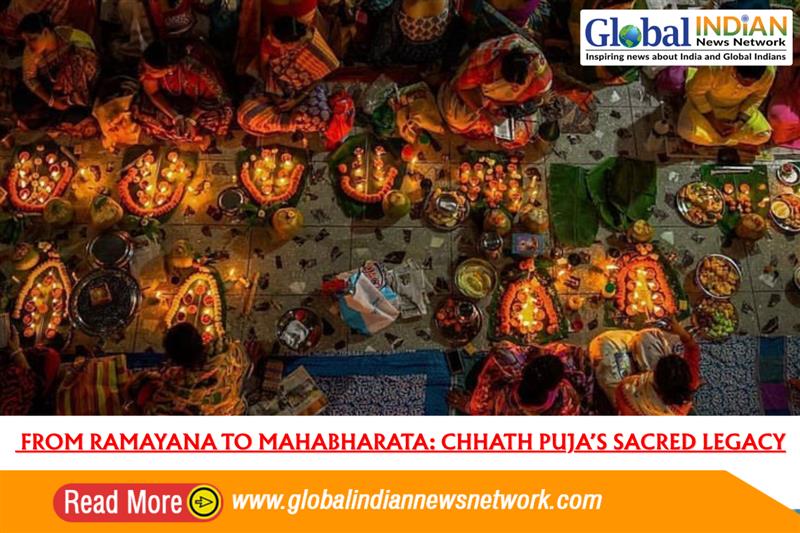
 Chhath Puja, one of the most spiritually profound festivals in India, is devoted to honoring the Sun God, Surya, and his consort Usha. Deeply rooted in devotion and purity, the festival is especially celebrated across Bihar, Jharkhand, eastern Uttar Pradesh, and parts of Nepal. Beyond its grand rituals and modern-day practices, Chhath Puja’s essence is anchored in ancient Hindu scriptures, tracing its heritage back to revered epics such as the Ramayana and the Mahabharata. These timeless texts depict early versions of the rituals that evolved into the festival as it is observed today.
According to the Ramayana, after Lord Rama and Sita returned to Ayodhya following their exile, the city celebrated Diwali. On the sixth day after the celebrations, Sita observed a day-long fast and offered prayers to the Sun God, seeking his blessings for fertility and motherhood. Her devotion was believed to have led to the birth of her twin sons, Lava and Kusha. The Sita Charan Mandir in Munger, Bihar, is still regarded as the sacred place where she performed this ritual—serving as a reminder of the festival’s ancient beginnings and its association with divine blessings.
In the Mahabharata, the origins of Chhath Puja are equally significant. After escaping from the burning palace of Lakshagriha, Kunti—the mother of the Pandavas—performed a ritual to invoke Surya’s protection and blessings for her sons. Her act of devotion represents one of the earliest forms of Sun worship linked to Chhath Puja. Additionally, Karna, born to Kunti and Surya, is said to have offered daily prayers to the Sun, reinforcing the connection between Surya and strength, prosperity, and endurance.
Another powerful legend ties Draupadi, the wife of the Pandavas, to the festival. It is believed that she performed Chhath Puja in Nagdi village near Ranchi to seek divine intervention for her husbands’ victory in the Kurukshetra War. This episode portrays the ritual as a source of courage, success, and prosperity.
The Brahma Vaivarta Purana further mentions the worship of Chhathi Maiya and attributes the festival’s early practice to Varanasi under the Gahadavala dynasty. Over centuries, the observance has spread and adapted, symbolizing the continuity of India’s cultural and spiritual heritage. Today, Chhath Puja stands as a living tradition—bridging the divine and the human through devotion to the life-giving Sun.