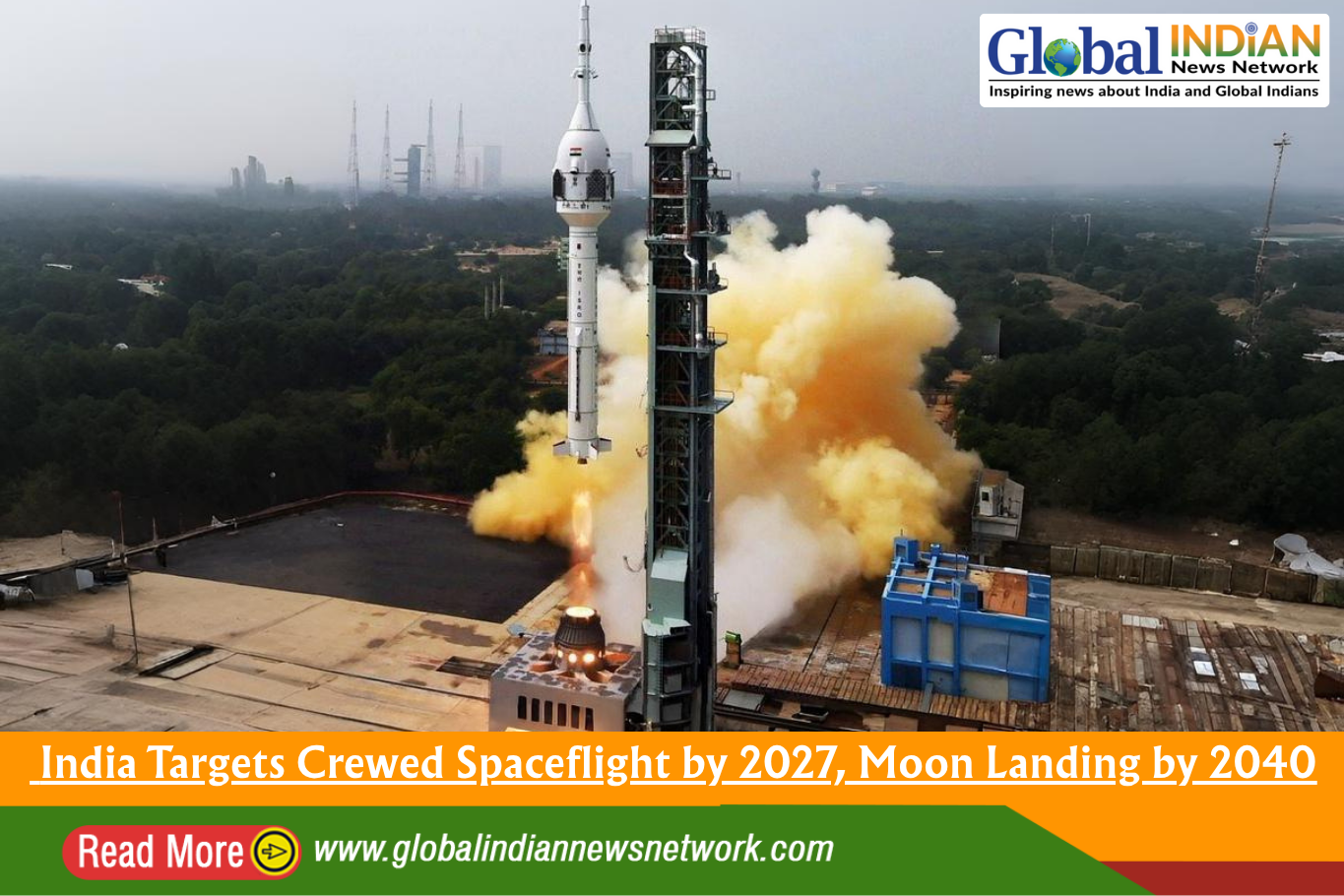
 India is preparing to take its space ambitions to unprecedented heights, with plans to send its first astronauts into space by 2027 and land citizens on the Moon by 2040. ISRO Chairman V. Narayanan announced that the country’s maiden human spaceflight mission, Gaganyaan, is progressing as scheduled, marking a historic milestone for the nation’s space program.
Narayanan revealed that before the main crewed mission, three uncrewed flights will be launched, beginning with one featuring a half-humanoid robot named Vyommitra in December 2025. Two additional uncrewed tests are planned for 2026, ensuring safety and precision ahead of the 2027 mission. He also confirmed that India’s own space station, the Bharatiya Antriksh Station (BAS), is on track for completion by 2035, with the first modules expected to be deployed by 2027.
Under the roadmap set by Prime Minister Narendra Modi, India’s space exploration will include a Venus Orbiter Mission, future lunar expeditions (Chandrayaan-4 and Chandrayaan-5), a new Mars mission, and AXOM, a high-priority space observatory. The Aditya-L1 mission has already generated more than 15 terabits of solar data, offering vital insights into solar activity and space weather.
Narayanan emphasized that India’s space sector is undergoing major transformation through the Indian National Space Promotion and Authorization Centre (IN-SPACe), which integrates over 300 startups into the national space ecosystem. This inclusion of private innovation is expected to boost advancements in satellite manufacturing, communication systems, and real-time monitoring solutions across sectors such as agriculture, transport, and disaster management.
He highlighted that India has moved from launching small 35 kg payloads to envisioning missions capable of lifting 80,000 kg—an enormous leap in capacity and ambition. With artificial intelligence, robotics, and big data becoming integral to space missions, Narayanan stated that these technologies would shape the next era of exploration.
With these advancements, India has already achieved global milestones, including the first soft landing near the lunar south pole with Chandrayaan-3 and successful space docking via the SPADEX mission. As Narayanan concluded, these achievements reaffirm India’s position as one of the world’s leading space powers, driven by innovation, resilience, and a vision for interplanetary exploration.