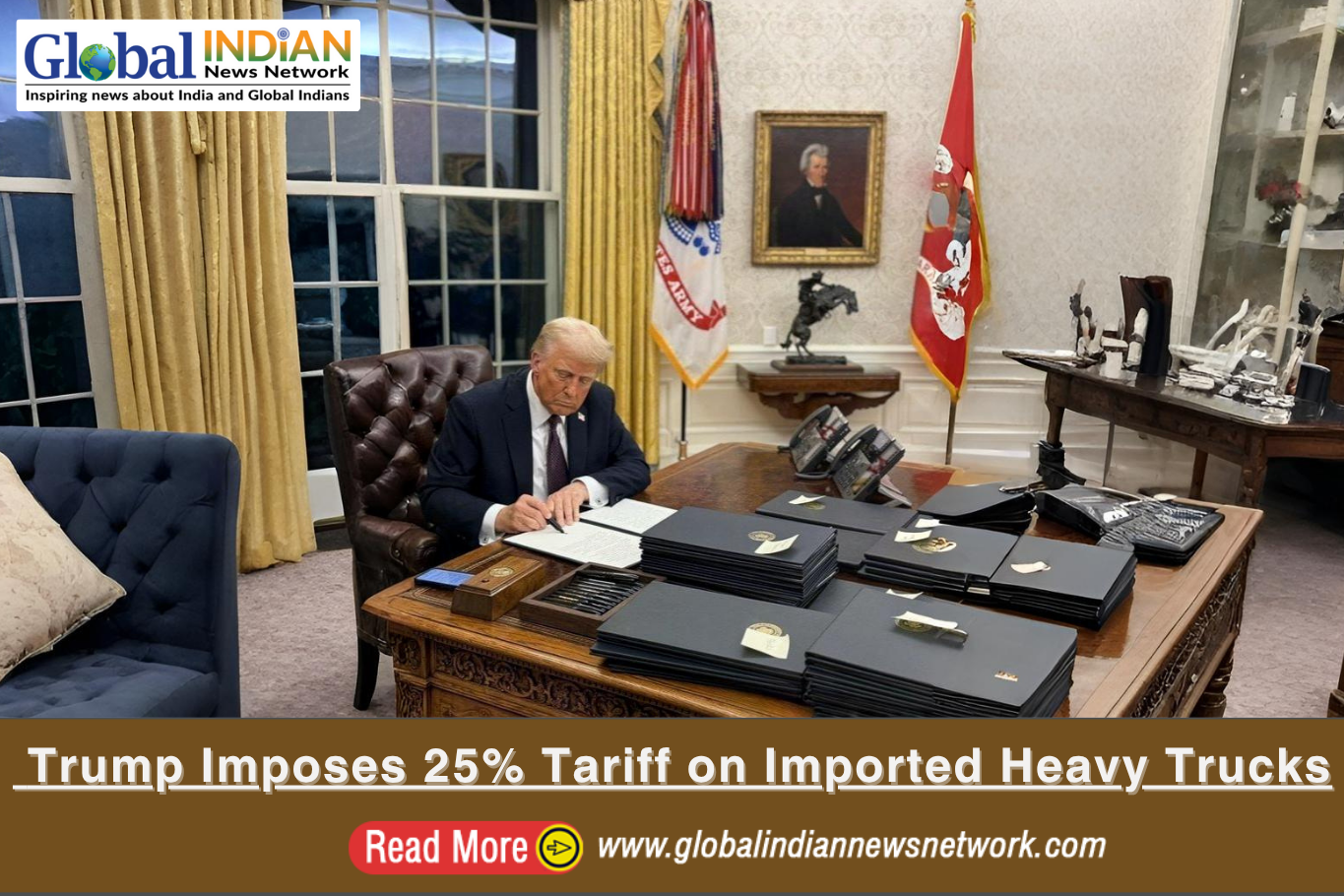
 US President Donald Trump announced on Monday that all medium- and heavy-duty trucks imported into the country will face a 25% tariff starting November 1, 2025. The move marks another escalation in his ongoing effort to shield American manufacturers from what he describes as “unfair foreign competition.”
Trump emphasized that the decision aligns with his broader trade protectionist agenda, which focuses on supporting domestic production and reducing dependence on overseas imports. “These tariffs are necessary to restore fairness and protect our workers,” he said during a White House briefing.
India, which has already been impacted by a series of US tariffs on goods like steel, aluminum, and electronics, remains largely unaffected by this latest policy since it does not export trucks to the American market. For now, the measure is expected to primarily target European automakers, several of whom are leading suppliers of commercial vehicles to the United States.
In a post on his social media platform, Trump declared, “Beginning November 1, 2025, all medium and heavy-duty trucks coming into the United States from other countries will be tariffed at the rate of 25%,” without offering additional clarification.
The White House had earlier indicated plans to introduce such tariffs on national security grounds as early as October. The policy is designed to favor domestic truck producers such as Peterbilt and Kenworth, owned by Paccar, and Freightliner, a Daimler Truck subsidiary.
Currently, the US imposes a 15% tariff on light-duty vehicles under existing trade agreements with Japan and the European Union. However, it remains uncertain how the new policy will interact with those agreements or whether exemptions will apply to specific manufacturers.
The 25% tariff is expected to have significant implications for America’s key trading partners — including Mexico, Canada, Japan, Germany, and Finland — which together represent the largest sources of truck imports. Mexico, in particular, could face serious disruptions. The country’s exports of medium- and heavy-duty trucks to the US have tripled since 2019, reaching around 340,000 units annually.
Under the United States-Mexico-Canada Agreement (USMCA), trucks can currently move duty-free if at least 64% of their value originates within North America. The new tariff threatens to upend this arrangement, potentially increasing costs for automakers like Stellantis, which builds Ram trucks and commercial vans in Mexico.
Meanwhile, Sweden’s Volvo Group has already invested $700 million in a new truck manufacturing plant in Monterrey, Mexico, set to open in 2026 — a move that may now face added challenges amid the shifting trade landscape.
Analysts warn that the policy could disrupt global supply chains, drive up costs for US consumers, and strain relationships with key allies, even as the Trump administration continues to push its “America First” trade strategy.