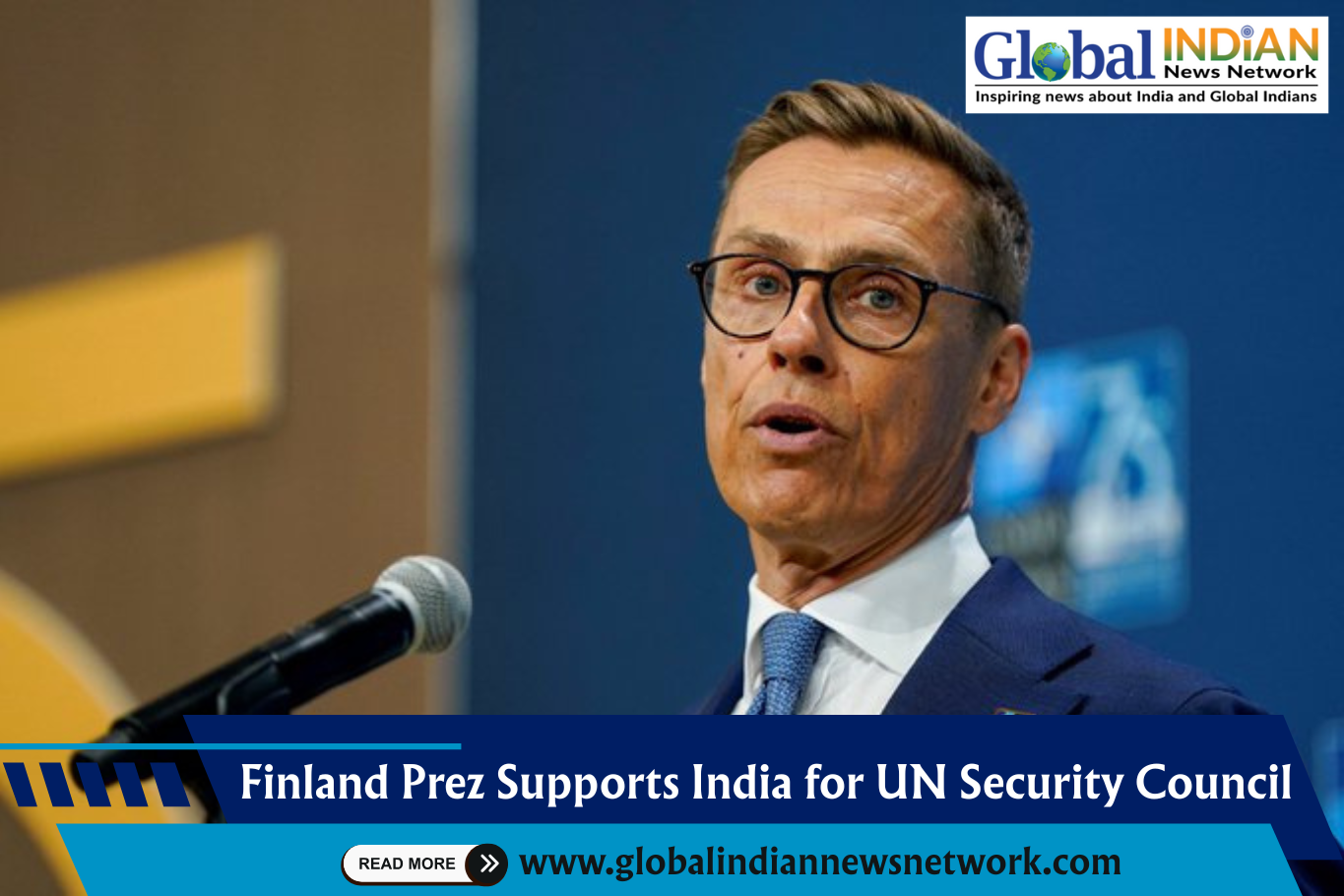
 Finland and India share strikingly similar perspectives on multipolarity, global governance, and the legitimacy of international institutions, reflecting the growing global consensus for multilateral reform. Finnish President Alexander Stubb, in his address to the 80th session of the United Nations General Assembly (UNGA), called for urgent reforms of global institutions, a message that strongly resonates with India’s long-standing demand for a permanent seat at the United Nations Security Council (UNSC).
President Stubb underscored the principles of multilateralism, legitimacy, and a rules-based international order, critiquing the outdated structure of the UN that still mirrors the realities of 1945. India welcomed this alignment, noting that the Finnish leader’s emphasis on balancing values, interests, and power echoes India’s diplomatic approach. Stubb’s assertion that “foreign policy is based on three pillars: values, interests, and power” mirrors the framework India has applied in climate negotiations, Indo-Pacific partnerships, and trade diplomacy.
India has long navigated the delicate balance between normative commitments—such as democracy, sovereignty, and non-alignment—and its developmental and security interests, while recognizing the power asymmetries among major nations. Stubb’s call for enduring values to guide foreign policy aligns closely with this philosophy, reinforcing India’s advocacy for reforms in multilateral institutions.
The Finnish President also highlighted the rise of the Global South and the shifting power dynamics toward the South and East. India has consistently positioned itself as a voice for developing nations, emphasizing equitable representation, bridging the developmental gap, and advocating for a more inclusive global decision-making framework.
Additionally, Stubb’s reaffirmation of sovereignty, territorial integrity, and the prohibition of force corresponds with India’s core diplomatic principles. India consistently invokes these norms in addressing cross-border terrorism, border disputes, and opposing unilateral interventions, particularly amid geopolitical crises from Ukraine to West Asia.
Analysts note that Finland’s stance signals a rare convergence between European and Indian perspectives, highlighting that multipolarity without legitimacy is unstable and reforms without legitimacy appear hollow. India can leverage these shared views to strengthen its case for global governance reforms while emphasizing the interests and perspectives of the Global South, bolstering its advocacy on the international stage.