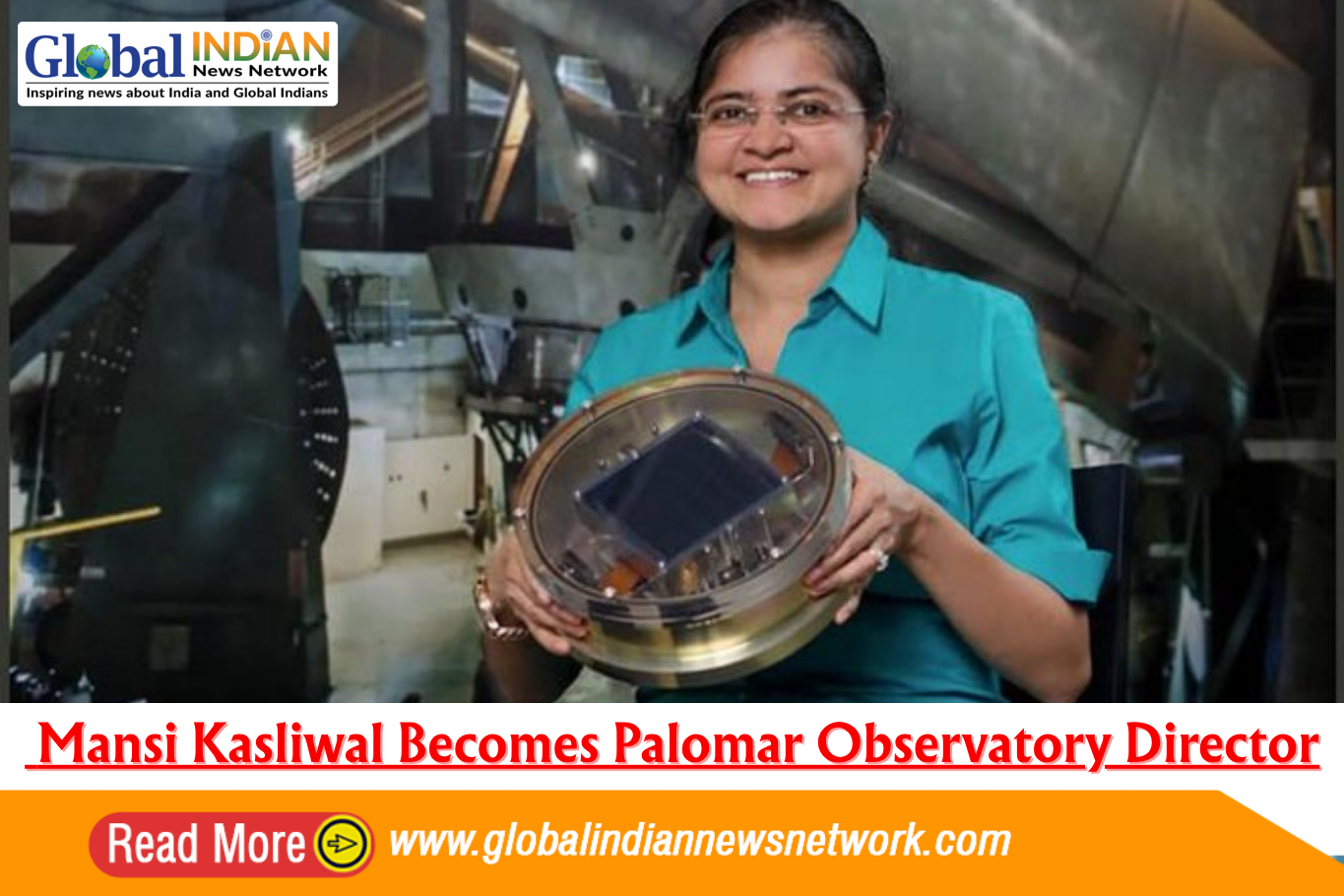
 Mansi Manoj Kasliwal’s journey from Indore to the forefront of astrophysics began at age 15, when she moved to the United States to attend boarding school. Encouraged by a mentor to explore science, she quickly found herself involved with NASA’s Spitzer Space Telescope during her undergraduate studies at Cornell University. Witnessing the telescope’s first data arrive sparked a lifelong passion for studying the cosmos.
This early inspiration has now led Kasliwal to a historic appointment: she has been named the director of Caltech’s Palomar Observatory, becoming the first woman to lead the facility in its 75-year history. Known for her work in time-domain and multi-messenger astrophysics, Kasliwal studies fleeting cosmic phenomena such as supernovae and neutron star mergers. She has contributed to the development of several advanced observational tools at Palomar, including the Zwicky Transient Facility (ZTF), Palomar Gattini-IR, WINTER, and the newly launched Next Generation Palomar Spectrograph (NGPS).
In addition to her work with instruments, Kasliwal has fostered global collaboration in astronomy. She directs the Global Relay of Observatories Watching Transients Happen (GROWTH), an international initiative funded by the National Science Foundation that ensures continuous monitoring of transient events across the globe. “We just go around the globe and keep passing the baton so that the sky remains dark,” she explained, summarizing the project’s mission.
Kasliwal’s connection to Caltech runs deep. After earning her Ph.D. there in 2011, she helped design the Palomar Transient Factory, a program that allowed systematic searches for stellar transients on an unprecedented scale. Her career boasts more than 440 peer-reviewed publications, an h-index of 100, and leadership roles in key gravitational-wave follow-up campaigns. Recognized for her significant contributions to astrophysics, she received the Breakthrough Prize in Physics in 2022.
With her appointment, Kasliwal not only breaks a historic gender barrier but also continues to advance the field of observational astronomy, guiding Palomar Observatory into a new era of exploration and discovery.