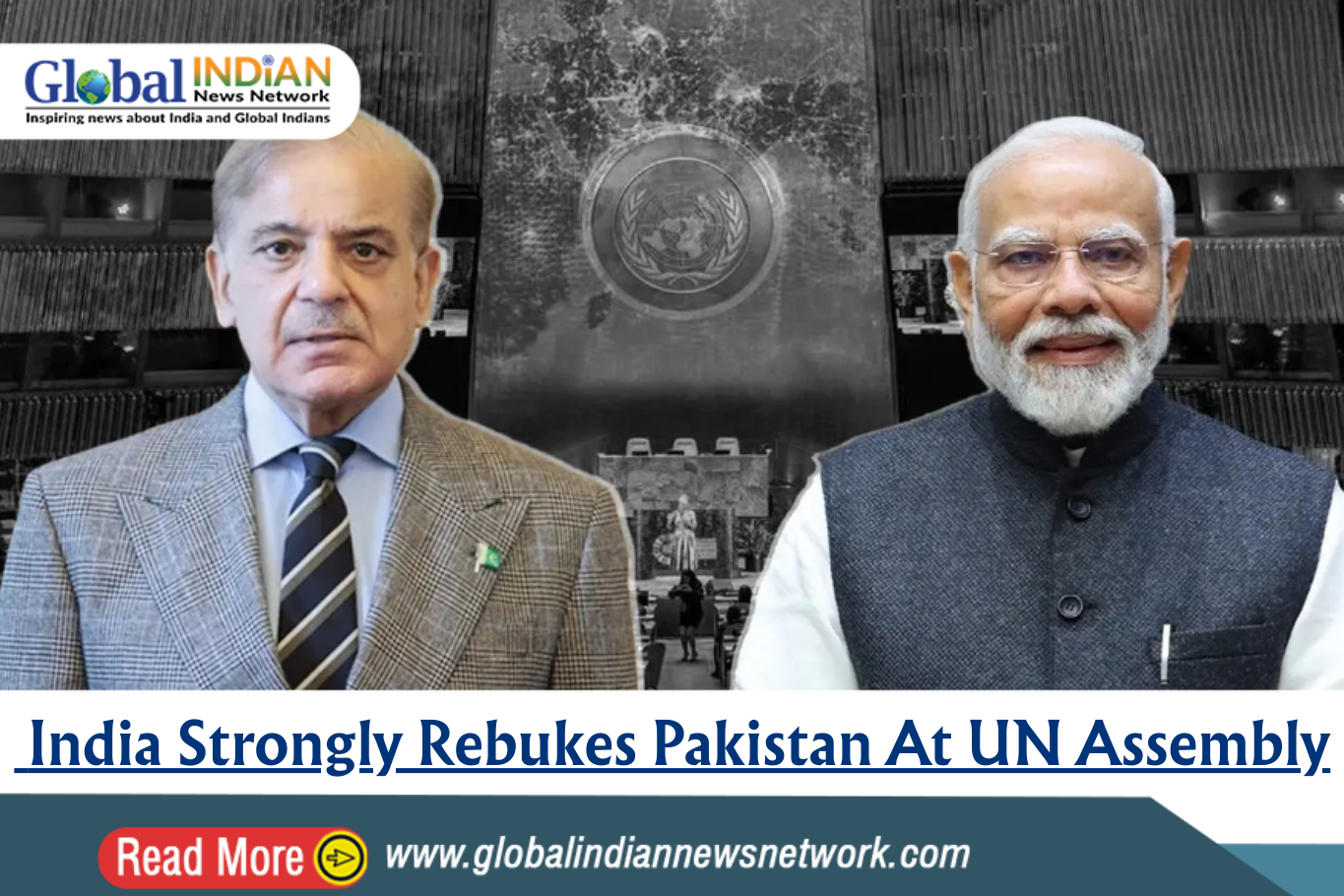
 At the United Nations General Assembly, India delivered a strong response to Pakistan’s narrative, with diplomat Petal Gahlot sharply criticizing Islamabad’s record on terrorism. Her remarks came shortly after Pakistani Prime Minister Shehbaz Sharif accused India of aggression while portraying himself as a proponent of peace.
Gahlot highlighted Pakistan’s decade-long sheltering of Osama bin Laden, pointing out that Islamabad had long operated terrorist camps while claiming to be an ally in the global fight against terror. She stressed that recent acknowledgments by Pakistani officials of running such camps were unsurprising, emphasizing that this duplicity persisted even at the level of the prime minister.
Referencing India’s Operation Sindoor, which targeted terror hubs in Bahawalpur and Muridke, Gahlot presented evidence in the form of images showing slain terrorists at these complexes. She noted that senior Pakistani military and civilian officials had publicly glorified these extremists, underscoring Pakistan’s ongoing support for terrorism.
Addressing Sharif’s account of the May conflict, Gahlot dismissed it as “bizarre.” She explained that until May 9, Pakistan was threatening further attacks on India, but by May 10, its military requested a cessation of hostilities following extensive damage to several Pakistani air bases. She asserted that India had acted in self-defense after a terrorist attack on civilians and reiterated that the pathway to genuine peace was clear: Pakistan must immediately close all terrorist camps and hand over the fugitives wanted by India.
Gahlot also criticized Pakistan for preaching on faith while internally fostering hatred and intolerance, urging Islamabad to “look in the mirror.” She warned that India would make no distinction between terrorists and their sponsors, rejecting nuclear blackmail and emphasizing zero tolerance for terrorism.
Sharif, in his earlier address, presented a counter-narrative, portraying Pakistan as a victim of cross-border militancy and claiming success in defending against Indian actions, including purportedly downing Indian jets during Operation Sindhur. He praised former US President Donald Trump for brokering a ceasefire, implicitly supporting third-party mediation—a position India firmly rejects.
Despite Sharif’s calls for “composite dialogue,” India maintained its stance that all disputes must be resolved bilaterally. Gahlot’s rebuttal underscored India’s unwavering position: terror camps must be shut down, wanted terrorists handed over, and there must be no tolerance for the duplicity fueling cross-border militancy.