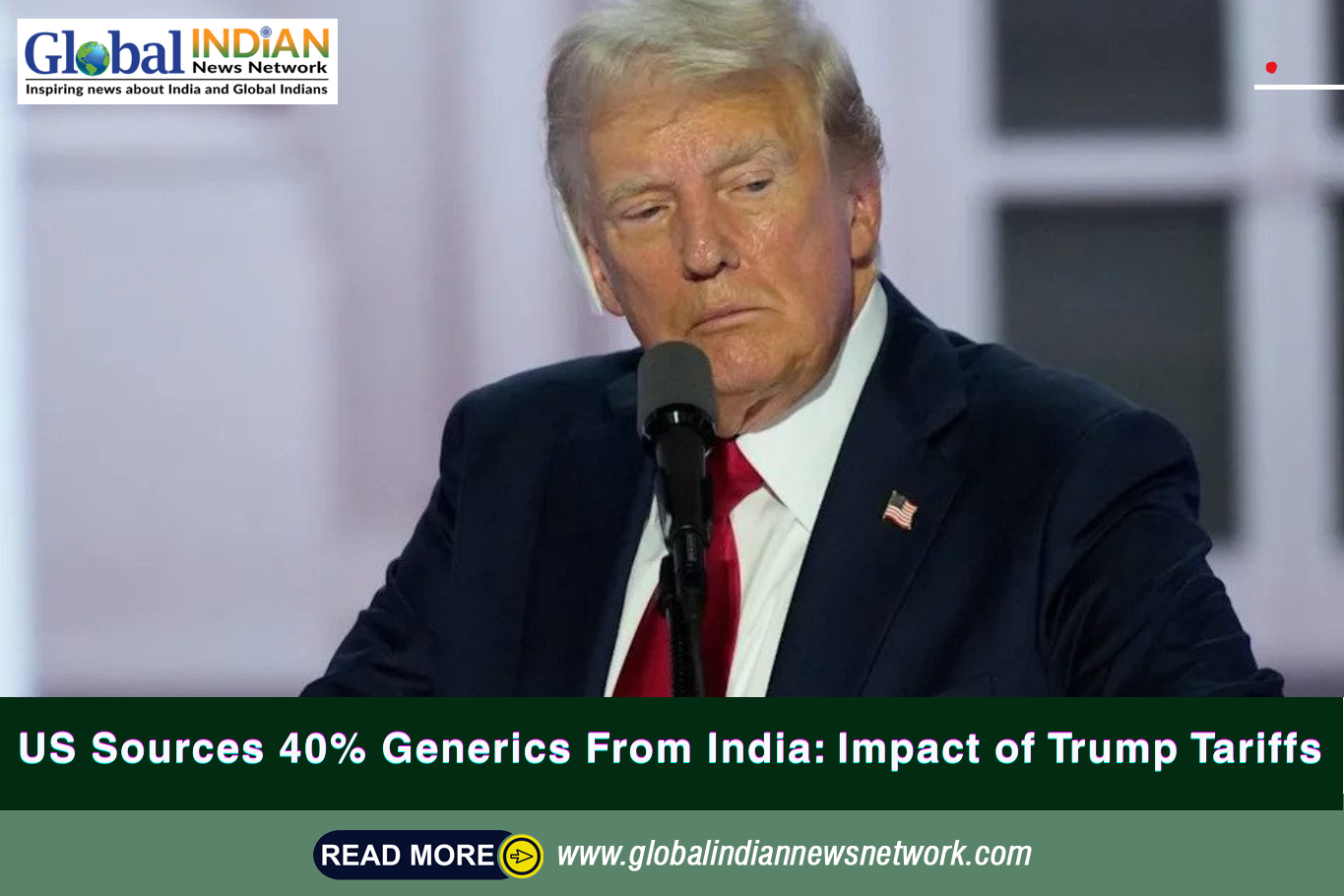
US President Donald Trump announced on Friday that, beginning October 1, 2025, all branded and patentedpharmaceutical products imported into the United States will face a 100% tariff. The policy exempts companies that are already constructing or planning US manufacturing plants, as clarified in Trump’s Truth Social post. The move is designed to incentivize domestic production of medicines and medical products.
Alongside pharmaceuticals, the administration will impose steep tariffs on household goods. Kitchen cabinets will see a 50% tariff, while upholstered furniture will face a 30% levy, effective from the same date. These measures are expected to impact trade with major exporting countries, including India.
India’s pharmaceutical sector plays a pivotal role in global healthcare, providing over half of the world’s vaccines and nearly 40% of generic drugs supplied to the US. Government statistics indicate that Indian pharmaceutical exports reached a record $30 billion in FY25, with March alone showing a remarkable 31% growth. By August 2025, exports climbed 7% year-on-year, totaling $2.51 billion. The US market accounts for $8.7 billion, roughly 31% of India’s total pharma exports, with companies like Dr Reddy’s, Sun Pharma, and Aurobindo Pharma deriving 30-50% of revenues from American sales.
A 100% tariff could have significant repercussions. In 2024, the US imported nearly $233 billion in pharmaceutical products. Indian generics have historically saved the US healthcare system $219 billion in 2022 alone, and around $1.3 trillion from 2013 to 2022. Over the next five years, these savings are projected to reach an additional $1.3 trillion. With tariffs, medicine prices may potentially double, increasing costs for Medicare, Medicaid, and private healthcare.
India continues to encourage domestic manufacturing through initiatives like the Production Linked Incentive (PLI) scheme, with $1.8 billion allocated for advanced drugs, and the Strengthening Pharmaceuticals Industry (SPI) program, investing $60 million to support smaller firms through R&D and lab modernisation. The Indian pharma industry is projected to reach $130 billion by 2030 and $450 billion by 2047, reinforcing its status as the “Pharmacy of the World,” known for affordable and high-quality medicines globally.