A Promise Squandered
When Trump returned to office, many in New Delhi were cautiously optimistic. Prime Minister Narendra Modi publicly congratulated his “friend,” signaling continuity. India’s foreign minister declared that, unlike other countries, India was “not nervous” about Trump’s return. The U.S.–India relationship seemed poised to deepen, especially amid concerns about China’s aggression in the Indo-Pacific.
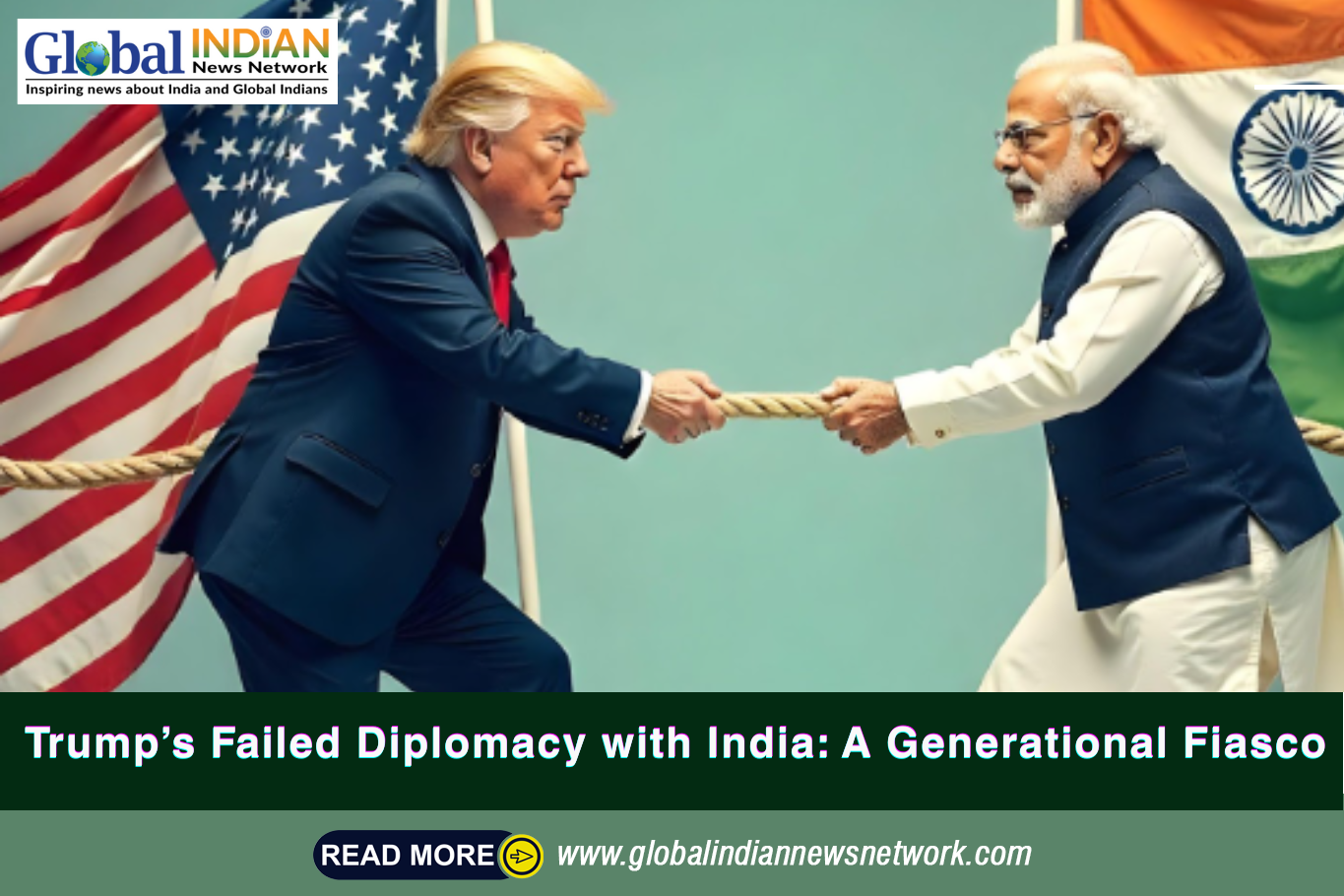
But optimism soon dissolved into disillusion. Trump’s approach was transactional, short-sighted, and ultimately destructive. He viewed diplomacy as a zero-sum game, where America’s gain must come at a partner’s expense. Instead of building trust, he demanded loyalty. Instead of understanding India’s sensitivities, he wielded tariffs and threats. The result: a collapse in goodwill, erosion of trust, and the loss of a partner that previous presidents had carefully cultivated.
Kashmir and the Nobel Delusion
Nowhere was Trump’s mismanagement clearer than in the Kashmir crisis. In May, after a terrorist attack and retaliatory strikes between India and Pakistan, the region teetered on the edge of war. Instead of standing by India’s long-held insistence on bilateral resolution, Trump declared himself peacemaker. On social media, he boasted that he had brokered a ceasefire. Days later, he claimed both sides would sit down with him as mediator.
Islamabad rejoiced. New Delhi was enraged. For India, any hint of third-party mediation over Kashmir was unacceptable—a red line honored by successive U.S. administrations. Modi made that clear in a phone call. Yet Trump persisted, bragging to Modi on June 17 that Pakistan planned to nominate him for the Nobel Peace Prize and nudging Modi to do the same. According to reporting cited by Steve Benen, Modi “bristled” at the suggestion. Trump “largely brushed off” the correction, but the damage was done.
Modi refused. Relations soured. Within weeks, Trump retaliated with punitive tariffs and canceled a planned visit to India. As Benen put it bluntly, Trump “set the relationship on fire, to the delight of China.”
Tariffs, Sanctions, and Miscalculations
Trump’s obsession with trade deals further poisoned the relationship. He slapped India with tariffs of up to 50% on key exports—higher even than those imposed on China. He dismissed India’s complaints as evidence of a “totally one-sided disaster.”
But as David Goldwyn and Geoffrey Pyatt argued, this wasn’t tough-minded strategy; it was “overreliance on coercive diplomacy.” Washington assumed New Delhi, like Tokyo or Brussels, would eventually capitulate under pressure. That was a fatal miscalculation. India, with its proud history of nonalignment, was never going to surrender core economic interests for the sake of Trump’s ego.
Energy policy offered another glaring example. Trump targeted India’s oil trade with Russia, expecting leverage. Instead, India doubled down, buying discounted crude while remaining compliant with the G7 price cap. Meanwhile, Washington largely ignored China’s far larger Russian purchases. The double standard was obvious. “Punishing India’s imports—while tacitly accepting China’s—only reinforces Beijing’s energy advantage,” Goldwyn and Pyatt warned.
By singling out India, Trump not only undermined U.S. credibility but also incentivized New Delhi to look elsewhere. Strategic patience was replaced by tactical bullying. And the costs were steep.
Trump’s Ridiculous Rhetoric and Pakistan Gambit
If tariffs and sanctions weren’t damaging enough, Trump compounded the insult with a string of reckless and frankly absurd statements about India. At one rally, he dismissed India as a “dead economy,” a claim that defied reality given India’s position as one of the fastest-growing major economies in the world. Simultaneously, he lauded Pakistan, asserting its abundant oil reserves and projecting its potential to meet India’s energy requirements in the future. He even called Pakistan “the best country to fight terrorism,” ignoring its long history of harboring extremist groups. These comments not only enraged Indian policymakers but also revealed Trump’s shallow grasp of South Asian geopolitics. To make matters worse, reports emerged that the Trump family, through their 60% stake in a company called World Liberty Financial (WLF), had signed a cryptocurrency and blockchain deal in Pakistan. The optics were appalling: while undermining India with insults and punitive tariffs, Trump’s family sought personal profit in Pakistan, further eroding trust in Washington’s intentions.
The Rise of “Nation First” Diplomacy
Underlying this diplomatic clash is a broader reality: the world has entered an era of “nation first” politics. Trump trumpets “America First” at every turn, demanding others bend to his vision. But Modi has been equally clear that India’s path is guided by “India First.” This is not hostility but sovereignty—a recognition that no leader can ignore domestic constituencies. Increasingly, others are following suit. The United Kingdom is talking openly about “UK First.” Japan and France emphasize their own “strategic autonomy.” By refusing to respect this global shift, Trump mistook national pride for disloyalty, and in doing so, he turned potential partners into wary skeptics.
Friends Lost, Rivals Gained
Trump’s failures didn’t occur in a vacuum. They reverberated across the globe. In Tianjin, the world watched as Xi Jinping, Vladimir Putin, and Narendra Modi linked hands in a symbolic display. As Benen noted, the footage was a clear message to Washington: “We’ve decided we don’t need you after all.”
For decades, U.S. strategy in Asia hinged on cultivating India as a counterweight to China. Trump squandered that leverage. Instead of strengthening the Quad, he weakened it. Instead of deepening supply chain cooperation, he pushed India closer to BRICS. Instead of cementing trust, he created resentment.
New Delhi, determined to protect its autonomy, began recalibrating. Modi met Xi, proclaiming that “the elephant and the dragon should dance together.” He rode in Putin’s limousine, discussing energy and defense. He courted Europe and Japan. In short, India diversified—not because it wanted to abandon the U.S., but because Trump made partnership too costly and unreliable.
America’s Strategic Setback
The consequences for the United States are profound. The Indo-Pacific strategy, already fragile, now faces new hurdles. Cooperation on critical minerals, defense technology, and supply chains has stalled. The perception of American unreliability has grown. And China, the very rival Washington hoped to contain with Indian partnership, has reaped the benefits of Trump’s blunders.
As Steve Benen observed, “It’s not easy for an American president to get friends, foes, and partners to leave the U.S. behind simultaneously, but Trump is failing so spectacularly that he’s managing to pull it off.” The U.S.–India partnership, once described by Bush as “brothers in the cause of human liberty,” is now at its lowest point in a quarter century.
A Generational Fiasco
The tragedy of Trump’s diplomacy with India is not just in the damage done but in the opportunity lost. For decades, Democrats and Republicans alike invested political capital in building trust with New Delhi. That careful progress cannot be easily rebuilt. Trust, once broken, takes years—even decades—to restore.
Goldwyn and Pyatt called for a “strategic reset,” urging Washington to treat India not as a swing state to be pressured but as a long-term partner to be respected. Yet Trump shows no interest in such nuance. His approach remains transactional, coercive, and tone-deaf.
The outcome is a generational fiasco: America’s most promising strategic relationship gutted by arrogance, impatience, and self-interest. China celebrates, Russia gains, and Washington loses.
Trump promised to put “America First.” Modi, meanwhile, has made it clear that India’s path is “India First.” Increasingly, other nations—from the United Kingdom to Japan—are speaking the same language: our nation first. In this new world of assertive sovereignty, Trump’s bluster and coercion have left the U.S. isolated rather than respected. By alienating India, he not only undermined a vital partnership but also weakened America’s global standing. Diplomacy requires respect, patience, and vision—values Trump abandoned. The result: a squandered alliance and a leadership vacuum China and Russia are eager to fill.