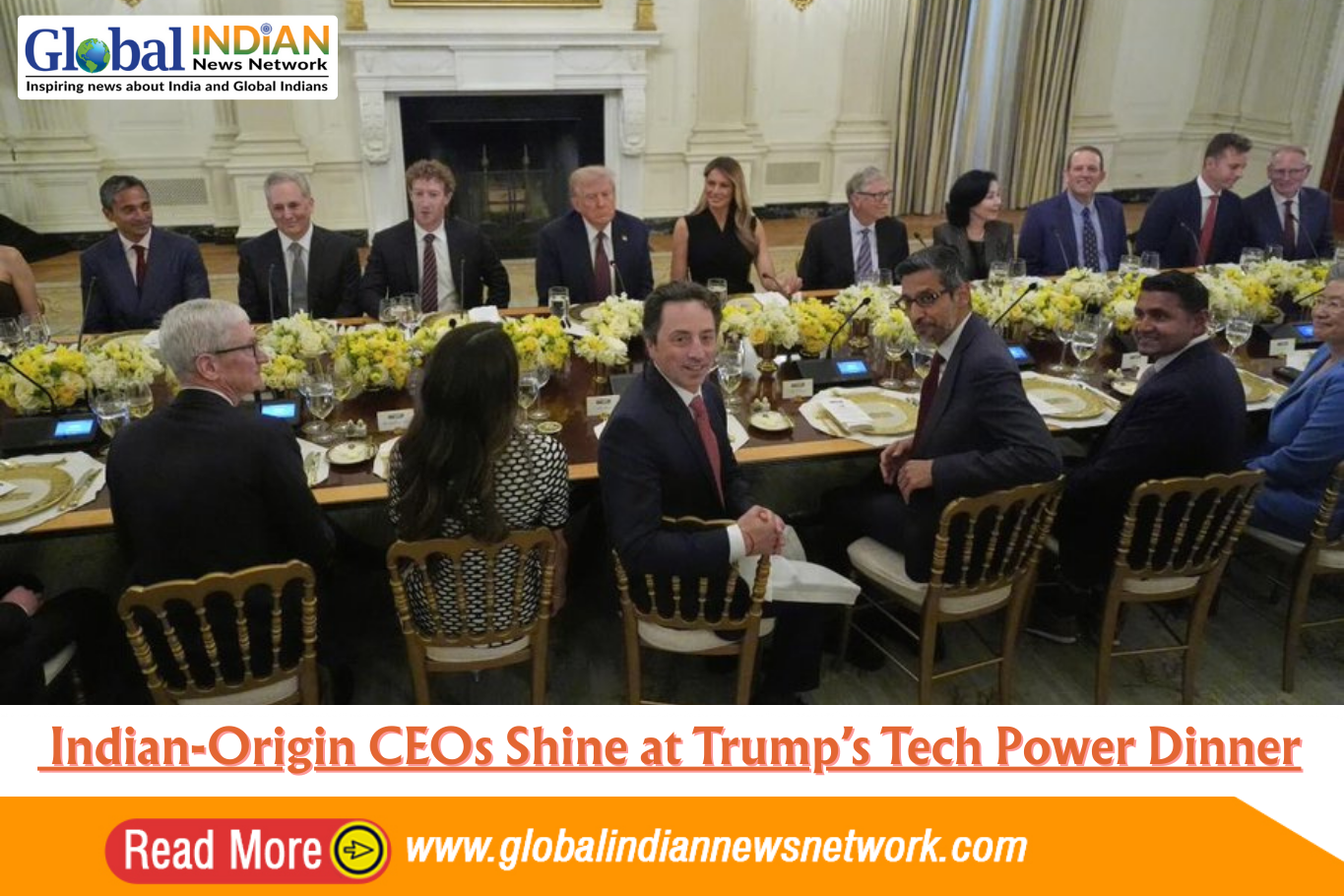
 US President Donald Trump on Thursday hosted a glittering White House dinner with some of the world’s most powerful technology executives, with the spotlight firmly on artificial intelligence and corporate investments in the United States.
The guest list read like a who’s who of the tech industry — Bill Gates, Tim Cook, Mark Zuckerberg, and Sundar Pichai were among the prominent names in attendance. The evening also underscored the rising influence of Indian-origin leaders, who made up a significant portion of the room.
“The most brilliant people are gathered around this table. This is definitely a high-IQ group and I’m very proud of them,” Trump remarked during his address to the CEOs.
Five Indian-American leaders were invited: Microsoft’s Satya Nadella, Google’s Sundar Pichai, Micron’s Sanjay Mehrotra, TIBCO’s Vivek Ranadive, and Palantir’s Shyam Sankar. Their presence reflected both the prominence of Indian-origin executives in Silicon Valley and their growing role in US policymaking circles, even as the administration has tightened immigration policies impacting Indian professionals.
Noticeably absent from the gathering was Elon Musk, once seen as a Trump ally. His exclusion underscored the growing tensions between Musk and the administration, particularly on space policy and federal contracts.
Trump, seated between First Lady Melania Trump and Meta’s Mark Zuckerberg, asked each leader to outline their company’s investments in the US. AI advancement, domestic job creation, and the technology sector’s role in boosting economic growth dominated the evening’s discussions.
Google’s Sundar Pichai, fresh from a major courtroom win that dismissed an antitrust case against Chrome, announced that Alphabet plans to invest $250 billion in the US over the next two years. The India-born CEO emphasized the company’s renewed commitment to Washington after a period of strained relations.
Microsoft’s Satya Nadella followed with equally striking numbers, confirming that his company is investing between $75 billion and $80 billion annually in the United States. Bill Gates, meanwhile, praised Trump’s vaccine initiatives as a model for medical innovation and pledged support for research into HIV, polio, and sickle cell disease.
Trump used the occasion to downplay concerns over upcoming job data, insisting that “real economic numbers” would be revealed in the coming year, forecasting historic job growth ahead.
The dinner also carried symbolic weight for India. The strong presence of Indian-origin executives signaled how deeply Indian talent is embedded in the global technology ecosystem. From trillion-dollar corporations like Microsoft and Google to key roles in chipmaking and enterprise software, their seats at the White House table reflected the undeniable influence of India’s diaspora in shaping both innovation and policy in the United States.