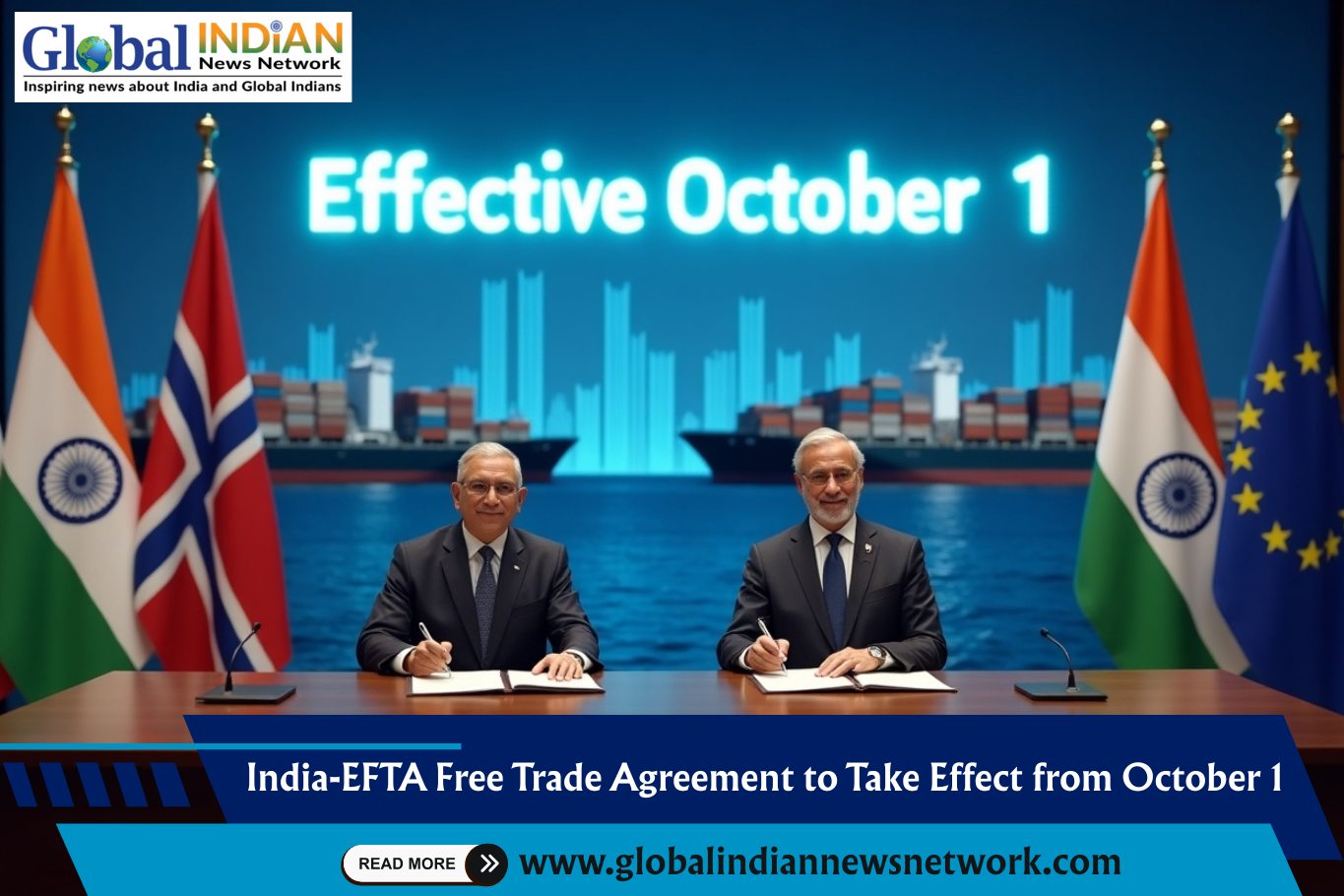
 India’s landmark Free Trade Agreement (FTA) with the European Free Trade Association (EFTA) — comprising Switzerland, Norway, Iceland, and Liechtenstein — will officially come into force on October 1, 2025, Switzerland confirmed on Wednesday. This marks the first Indian trade pact to feature binding provisions on both trade and sustainable development.
The agreement, formally signed on March 10, 2024, is structured to strengthen economic ties, expand market access, and provide stronger legal safeguards for businesses. Known as the Trade and Economic Partnership Agreement (TEPA), it represents a significant step in India’s trade diplomacy.
Under the terms of the deal, EFTA nations have pledged investments worth Rs. 8,80,700 crore (US$ 100 billion) over a 15-year period. Of this, Rs. 4,40,350 crore (US$ 50 billion) will flow into India within the first decade, followed by another Rs. 4,40,350 crore (US$ 50 billion) over the next five years. These commitments are expected to generate one million direct jobs across India, creating a powerful economic multiplier effect.
For its part, India will grant lower or zero tariffs on a wide range of products. This includes Swiss luxury watches, chocolates, pharmaceuticals, cut and polished diamonds, high-end machinery, optical instruments, and processed agricultural goods. The reduced barriers will open new opportunities for European exporters while also diversifying choices for Indian consumers.
Beyond trade, the TEPA integrates legally binding commitments on environmental protection, labor standards, and human rights, reflecting international treaty obligations. Switzerland highlighted that these safeguards ensure economic cooperation does not come at the expense of domestic laws or social protections.
The agreement signals India’s growing willingness to strike balanced trade partnerships that align economic growth with sustainability. By coupling market access with massive investment commitments, the India-EFTA pact is seen as a model for future trade agreements with other global blocs.
As implementation begins in October, policymakers and businesses on both sides are preparing to capitalize on the opportunities the deal offers — from job creation in India to expanded European exports. The pact is widely regarded as a win-win, boosting India’s role as a major global trade partner.