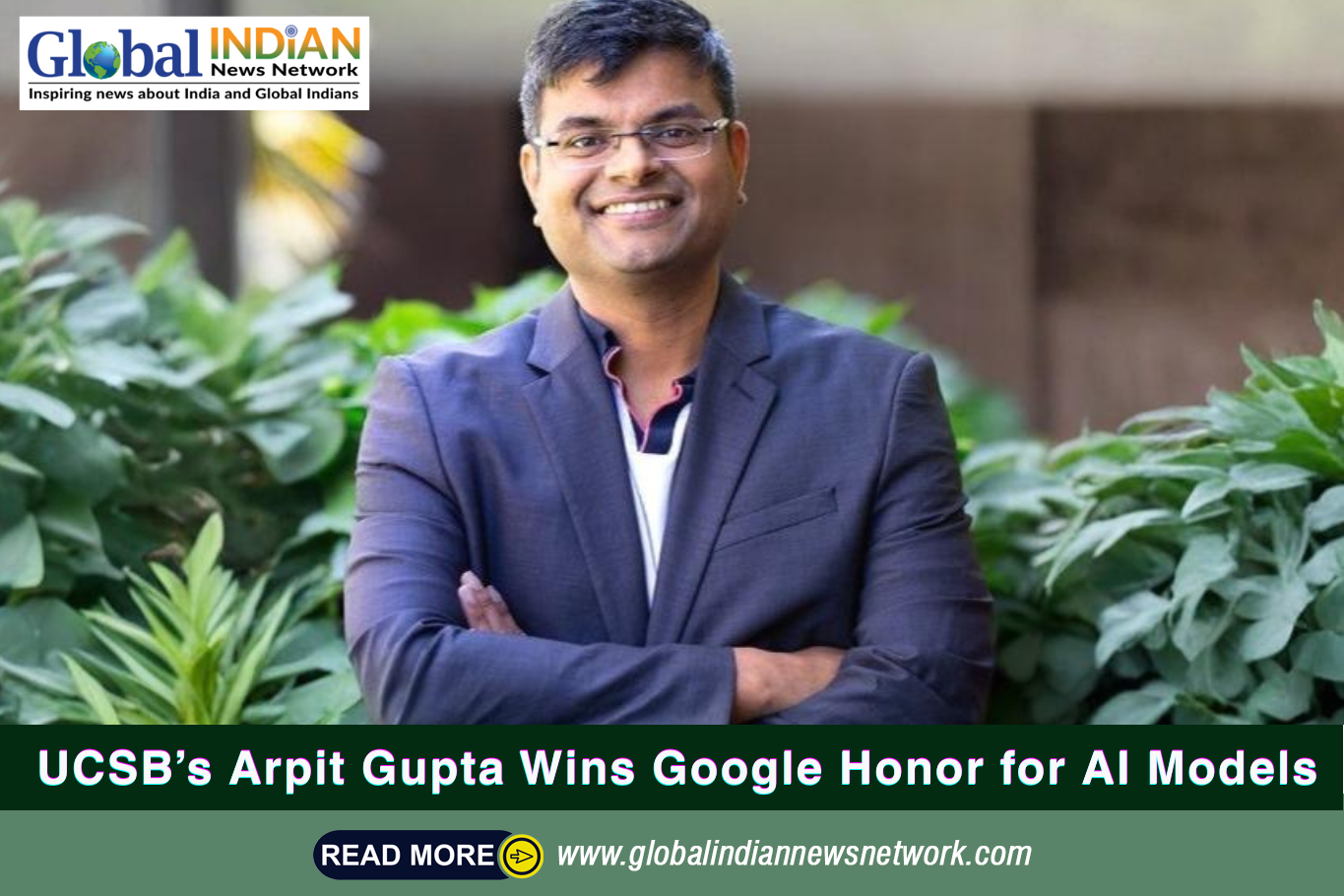
 UC Santa Barbara computer scientist Arpit Gupta has been recognized by Google with two distinguished awards for his groundbreaking research on low-cost AI network models. His work seeks to make artificial intelligence infrastructure more affordable, scalable, and efficient, with the long-term goal of transforming how global networks are built and managed.
Gupta received the Google Research Scholar Award, which supports promising early-career faculty, and the inaugural Google ML and Systems Junior Faculty Award, given to rising researchers who are redefining the intersection of machine learning and systems engineering. Together, these honors place him among the most innovative voices shaping the future of artificial intelligence and networking.
Amin Vahdat, Google’s VP/GM of ML, Systems & Cloud AI, highlighted the significance of the recognition, noting that more than 50 assistant professors from 27 U.S. universities received the new ML and Systems Award, making Gupta part of an exclusive group of thought leaders.
Traditionally, networking challenges have been addressed with “point solutions”—individual machine-learning models tailored for specific tasks. However, as networks become increasingly complex, this piecemeal approach has proven difficult to scale. Gupta’s vision, which he terms the “convergence principle,” proposes replacing these fragmented models with a single, general-purpose foundation model. Such a model could be pre-trained on diverse data and fine-tuned for specific network-related tasks, reducing costs and complexity.
Gupta draws inspiration from the evolution of natural language processing (NLP). For years, NLP required separate models for translation, sentiment analysis, and other functions, but the development of foundation models like BERT and GPT-3 revolutionized the field by enabling a single adaptable system. Gupta believes a similar transformation is possible in networking.
His research aims to bring this same adaptability to computer networks, opening the door to “self-driving” networks that can monitor and manage themselves with minimal human intervention. If successful, this approach could democratize access to AI-driven infrastructure, making it more cost-effective and accessible worldwide.
By challenging conventional approaches and envisioning scalable solutions, Arpit Gupta is not only advancing academic research but also laying the groundwork for a new era in intelligent, affordable networking.