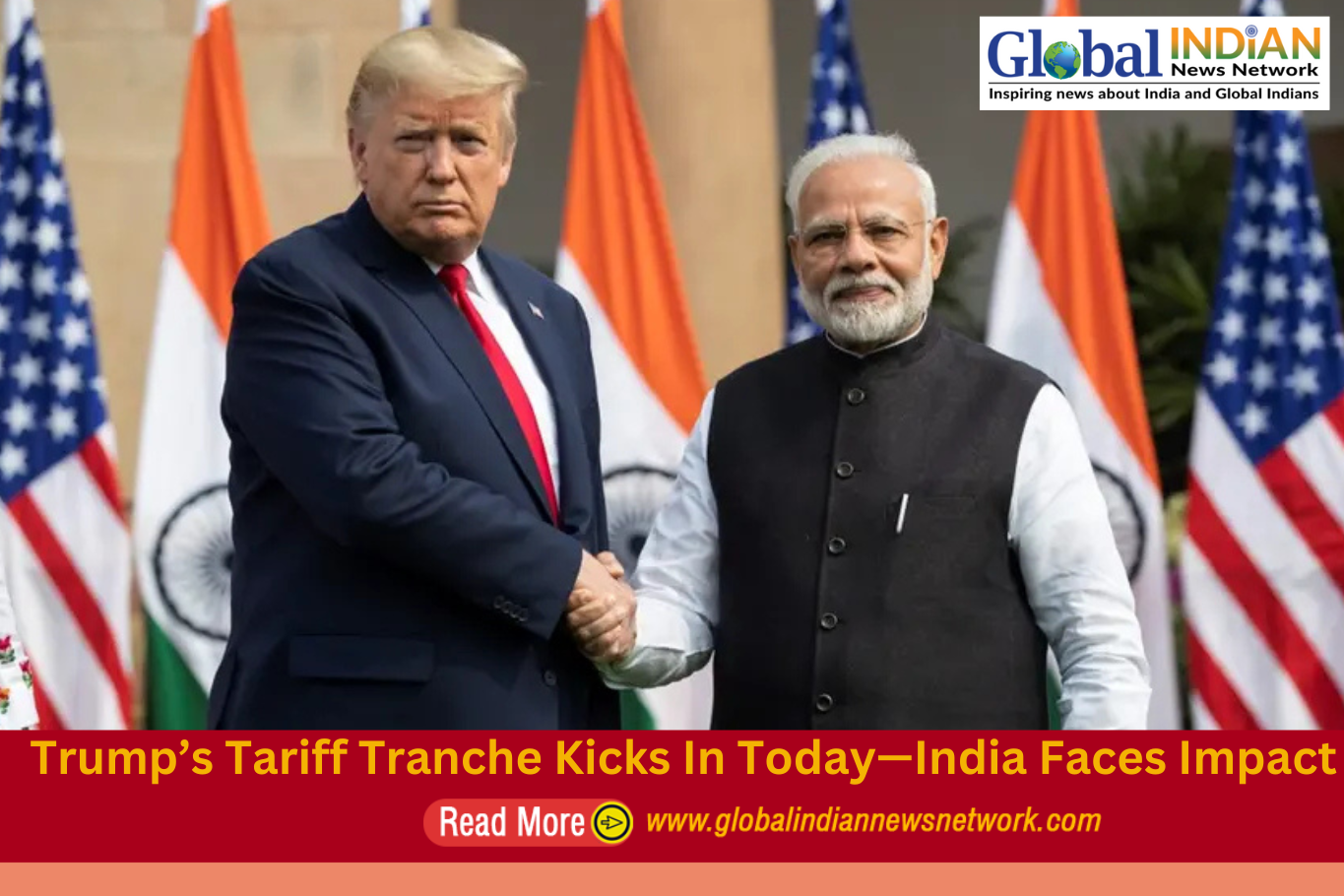
 In a major development in global trade policy, U.S. President Donald Trump has enforced a steep 50% tariff on Indian imports. The first tranche, initially set at 25%, was announced on July 30, followed by another 25% levy revealed on August 6. Trump also imposed a “penalty” on Indian imports tied to oil purchases from Russia, signaling heightened trade tensions between the two democracies.
These tariffs are not paid by Indian exporters directly but by U.S. importers, making Indian goods substantially more expensive in American markets. As a result, many Indian products may lose their competitive edge, especially when stacked against exports from countries like Vietnam, South Korea, and Indonesia — all of which face significantly lower U.S. tariffs ranging from 15% to 20%.
While the overall effect on India’s economy might appear modest on the surface — a predicted GDP slowdown from 6.6% to 6.4% according to the Bank of Baroda — the real impact is expected to hit specific sectors. Industries with high export dependence on the U.S. will be the most affected, as they may be forced to lower prices, absorb losses, or seek alternative international markets.
The disparity in tariff rates may encourage global buyers to pivot toward countries with more favorable trade terms, potentially leaving Indian exporters at a disadvantage. Nevertheless, the Indian government remains steadfast in its commitment to protecting key domestic sectors.
Speaking at the MS Swaminathan Centenary International Conference, Prime Minister Narendra Modi responded assertively to the situation. “India will never compromise on the interests of its farmers, fishermen, or dairy sector,” he declared. Acknowledging that defending these sectors could come at a cost, Modi stated, “I know we will have to pay a heavy price for it, and I am ready for it.”
This bold stance signals that India is prepared to weather short-term economic strain in exchange for long-term sovereignty over its core industries. As the world watches this tariff standoff unfold, Indian exporters must quickly adapt by adjusting pricing strategies, exploring new markets, and focusing on domestic demand to stay resilient amid turbulent trade shifts.