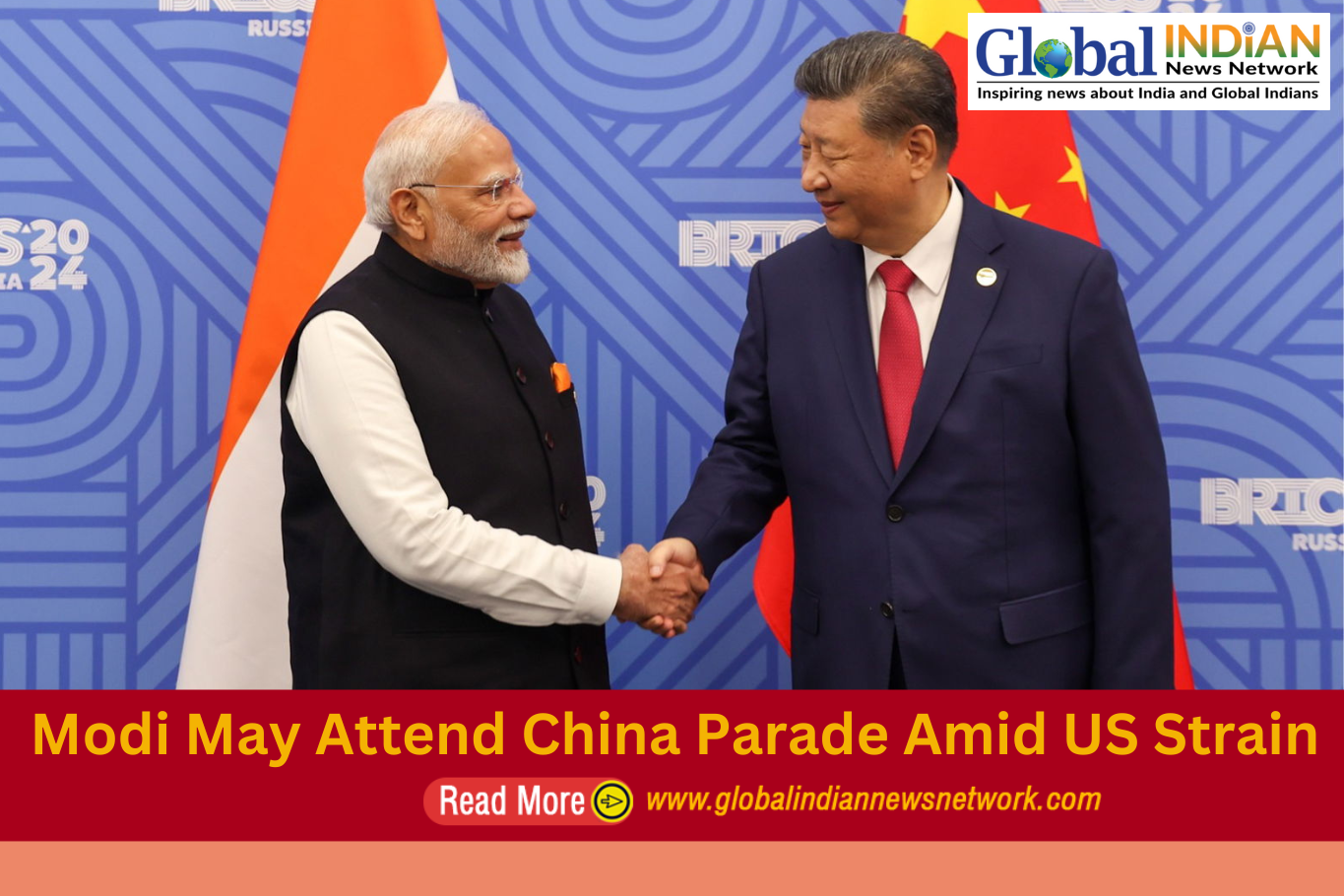
 Every September 3, China organizes an elaborate military parade in Tian’anmen Square, Beijing, commemorating its victory in the War of Resistance Against Japanese Aggression. This year’s event is expected to follow tradition with an impressive display of military strength. Among the invited world leaders are Russian President Vladimir Putin, US President Donald Trump, and Indian Prime Minister Narendra Modi.
While Modi declined similar invitations in previous years, including in 2015, the geopolitical context in 2025 is significantly different. India’s current diplomatic approach toward China appears to be softening, especially in contrast to its previous stance that normalization depended on restoring pre-2020 border conditions. This potential policy shift may prompt Modi to attend the parade—signaling a notable recalibration in India’s regional diplomacy.
The change is partly fueled by high-level diplomatic talks between New Delhi and Beijing in recent weeks. At the same time, India’s relations with Washington are under strain, notably following Trump’s aggressive tariff measures and controversial remarks on Kashmir. His openness to collaborating with Pakistan on energy projects, along with suggestions of mediating in the Kashmir issue—long considered a bilateral matter by India—has ruffled feathers in New Delhi.
According to Biswajit Dhar of the Council for Social Development, Trump’s aggressive economic tactics and unpredictable alliances have indirectly pushed India closer to China. His remarks have altered regional dynamics, prompting Indian strategists to reconsider the costs of confronting China without reliable U.S. backing.
Analysts at the Lowy Institute echo this view, suggesting that isolating China may no longer be viable for India in an environment where U.S. support appears uncertain. Attending the parade would not only reflect India’s shifting diplomatic posture but could also serve as a platform for broader dialogue.
Vijay Prashad, director of Tricontinental: Institute for Social Research, has advocated for Modi’s presence at the parade, proposing a tripartite discussion between India, China, and Russia. He believes that leveraging Russia’s intermediary role could help resolve long-standing disputes like the border issue, which he describes as “solvable” and primarily political in nature.