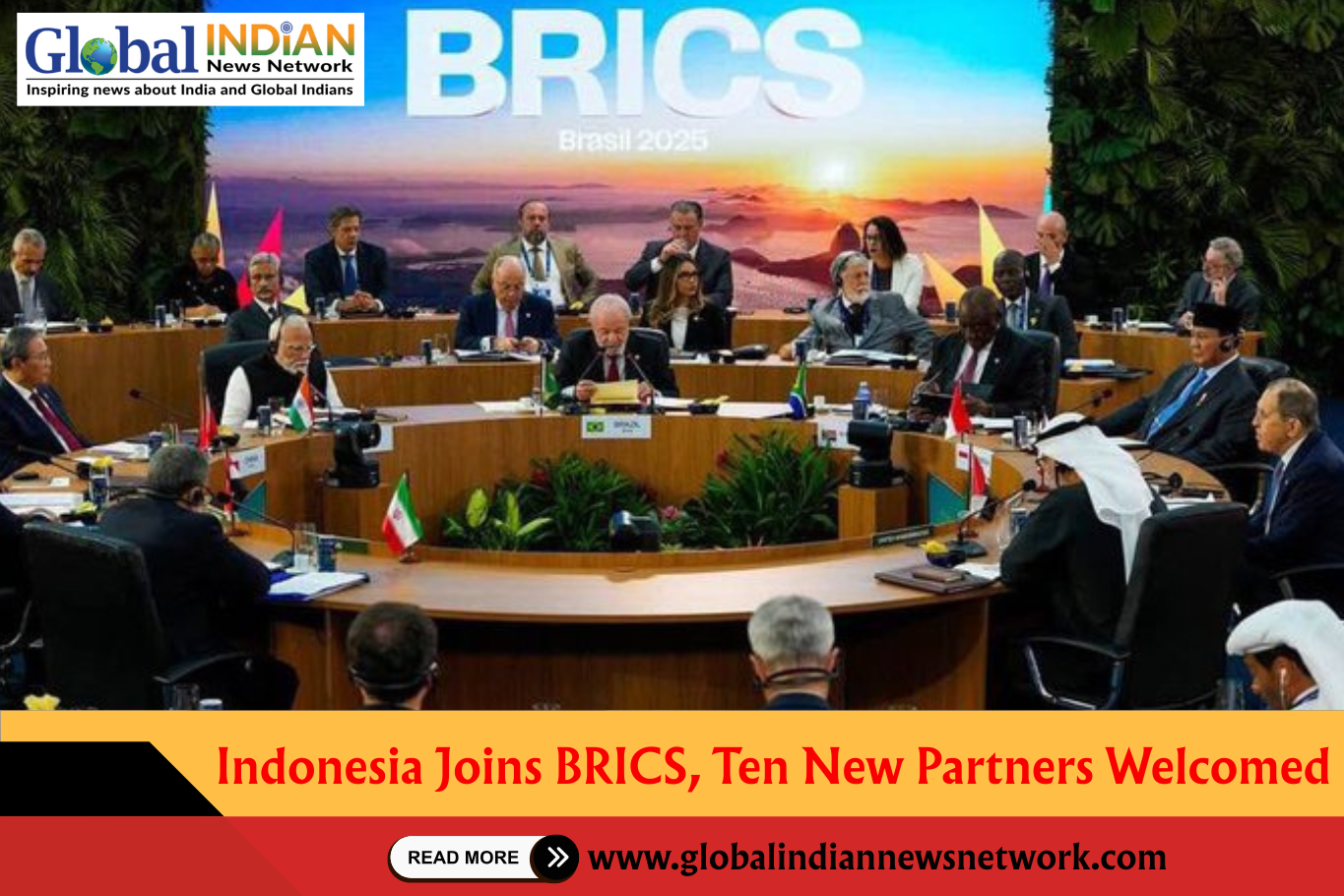
In a major expansion move, the BRICS nations have formally welcomed Indonesia as a full member of the group. This announcement came during the 17th BRICS Summit held in Rio de Janeiro, Brazil. Alongside Indonesia, ten additional countries — Belarus, Bolivia, Kazakhstan, Nigeria, Malaysia, Thailand, Cuba, Vietnam, Uganda, andUzbekistan — were inducted as BRICS partner countries.
The joint declaration from the summit highlighted the evolving nature of BRICS and emphasized the collective intention of its members to foster equitable global partnerships. The leaders endorsed several significant documents, including the BRICS Leaders’ Framework Declaration on Climate Finance, the Statement on the Global Governance of Artificial Intelligence, and the launch of the BRICS Partnership for the Elimination of Socially Determined Diseases. These efforts underscore BRICS’ commitment to addressing pressing international challenges through collaborative and sustainable approaches.
Addressing the session on ‘Peace and Security and Reform of Global Governance’, Indian Prime Minister Narendra Modi called the expansion a reflection of BRICS’ adaptability. He stressed the urgent need for reforms in legacy global institutions like the United Nations Security Council, the World Trade Organization (WTO), and Multilateral Development Banks. Drawing an analogy to technology, Modi said, “In the age of AI, where advancements occur weekly, it’s unacceptable for global institutions to remain unchanged for 80 years. You can’t run 21st-century software on 20th-century typewriters.”
Tracing back to its origins, BRIC was conceived after a meeting between leaders of Russia, India, and China on the sidelines of the G8 Outreach Summit in St. Petersburg in 2006. The inclusion of Brazil shortly after, and later South Africa in 2010, formally expanded BRIC into BRICS. South Africa participated in its first summit in 2011.
The most recent wave of expansion began in 2024 when Egypt, Ethiopia, Iran, and the United Arab Emirates joined the group as full members starting January 1, 2024. Indonesia followed as a full member in January 2025, with ten others joining as partners, setting the stage for BRICS to become a more inclusive and diversified coalition on the global stage.