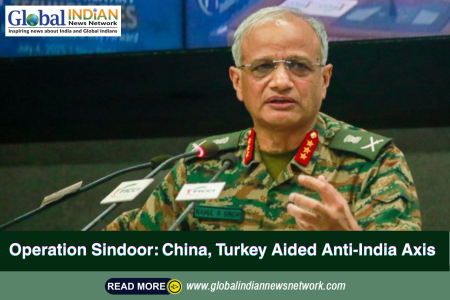
 Operation Sindoor, India’s decisive military retaliation to the Pahalgam terror attack, became a landmark achievement during Prime Minister Narendra Modi’s third term. But 2024-25 also witnessed sweeping developments in defense strategy and readiness, according to senior officials tracking the sector.
Several significant defense contracts were secured throughout the year, such as a $7.6 billion deal with France for 26 Rafale Marine fighter jets, a $7.5 billion agreement with HAL for 156 Prachand helicopters, a $1.6 billion purchase of 12 Sukhoi-30 jets, and additional artillery and Vajra-T guns worth more than $1.8 billion.
On the border front, October 2024 saw a breakthrough in eastern Ladakh, with Indian and Chinese troops disengaging from Depsang and Demchok, ending a two-year standoff.
India’s nuclear triad was bolstered with the commissioning of INS Arighaat, the country’s second indigenous nuclear-powered submarine. In January 2025, three naval assets — destroyer Surat, frigate Nilgiri, and submarine Vaghsheer — were simultaneously inducted, all crafted at Mazagon Dock Shipbuilders.
India’s air defense capabilities received a boost with the deployment of Akashteer, an indigenously developed radar and control system. Integrated with the IAF’s command grid, it played a pivotal role in countering Pakistan’s aerial attacks during the May 7–10 confrontation, intercepting threats with precision.
The long-pending theatre command reform progressed with the implementation of the Inter-Services Organizations Act by the government. This legal framework, supported by new rules, is key to creating joint-service commands for coordinated military operations — a central goal for what the defense ministry has called “the year of reforms.”
India’s infrastructure got a strategic boost when Modi flagged off tunneling for the Shinku La tunnel, which, at 15,800 feet, will become the world’s highest, offering year-round access to Ladakh and reducing logistic hurdles.
In May 2025, India unveiled a competitive execution framework for the Advanced Medium Combat Aircraft (AMCA) project, allowing private firms such as Tata, L&T, and Mahindra to collaborate in developing the nation’s fifth-generation stealth fighter. Simultaneously, key advancements were made in defence technology, including tests of the K-4 submarine-launched missile, a domestically developed laser-based anti-drone system, and a successful trial of a hypersonic missile with a range surpassing 1,500 km.
“These developments underscore India’s determination to accelerate self-reliance and enhance preparedness for next-generation warfare,” noted retired Air Marshal Anil Chopra.