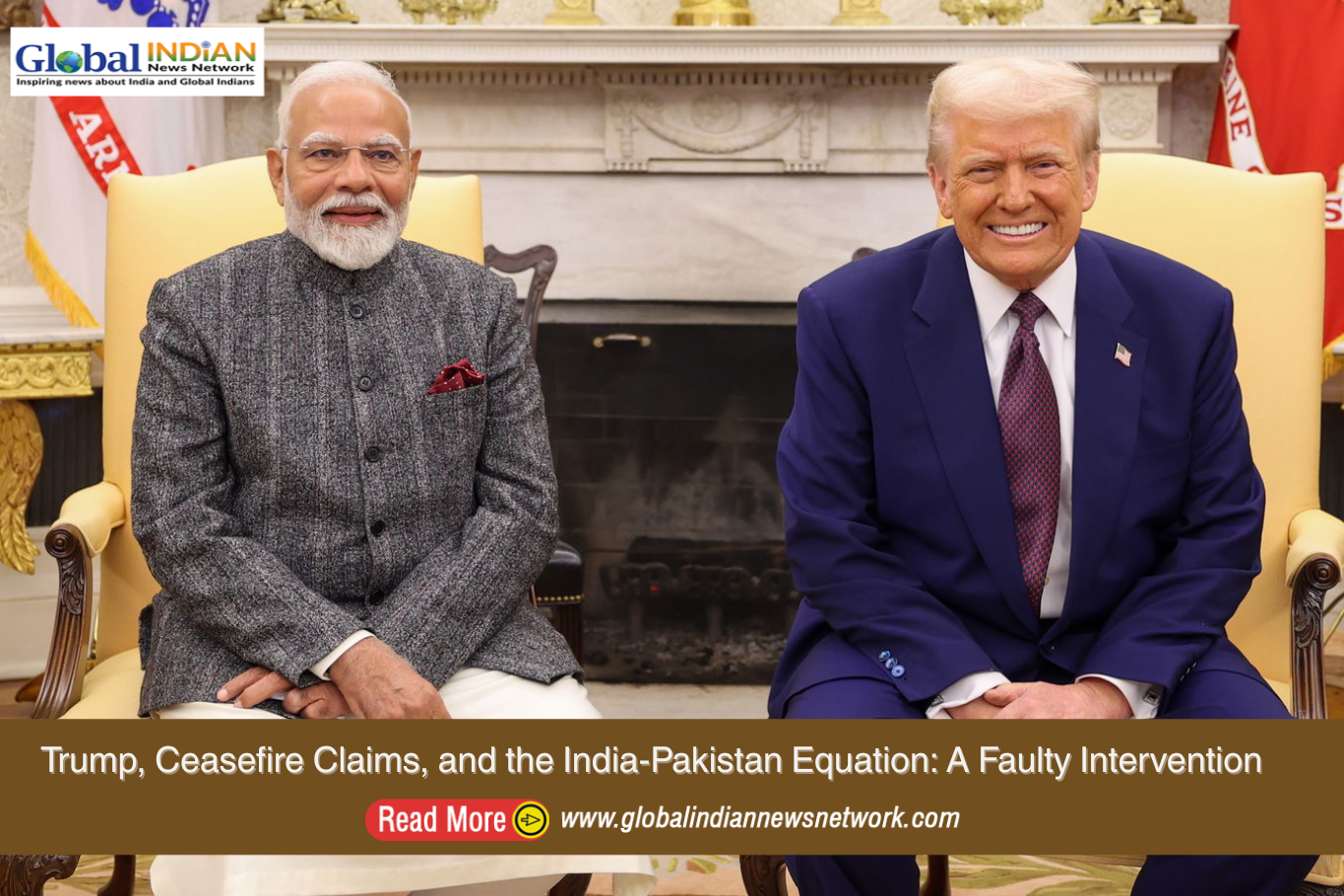
 Vivek Mishra, the Deputy Director of the Strategic Studies Programme, Observer Research Foundation wrote an article titled’ Operation Sindoor: Trump’s Fault Lines. In his Insightful article Dr. Vivek Mishra exposes the deeper diplomatic and geopolitical rifts revealed by U.S. President Donald Trump’s opportunistic involvement in the India-Pakistan crisis of May 2025. Mishra, a recognized expert in Indo-U.S. strategic relations, highlights how Trump’s sudden claim of brokering peace during “Operation Sindoor”—India’s assertive military response to the Pahalgam terror attack—signals a regressive shift in U.S. foreign policy, potentially undermining two decades of strategic trust between India and the United States.
Mishra critiques Trump’s self-congratulatory narrative, arguing that it amounts to premature triumphalism and masks a broader, troubling realignment of U.S. policy toward Pakistan. Once branded by Trump himself as a haven for terrorists in 2018, Pakistan is now being oddly praised and courted—signaling what Mishra calls a dangerous return to “hyphenation,” where India and Pakistan are viewed as equals in Washington’s strategic calculus. This perceived equivalence has rightfully caused consternation in India.
According to Mishra, India faces three strategic choices in response: dismiss Trump’s remarks as rhetorical showmanship; draw a distinction between U.S. political noise and institutional commitments; or treat this shift as a forewarning of deeper changes in U.S.-Pakistan relations and prepare accordingly. Given Trump’s transactional instincts, all three options remain viable.
The article outlines a possible motivation for Trump’s pivot: a Faustian bargain with Islamabad. Ties between the Trump family and the Pakistan Crypto Council, along with potential mineral deals in the Af-Pak region, hint at a geo-economic strategy. However, Mishra warns this could prove disastrous, given Pakistan’s unstable borders and history of militant extremism.
Mishra applauds India’s diplomatic counter-move—sending all-party delegations to over 30 countries to present hard evidence of Pakistan’s involvement in terrorism and assert the legitimacy of Operation Sindoor. This proactive step helps India control the narrative, especially as Pakistan attempts to regain sympathy on the global stage.
Crucially, the article emphasizes that India’s zero-tolerance approach to terrorism, embodied in Operation Sindoor, must be matched by narrative strength on the global front. Mishra questions whether restraint is always strategic in a realist world and calls for recalibrating this doctrine when dealing with an actor like Pakistan.
Further complicating matters is Trump’s broader foreign policy disarray—his failure to resolve conflicts in Ukraine, Gaza, or with China, and his “deal-first” approach now falling short. Meanwhile, U.S. domestic politics are also divided. Some American lawmakers, like Joe Wilson, are attempting to promote democratic values in Pakistan through proposed legislation, but India remains skeptical.
Mishra concludes with a warning: the U.S.-India strategic partnership may suffer if Washington continues its current path. India sees Pakistan as incapable of becoming a rational democratic partner, while the U.S. remains politically ambivalent. In this climate, Trump’s transactional diplomacy not only weakens bilateral ties but also risks emboldening India’s adversaries.
Vivek Mishra’s article is both timely and penetrating, offering a sobering analysis of how personal diplomacy can disrupt long-term strategic alignment and calling for sustained clarity in Indo-U.S. relations amidst shifting geopolitical winds.