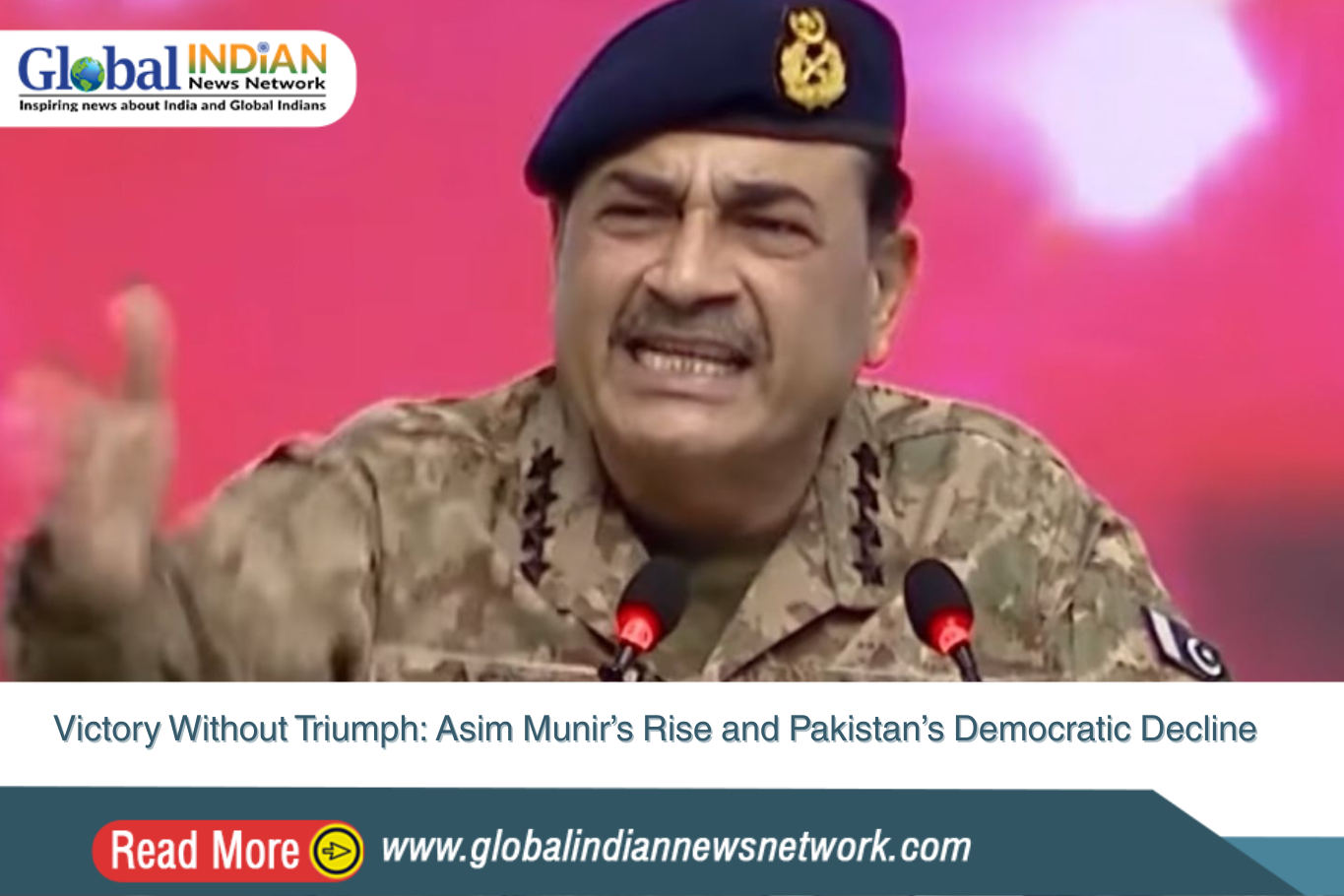
 Sarral Sharma, Doctoral Candidate at Jawaharlal Nehru University, New Delhi; former NSCS official and South Asian Voices Fellow at The Stimson Center published an article titled” “Munir’s Controversial Rise and Pakistan’s Drift to a ‘Hard State’”
In his incisive article, Sarral Sharma critically examines the rapid ascent of Pakistan Army Chief General Syed Asim Munir, his promotion to Field Marshal following a conflict-laden defeat, and the alarming transformation of Pakistan into a militarized “hard state.” Sharma argues that Munir’s rise is emblematic of a deeper institutional crisis—one where military prestige is restored not through genuine victory, but by manipulating narratives and suppressing democratic checks.
Despite tactical setbacks in the brief war with India, Munir was lauded domestically as a strategic victor. His promotion to Field Marshal, Sharma contends, was less about battlefield success and more a strategic move to protect the military’s waning image and tighten its grip on an increasingly fragile and economically strained Pakistan. While the army celebrated, the average citizen continued to suffer from deteriorating public services, rising inflation, and widespread resource shortages.
Sharma highlights how Pakistan’s military exploits conflicts—both internal and external—to bolster defence budgets and political control. The 2025 defence spending is projected to hit USD 11 billion, placing enormous strain on a debt-ridden economy reliant on IMF bailouts and foreign loans. Growth forecasts have been slashed, and Moody’s has warned that tensions with India threaten Pakistan’s fiscal recovery.
India, meanwhile, is leveraging diplomatic channels through ‘Operation Sindoor’, aiming to re-list Pakistan on the FATF grey list and block international funding, citing terror sponsorship. Such a listing could cost Pakistan billions in GDP, further weakening its economy.
Domestically, Sharma outlines how Munir’s Special Investment Facilitation Council (SIFC) faces backlash, especially over the Green Pakistan Initiative. This project has sparked violent protests in Sindh over perceived Punjabi appropriation of Indus water—fueling inter-provincial resentment and resource disputes. This unrest, Sharma notes, mirrors wider national grievances over the army’s economic and political dominance.
Sharma details how Munir’s militarised governance is intensifying repression, particularly in Balochistan and Khyber Pakhtunkhwa, where extrajudicial killings and disappearances are rising. Post-conflict, Pakistan has renewed efforts to falsely implicate India in Baloch insurgency, masking its own support for UN-designated terrorist groups like LeT and JeM.
In Parliament, Munir has called for a transition to a “hard state,” blaming political leadership for security failures and justifying deeper military governance. Civilian leaders, meanwhile, remain powerless, failing to hold the army accountable for failures like Operation Azm-i-Istehkam.
Sharma concludes by warning that Munir’s tactics—built on nationalism, misinformation, and suppression—may win short-term control but are unlikely to endure. The military’s attempt to frame external threats as existential could backfire, as economic despair and public anger mount. Munir may have claimed symbolic victory, but as Sharma insightfully notes, the cost may be Pakistan’s further descent into authoritarianism and chaos.