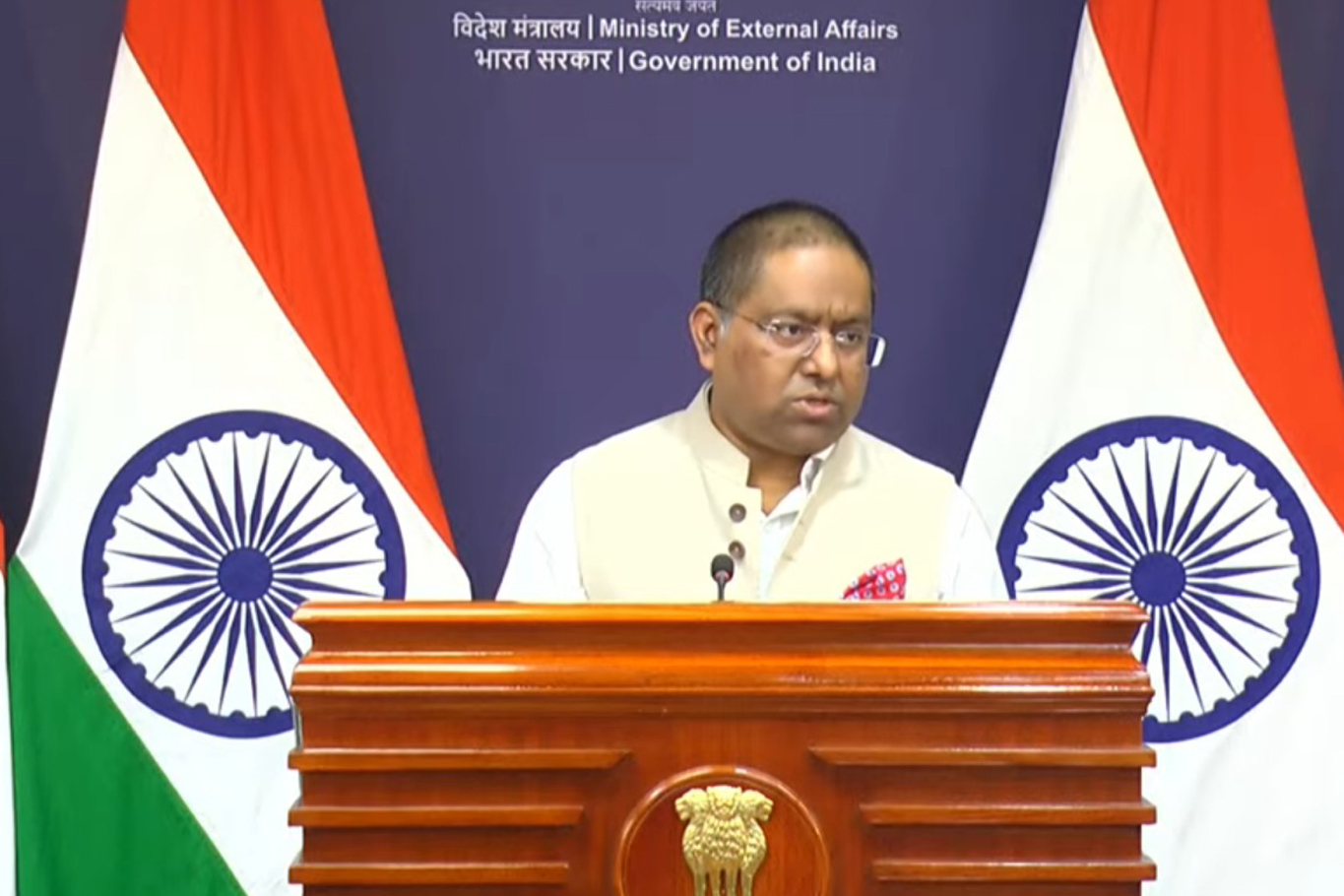
India reaffirmed on Thursday that any potential engagement with Pakistan must be conducted strictly on a bilateral basis, while clearly restating its firm position that the Indus Waters Treaty (IWT) will remain suspended unless Pakistan definitively renounces its support for cross-border terrorism.
Addressing journalists at the weekly press briefing, Ministry of External Affairs (MEA) spokesperson Randhir Jaiswal emphasized, “Any engagement between India and Pakistan has to be strictly bilateral. Let me also reiterate that talks and terror cannot go hand in hand.”
Jaiswal further added that India remains open to discussing the extradition of known terrorists, referring to a list previously provided to Islamabad. “On the issue of terrorism, as I have stated earlier, we are willing to talk about the extradition of wanted terrorists whose details were shared with Pakistan some years ago.”
He underscored India’s consistent position on Jammu and Kashmir, stating, “Any bilateral dialogue concerning Jammu and Kashmir will be limited to the issue of Pakistan vacating illegally occupied Indian territories.”
Revisiting India’s long-standing position on the Indus Waters Treaty, Jaiswal reiterated: “As I have mentioned before, the Indus Waters Treaty will remain in abeyance until Pakistan credibly and irreversibly abjures support for cross-border terrorism. As our Prime Minister has said — water and blood cannot flow together, and similarly, trade and terror cannot coexist.”
This firm response from New Delhi came shortly after Pakistan Prime Minister Shehbaz Sharif suggested Saudi Arabia as a possible neutral venue for talks with India and proposed that the United States could mediate between the two nations.
Speaking to the press in Islamabad, Sharif indicated that any such discussions would likely be led by the National Security Advisors (NSAs) of both countries. He stated the agenda would center around issues such as Kashmir, water resources, terrorism, and trade.
Sharif also claimed that bilateral tensions were easing, citing communication efforts between the Directors General of Military Operations (DGMO) from both sides. “If talks proceed, Pakistan’s National Security Advisor will lead our side. Saudi Arabia could serve as a neutral venue, with the US playing a mediatory role. However, India has yet to agree to any such neutral location,” he noted.
Reinforcing the proposed framework, Sharif added, “The key agenda items will include Kashmir, water, trade, and terrorism — these will form the foundation of any Pakistan-India dialogue.”
Earlier in the day, Prime Minister Narendra Modi delivered a strong message during a public address in Bikaner, Rajasthan, reiterating India’s non-negotiable stance on terrorism and Pakistan’s illegal occupation of Kashmir.
“If there are to be any talks, they will only focus on Pakistan-occupied Kashmir (PoK). So long as Pakistan continues to export terrorism, it will find itself begging for funds and resources. It will not receive a single drop of India’s water,” Modi asserted.
He further warned that any aggression against India would be met with severe consequences. “Playing with the blood of Indians will come at a grave cost for Pakistan,” the Prime Minister said to a roaring crowd.